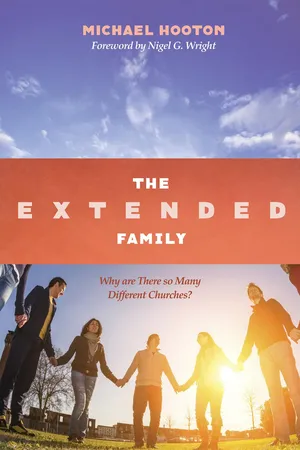
- 284 pages
- English
- ePUB (mobile friendly)
- Available on iOS & Android
eBook - ePub
About this book
"Why are there so many different churches?" Tracing the family tree of the modern church back to the early Christian centuries, The Extended Family explains how and why the various Christian denominations arose. It outlines the distinctive beliefs, traditions, practices, and values of the many church families in modern Britain, what they have in common, and where they have either disagreed or agreed to differ. It also examines the vital question: whether any of the differences between churches should still matter today.
Information
Topic
Theology & ReligionSubtopic
Christian Theology1
The Extended Family
The Many Faces of Christianity
The French satirical writer Voltaire complained, in the middle of the eighteenth century, that England had 365 religions and only one sauce. These days, if the number of sauces on the supermarket shelves has increased, the number of Christian groups is also showing no signs of diminishing. Anyone wanting to explore Christianity, or anyone coming new into church life, is confronted with a bewildering array of churches: Methodist, Baptist, Anglican, Pentecostal, United Reformed, Salvation Army, and many others. UKCS estimates that there are now in Britain 340 Christian denominations, a rise from 275 in 2006,1 though it notes that most of the increase is due to the founding of more and more branches of new Pentecostal churches, many of which have only a small number of related congregations. Moreover, Christians often use a number of adjectives to describe different churches, such as “evangelical,” “traditional,” “free,” “charismatic,” as well as other words that are more familiar as the names of political parties, like “conservative” or “liberal”; and the people who use terms like these rarely define what they mean by them—in fact, the cynic might almost suspect that they don’t really know what they mean by them. A teenager was once asked what the basic difference was between the Anglican Parish Church and the local Baptist Church, both of which he had visited; he replied that, at the Parish Church, they served coffee in china cups after the services, but the Baptists drank mugs of tea. It might have been interesting to find out whether the members of the respective congregations could have given an answer with any more theological substance.
To make matters worse, the person who is new to church will probably also have heard of various other groups, like those Jehovah’s Witnesses who call round at regular intervals, and may wonder if they are another Christian church or something different. And he might have a friend at work who says he goes to “The Christian Centre,” or, even more confusing, to a group with a name like “Springs of Living Water” or “The Vineyard Fellowship.” No wonder people get confused, and ask embarrassing questions, like “Why are there so many different churches?”
This book is intended to help people who are new to Christianity, or who are unfamiliar with church, to understand the various groups that make up the Christian family—how and why they arose, and what is distinctive about them—and also to be able to distinguish them from those other groups that have borrowed some ideas from bits of Christianity, or that use some of the same language as Christianity, but are in fact not Christian at all.
The various branches of the Christian church are traditionally referred to as denominations—the word means “names” or “ways of naming.” The non-Christian groups are usually called cults or sects. “Cult” is from a word meaning “worship” or “religious rites,”2 and refers to a distinctive and exclusive approach to religion; “sect” is from the Latin word for “a group of followers,” and refers to a separate group of people committed to following a particular leader or religion. Up to the mid-twentieth century, the word “sect” was often used to refer to Christian Protestant denominations; for example, C. S. Lewis wrote in 1948 (in his essay God In The Dock)3 of “extreme Protestant sects, (e.g. Baptists)” (!). These days, using the word “sect” of Christian denominations—except as a technical term in the sociology of religion4—is apt to cause confusion and even resentment, and is perhaps better avoided.
In this book the normal word “denominations” will be used to refer to branches of the Christian church (Church of England, Methodists, Baptists, etc.),5 although I accept that there are a number of groups within the Christian church that prefer not to think of themselves as “denominations”; the implications of the term are discussed in a later chapter. And non-Christian groups, such as Jehovah’s Witnesses and Mormons, will be referred to as “cults”; but I understand that many people use the word “sect” in the same sense as “cult.”
The Basis of This Book
Five things should be said about the views that lie behind this book.
1. The basic understanding of the church that underlies all the comments in this book is the view usually known as “evangelical”: that is, that the Bible is the sole and absolute authority for all matters of Christian faith, life, practice and order, and is normative for the whole church. Ideas about what the church should be or do are to be judged as “right” or “wrong” inasmuch as they conform to or depart from what the New Testament says. On that basis, no single denomination can claim to be 100 percent right about everything; but most have identified and sought to embody some aspects of the New Testament model of church, which have become their distinctive strengths.
2. The information in this book is very basic; and, when it comes to the cults, it will not be sufficient to engage in debate or discussion with members of the cults. Anyone who wants to do that—and it is not to be undertaken lightly—will need far more information than is found here. And new Christians are strongly urged not to get too interested in exploring the cults, unless it is because they have a personal reason for needing to learn about a particular cult—for example, because they have a close relative who is involved in it. But there are some good books that can help: for example: Josh McDowell and Don Stewart, Understanding the Cults, Nigel Scotland, Pocket Guide to Sects and New Religions, Maurice Burrell, The Challenge of the Cults, or Eryl Davies, The Guide: Truth Under Attack. The series of booklets called What They Believe by Harold Berry, published by “Back to the Bible Publishing,” covers most cults and religious movements (and also the major world religions, like Islam and Hinduism, which are not dealt with in this book). Most good Christian bookshops will stock or recommend books or booklets explaining about any particular cult from a Christian perspective; a very simple but helpful leaflet is Christianity, Cults and Religions (Rose Publications), which summarizes the essential beliefs (about God, Jesus, heaven, etc.) of twenty groups, including the main world religions, alongside what the Bible says about each topic. And the “Reachout Trust,” a Christian organization specializing in education about and mission to the cults, provides information about the cults which is reliable, up-to-date, balanced and well researched.6
3. Regarding the Christian denominations, the view held in this book, and by the overwhelming majority of evangelical believers in all denominations, is that anyone who trusts in Jesus Christ as their personal Savior and Lord is a Christian, regardless of denomination. That does not mean that the differences between denominations are completely irrelevant, or even unimportant; but they are at most secondary. Anyone who believes in Jesus is a member of the one true church of Jesus Christ.
4. This book tries—especially in chapters 2 and 4—to be as objective as possible, and to give basic factual information about all the denominations. Inevitably there are sometimes assessments to be made; this has always been done with the intention of being honest about my convictions, and never with any desire to cause offence to those holding different views about church. For the record, the author is a Baptist pastor who has been very positively helped by and is deeply indebted to Christian friends and colleagues from a wide variety of denominational backgrounds, and who is sometimes quite critical of a number of aspects of Baptist church life. The last chapter, sub-titled “How Should We Think About Denominations?,” tries to sum up my views on the place of denominations in the contemporary church. Most of the rest of the book tries to be objective rather than polemical, at least in denominational terms, though I am admittedly more explicit (especially in chapter 3) when it comes to my personal convictions in the discussion between different fundamental schools of theology; and it would have been disingenuous to pretend that I have no views about what the church should be.
5. Finally, the comments that follow, especially those in chapters 3 and 7, are intended primarily to reflect the church scene in Britain—and more specifically, in England. The nature of the relations between different branches of the church can be very different in other parts of Europe and the world.
The Essential Marks of Real Christianity
There are two ways of expressing the essential differences between the Christian denominations and the cults: historically, or theologically.
Historically, all the Christian denominations claim to be part of the historical church of Jesus Christ that dates back to the New Testament, and they see themselves as standing in that tradition. Cults usually stand apart from that historical lineage; they do not normally regard themselves, as Christian denominations would, as a new or reformed group within the unfolding history of the church, but rather as a new movement founded in a deliberate rejection of and departure from the historical Christian churches.
Theologically, the cults invariably show two important differences from the biblical Gospel.
1. Christian groups are all Trinitarian; that is, they believe that there is one God, who exists eternally in three Persons—Father, Son and Holy Spirit. The Trinity is the distinctively Christian doctrine about the nature of God. Cults normally reject the idea of the Trinity; they would deny that God is Three-in-One.
Specifically, what this means in practice is that orthodox Christianity affirms that Jesus Christ is fully divine: that he is God the Son, who became a human being. To all the cults, though Jesus may be important, he is invariably seen as less than fully God, and he is not worshiped as Lord and God.
2. Christian denominations all affirm salvation by God’s grace, through the work of Jesus in his death and resurrection; in other words, salvation is a free gift that we can do nothing to earn or deserve or achieve, but that Jesus has made freely available for us and that we receive on the basis of faith in Jesus alone. Cults normally speak of something that people need to do in order to attain salvation. (Note: this second key characteristic may raise some difficult questions when it comes to Roman Catholicism—more on that later.)
It is important to stress that whether or not a group is a cult is a matter of objective fact, based on the doctrines that the group claim...
Table of contents
- Foreword
- Preface
- Abbreviations
- Chapter 1: The Extended Family
- Chapter 2: The Developing Family
- Chapter 3: The Modern Family
- Chapter 4: The varied family
- Chapter 5: The Leaders of the Family
- Chapter 6: The Deviations from the Family
- Chapter 7: One Family?
- Bibliography
Trusted by 375,005 students
Access to over 1.5 million titles for a fair monthly price.
Study more efficiently using our study tools.
Frequently asked questions
Yes, you can cancel anytime from the Subscription tab in your account settings on the Perlego website. Your subscription will stay active until the end of your current billing period. Learn how to cancel your subscription
No, books cannot be downloaded as external files, such as PDFs, for use outside of Perlego. However, you can download books within the Perlego app for offline reading on mobile or tablet. Learn how to download books offline
Perlego offers two plans: Essential and Complete
- Essential is ideal for learners and professionals who enjoy exploring a wide range of subjects. Access the Essential Library with 800,000+ trusted titles and best-sellers across business, personal growth, and the humanities. Includes unlimited reading time and Standard Read Aloud voice.
- Complete: Perfect for advanced learners and researchers needing full, unrestricted access. Unlock 1.5M+ books across hundreds of subjects, including academic and specialized titles. The Complete Plan also includes advanced features like Premium Read Aloud and Research Assistant.
We are an online textbook subscription service, where you can get access to an entire online library for less than the price of a single book per month. With over 1.5 million books across 990+ topics, we’ve got you covered! Learn about our mission
Look out for the read-aloud symbol on your next book to see if you can listen to it. The read-aloud tool reads text aloud for you, highlighting the text as it is being read. You can pause it, speed it up and slow it down. Learn more about Read Aloud
Yes! You can use the Perlego app on both iOS and Android devices to read anytime, anywhere — even offline. Perfect for commutes or when you’re on the go.
Please note we cannot support devices running on iOS 13 and Android 7 or earlier. Learn more about using the app
Please note we cannot support devices running on iOS 13 and Android 7 or earlier. Learn more about using the app
Yes, you can access The Extended Family by Michael John Hooton in PDF and/or ePUB format, as well as other popular books in Theology & Religion & Christian Theology. We have over 1.5 million books available in our catalogue for you to explore.