- 174 pages
- English
- ePUB (mobile friendly)
- Available on iOS & Android
eBook - ePub
About this book
Learn to paint, learn to see--it will change your life.
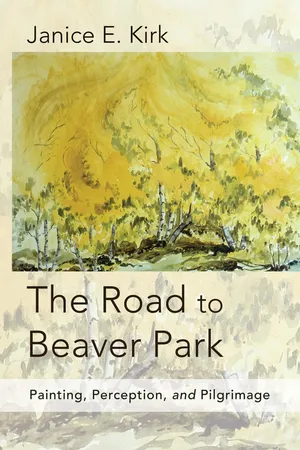
On Sabbatical, Janice carries her art pack and folding stool into one of the most incredible landscapes on the planet: the canyons, deserts, mountains, and river valleys of the greater Southwest. Awed, amazed, inspired, and humbled by what she finds there, she sketches and paints en plein air. The family fishes, hikes, catches bugs, chases lizards, digs fossils, photographs, and studies plants. The year-long campout in National Parks and Forest Service sites becomes a journey of the heart. The family grows to love the way the great outdoors is put together. Part travelogue, part natural history, part field course in art appreciation, the author records her development as an artist as she learns to paint and learns to see. To her surprise, a spiritual awakening sneaks up on her, and the journey turns into something more--a pilgrimage.
Information
Topic
Theology & ReligionSubtopic
Christian TheologyPART I
Point out the road I must travel; I’m all ears, all eyes before you.
—Ps 143:8b The Message
1
The Pacific Coast
Trial Run, April 1976
Tide splash, transition, and other time
Look for the edges between habitats: where the trees stop and a field begins; where rocks and earth meet water. Life is always at the edges.2
“Watch out for sneaker waves,” Don hollers. “Keep one eye on the sea!” Nate and Amy dash toward the ocean. “Cold water will keep them from going out too far,” he adds, “and the water is shallow for a long way out.” We turn away from the beach. I shoulder my art pack and follow Don into the dunes.
Walking with a naturalist is hardly heart-pumping exercise. We amble along, look, touch, sniff crushed leaves, and listen to the surf. We note locations and area conditions. Don points out the lay of the land. Natural drainage troughs serve to channel runoff. Signs of erosion mark the dunes. Dune succession is easy to see on this beach, from flat sand to foredunes, back dunes, and coastal land.
The dunes have their own ecosystem. The early springtime wildflowers beg identification. Don pulls out the wildflower guide to check names: beach pea, dune tansy, bush lupine. White-crowned sparrows flit through the chaparral broom. We follow deer tracks in the mud where a small creek meanders to the sea. I stop to sketch dune grasses, lines of slender stalks bending with the wind.
We top the rise of a major dune and gaze out to sea. The flat beach extends north and fades into fog near the headland.
“Are we really going to do this for a whole year?” I ask.
Don grins at me. It’s unbelievable! Don has been granted a sabbatical leave. Officially it’s field study in the Rockies and the Southwest. For once we will have the freedom to explore during fall and springtime, the very months that are impossible on a school schedule. I am brimming with questions and plans.
My tour leader plunges down the sandy slope to the beach. I follow, a shoe-filling endeavor. The beach is partly land, partly water, and the balance shifts back and forth. The sand looks barren but is home to a mixture of plants and animals both aquatic and terrestrial. Don calls this a transition zone, technically an ecotone, since it is rich with life from both land and sea. “Transition zone” rings in my ear. An appropriate term to describe not only the beach, but also us at this moment in our lives. A year apart from our normal routines and home habitat will change us all.
We separate. Don wanders over to where the children dig near the water. I plunk down beside a low mound in the sand. I empty sand out of my shoes and admire the hardy plant—sand verbena—that clings tenaciously to the shifting landscape. The wind peppers me with tiny grains, but I open my sketchbook and draw the yellow blooms. I move to the other side of the mound and find a warm spot out of the wind. I sink back against a driftwood log. My mind spins. Will the tent trailer be adequate? We need warmer clothes and blankets. Will the children keep up with their studies? What about mail delivery? And will the house be OK? Will togetherness become a burden? How am I going to spend my time? I have the answer to that. I will review my art lessons, hone my drawing and painting skills, and perhaps, at long last, I will learn to paint watercolors. I will have time to practice, practice, practice.
My first day en plein air is less than productive. My senses are overwhelmed. The warmth of the sun, soft sand, the space of sea and sky before me—I want nothing more than to sit and absorb it all. This sandy earth feels more solid than I remember. Every move I make hollows out even more sand, shaping a bowl to hold me in place. I squint in the bright light, the better to see down the beach to the waterline. That flat playground is the edge of the landmass that rises out of the sea. I draw with my eyes the long undulating lines of surf and beach that disappear into the distance. The view expands into space—infinite space and light—everywhere light in the overarching sky. My art professor would point out that I’m looking at the most basic art components: mass, space, and light.
At times like this, why is it I feel so much a part of the earth? What draws me to the vastness of space? Why do I seek the light?
A wind gust scatters sand over me and ends my reverie. I put my sketchbook away. I can’t paint today. The wind will blow sand into my watercolor pans and ruin the colors. I shoulder my pack and run to catch up with my family.
We walk the waterline and sidestep incoming surges that swirl over the sand. Bits of seaweed and aquatic grasses float on the tide and drape themselves gracefully on the beach. I stoop to pick up a perfect snail shell, a tiny marvel of functional housing. Small pieces of sculpted driftwood lay half buried in the sand, along with scraps of bright orange-and-white crab shells. I can’t resist reaching for occasional stones that glisten in the receding water. Smooth and round, the white pebbles lay in my hand like small moons.
The children dance around us, playing tag with the waves. They spot the first sand dollar shell and race back to show us. Off come their shoes, and splashing begins in earnest. I kick off my sneakers and wade into the shock of cold water. Waves rush in. I am knee-deep. I hold my breath as the tide pulls away again, swirling sand around my feet. Laughing, we splash back toward shore, our feet blue from the cold. The next wave follows right behind us, and we run to rescue our shoes.
On this day of sun and sand and splashing tide, we first sense “other” time—something apart. Our odyssey will not be governed by clocks or calendars, just seasons and cycles, day and night, patterns of existence that break up time, define it, give it a point of reference. I watch the waves come in. The rhythmic succession flows shoreward. With my artist’s eye, I try to memorize the curving path of tidewaters, the ripples on the surface. Those lines on paper will take on their own rhythm. The tide swirls higher, and we scramble even farther back on the sand to put on our shoes. Our space-time dimension has come right down to practical matters: it’s lunchtime.
We enjoy two more days before the rains begin. We hike the Rim Trail, which leads into deep forests of spruce and fir. I sketch ferns with their own rhythmic leaf patterns and spirals of emerging new fronds. When Don and the children take the long trail down to the rocks, I sit on an overlook bench and try with little success to paint the ocean view, with its shoreline curving into the distance. My painting is too watery, too pale. Later we all stand at the rail and hand around binoculars, looking for the unmistakable spout of water that signals a whale.
Each evening we hike down to the rocks and wait for sunset colors. We climb onto gigantic boulders and sit as close to the crashing waves as we dare, just out of the waterline. We identify brown pelicans that fly close to us in follow-the-leader formation. They rise and dip like trained dancers. Western gulls idle along the tide line, pecking at piles of seaweed. An enormous wave crashes right in front of us, spraying our rock as we scramble. I jump back from the front slab to the next one. Deep in the crevice between the massive sedimentary boulders, the tidewater swirls around, bringing garbage with it. A plastic jug and other debris float onto a gravel bar and stay there. How out of place it looks, how wrong. I turn away.
The low sun disappears behind a fog bank on the horizon. Colors soften somewhat to an orange-violet, but the fog veils any dramatic drop into the ocean. My painterly eye records the monochromatic color scheme. Why does it seem so right? Everything belongs here except the garbage.
We sit a few moments longer in the twilight that separates daylight from the darkness of the coming night. I study the series of gray tones that now cloak the rhythm of the sea. What a lesson in values! Only a master painter could manage so many gradations of gray without losing the scene.
The children lead the way up the steep trail by the fading light. It is time for campfire stories, hot cocoa, and early-to-bed. Tomorrow we will hike the redwood grove a few miles north of camp.
A wind comes up in the night. It sighs through the trees and scatters fog drip that has collected on needles and branches. The huge drops of water resound on the roof of the tent trailer. By morning, the rain has begun in earnest—a soft, steady, soaking drizzle. We scrap plans for our redwood hike. We play games and read the books we brought. Later we drive to the grocery store to buy seafood and get a weather forecast. The coastline is socked in; clouds and rain will continue for several days.
Nate has caught a cold, and we can’t keep warm enough in the tent trailer. At night when I climb into bed, the bedding is damp where the outer edge of the mattress meets the tent. By morning, the dampness has crept inward. We have no good way to dry it out. The four of us huddle inside the trailer discussing our options. Clearly, this arrangement will not do for prolonged bad weather. We need a rig that can handle minor illness, storms, wind, and desert heat. We pack up and head home. The redwoods will have to wait.
•
[God] alone stretches out the heavens and treads on the waves of the sea . . . When he passes me, I cannot see him; when he goes by, I cannot perceive him.
—Job 9:8, 11, NIV

Piñon Pine Cone, Nevada
2. Ibid., 172.
2
The Great Basin, Nevada
Eagle Lake and Bob Scott Campground
Sagebrush country, a horned toad, and desert art
“Wait, Mom!” Nate shouts just as I am shutting the house door. “The bug net!” He dives past me at the last minute to find that basic piece of equipment. I’m glad he thought of it now. Don is already in the driver’s seat, but the rest of us—Amy, teenage cousin Tevis, and me—pace beside the truck and trailer. I rack my brain for anything else we might be forgetting as I dig into my purse for dark glasses.
Our neighbor shouts from t...
Table of contents
- Preface
- Acknowledgments
- Prologue: Sabbatical 1976–1977
- PART I
- PART II
- Conversations with the Author
- Bibliography
Trusted by 375,005 students
Access to over 1.5 million titles for a fair monthly price.
Study more efficiently using our study tools.
Frequently asked questions
Yes, you can cancel anytime from the Subscription tab in your account settings on the Perlego website. Your subscription will stay active until the end of your current billing period. Learn how to cancel your subscription
No, books cannot be downloaded as external files, such as PDFs, for use outside of Perlego. However, you can download books within the Perlego app for offline reading on mobile or tablet. Learn how to download books offline
Perlego offers two plans: Essential and Complete
- Essential is ideal for learners and professionals who enjoy exploring a wide range of subjects. Access the Essential Library with 800,000+ trusted titles and best-sellers across business, personal growth, and the humanities. Includes unlimited reading time and Standard Read Aloud voice.
- Complete: Perfect for advanced learners and researchers needing full, unrestricted access. Unlock 1.5M+ books across hundreds of subjects, including academic and specialized titles. The Complete Plan also includes advanced features like Premium Read Aloud and Research Assistant.
We are an online textbook subscription service, where you can get access to an entire online library for less than the price of a single book per month. With over 1.5 million books across 990+ topics, we’ve got you covered! Learn about our mission
Look out for the read-aloud symbol on your next book to see if you can listen to it. The read-aloud tool reads text aloud for you, highlighting the text as it is being read. You can pause it, speed it up and slow it down. Learn more about Read Aloud
Yes! You can use the Perlego app on both iOS and Android devices to read anytime, anywhere — even offline. Perfect for commutes or when you’re on the go.
Please note we cannot support devices running on iOS 13 and Android 7 or earlier. Learn more about using the app
Please note we cannot support devices running on iOS 13 and Android 7 or earlier. Learn more about using the app
Yes, you can access The Road to Beaver Park by Janice E. Kirk in PDF and/or ePUB format, as well as other popular books in Theology & Religion & Christian Theology. We have over 1.5 million books available in our catalogue for you to explore.