- 274 pages
- English
- ePUB (mobile friendly)
- Available on iOS & Android
eBook - ePub
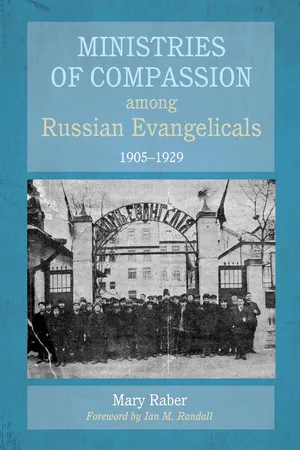
Ministries of Compassion among Russian Evangelicals, 1905–1929
About this book
The present study fills a gap in the study of the evangelical movement in Russia by presenting a comprehensive picture of their compassionate ministry during their longest stretch of relative freedom before the 1980s.
Better known for their energetic preaching and literature work, Russian evangelicals also gave attention to compassionate ministry, although it was never extensive because of their marginal status. They established assistance funds, organized charitable institutions, practiced urban rescue ministry, participated in the Russian temperance movement, and established economic communities.
Each area is distinct, yet all were supported by the same set of theological convictions. The Russian evangelicals were convinced that their witness should consist of good works as well as words, and that the gospel had the power to undo human suffering. While intentionally cultivating an attitude of concern for the needs of others, they taught that compassion was the concern of all members of the community, regardless of economic status or age. In their publications evangelicals devoted a good deal of teaching to the proper Christian attitude toward money and giving. They drew on Western models, but also their indigenous sectarian roots.
Information
Topic
Teologia e religioneSubtopic
Teologia cristiana1
Russian Evangelical Ministries of Compassion before 1905
This chapter will sketch the historical and cultural background of ministries of compassion in Russia during the late nineteenth and early twentieth centuries and place the evangelicals in that context. Many of the patterns for ministries of compassion among the Russian evangelicals between 1905 and 1929 were set during the second half of the nineteenth century as their movement took on a coherent shape. An organic part of their evangelistic activity from the very beginning was the practice of ministries of compassion, responding in various ways to a range of human need. The particular focus of this chapter is on Pashkovism, after Colonel Vasilii Alekseevich Pashkov, a Russian aristocrat who responded to the evangelistic preaching of William Granville Waldegrave, Lord Radstock.
The Pashkovites, many of whom were from the upper classes, were greatly inspired in compassionate ministry by Lord Radstock, who first visited St. Petersburg during the winter of 1873 to 1874. However, a number of the aristocrats were already active in the charitable work that was practiced in Russia at the time, even before they gathered around Radstock. Their work as sisters of mercy, providing medical and educational services to peasants on their own estates, or organizing sewing cooperatives for poor women, were all done according to existing patterns. It was their conversion to an evangelical approach to Christianity through Radstock and their subsequent commitment to preaching the gospel as part of their service that made their activities distinct. As Pashkov and his close associate, Count Modest Modestovich Korf (1843–1937) explained to the emperor, their greatest desire was to help people “understand the love of Christ which passes our understanding.”64 In contrast to some traditional Orthodox thinking, Radstock, Pashkov, and their followers taught that Christ’s love is appropriated by faith, not by good works. Instead of a means of earning salvation, the Pashkovites regarded good works as its fruit: those who believed and were saved would inevitably do good works.65 Thus, compassionate ministries were a sign of their relationship to Christ and an organic part of their witness.
The situation of the evangelicals changed abruptly in 1884 when Colonel Pashkov and Count Korf were exiled from Russia. After 1884 the evangelical movement in St. Petersburg took on a semi-underground character; nevertheless, many of the old activities continued while another generation of evangelicals rooted in Pashkovism developed new forms of service, also drawing on models that were practiced in the wider society. The Pashkovites also gave attention to compassionate ministry practiced abroad by such organizations as the Salvation Army and the YMCA. However, the combination of two aspects—easing human need and spreading the gospel in Russia—remained one of their basic characteristics. The model of the Pashkovites would continue to inform the activities of evangelicals after religious toleration was introduced by imperial decree in 1905, especially in St. Petersburg. This was an important part of the inheritance the evangelicals brought into what has been called their Golden Age (1905 to 1929).
Compassionate ministry and Russian identity
During the second half of the nineteenth-century in Russia it seems to have been impossible to avoid the question, “What is to be done?”66 According to the philosopher Nicholas Berdyaev, the search for social solutions in Russia was intensely moral and idealistic, based on a sense of guilt and the desire to set all of humanity free from suffering and injustice.67 Furthermore, it was widely perceived that something was seriously wrong with Russia that had to be addressed. Russia’s humiliating defeat in the Crimean War (1854 to 1856) had revealed the country’s backwardness. It seemed evident that the existing order had failed and many believed that “not only serfs, but society more generally must be ‘emancipated’ from the shackles of state tutelage.”68 Accordingly, during the Era of Great Reforms (approximately 1861 to 1880) policies were launched to eradicate the empire’s distressing and widespread poverty, ignorance, and injustice. The most famous of the reforms introduced during the reign of Emperor Alexander II (ruled 1855–1881) was the emancipation of the serfs in 1861. The emperor also initiated a general trend toward decentralization, social involvement, and the personal responsibility of individual citizens. Key to these goals was the founding of the zemstvo, an elected local governing body that was to take over responsibility for basic education and the provision of medical and other social services.
Ultimately, the reforms were not an outstanding success, and are even considered by some historians to have been “highly dysfunctional and destructive.”69 Although technically “liberated” and working their own land, peasants were still bound to their traditional village communes, which were required to take collective responsibility for paying off the debt owed to the government for the lump sum paid to former masters as reparations for the loss of their serfs. Rather than transforming serfs into independent small farmers, emancipation instead had the effect of reinforcing ancient land tenure patterns and burdening the rural population with debt.70 In general, liberal critics of the reforms felt that they did not go far enough in ameliorating social conditions. Meanwhile, conservative critics held that the reforms created instability and even contributed to the increasing ...
Table of contents
- Foreword
- Preface
- Glossary and Abbreviations
- Introduction
- Chapter 1: Russian Evangelical Ministries of Compassion before 1905
- Chapter 2: Russian Evangelicals from 1905 to 1929
- Chapter 3: Aid within the Evangelical Community—D. I. Mazaev,V. G. Pavlov, and V. V. Ivanov
- Chapter 4: Urban Rescue Ministry—W. A. Fetler
- Chapter 5: War, Revolution, and Famine, 1914 to 1923
- Chapter 6: Christian Economic Communities—I. S. Prokhanov
- Bibliography
Trusted by 375,005 students
Access to over 1.5 million titles for a fair monthly price.
Study more efficiently using our study tools.
Frequently asked questions
Yes, you can cancel anytime from the Subscription tab in your account settings on the Perlego website. Your subscription will stay active until the end of your current billing period. Learn how to cancel your subscription
No, books cannot be downloaded as external files, such as PDFs, for use outside of Perlego. However, you can download books within the Perlego app for offline reading on mobile or tablet. Learn how to download books offline
Perlego offers two plans: Essential and Complete
- Essential is ideal for learners and professionals who enjoy exploring a wide range of subjects. Access the Essential Library with 800,000+ trusted titles and best-sellers across business, personal growth, and the humanities. Includes unlimited reading time and Standard Read Aloud voice.
- Complete: Perfect for advanced learners and researchers needing full, unrestricted access. Unlock 1.5M+ books across hundreds of subjects, including academic and specialized titles. The Complete Plan also includes advanced features like Premium Read Aloud and Research Assistant.
We are an online textbook subscription service, where you can get access to an entire online library for less than the price of a single book per month. With over 1.5 million books across 990+ topics, we’ve got you covered! Learn about our mission
Look out for the read-aloud symbol on your next book to see if you can listen to it. The read-aloud tool reads text aloud for you, highlighting the text as it is being read. You can pause it, speed it up and slow it down. Learn more about Read Aloud
Yes! You can use the Perlego app on both iOS and Android devices to read anytime, anywhere — even offline. Perfect for commutes or when you’re on the go.
Please note we cannot support devices running on iOS 13 and Android 7 or earlier. Learn more about using the app
Please note we cannot support devices running on iOS 13 and Android 7 or earlier. Learn more about using the app
Yes, you can access Ministries of Compassion among Russian Evangelicals, 1905–1929 by Mary Raber in PDF and/or ePUB format, as well as other popular books in Teologia e religione & Teologia cristiana. We have over 1.5 million books available in our catalogue for you to explore.