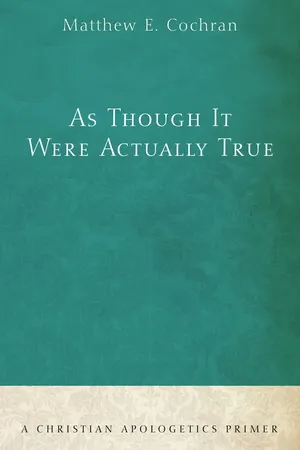
- 256 pages
- English
- ePUB (mobile friendly)
- Available on iOS & Android
eBook - ePub
About this book
How true can Christianity really be? In a culture where religion and "real life" often occur in completely different times and places, the question troubles many Christians. How can we give the reason for the hope that we have amid the many voices telling us that Christianity might be helpful or interesting, but not really "true" for anyone except Christians? Why should we ourselves bother with a religion so insubstantial that it is only legitimate within our own minds? People with real sins require a real savior, not merely inspiring stories and advice on how to live.
As Though It Were Actually True provides Christians with an introduction to the age-old practice of apologetics--the rational defense of Christianity as objective truth. It explores some of the most important issues on which the Church finds itself in conflict with today's culture through a combination of critical reasoning, evidence, and the law written on our hearts. By providing a philosophical foundation that is reasonable, a historical foundation that is factual, and a theological foundation that is biblical, this book will help equip Christians to contend for their faith against the shallow and deceptive philosophies that seek to undermine it.
Information
Topic
Theology & ReligionSubtopic
Christian ChurchI
Philosophy
Can Christianity be True?
1
Faith and Reason
Everything in its Place
Introduction
Many of the modern difficulties in reconciling faith and reason stem from two common attitudes. Faith often has a bad reputation in secular circles, and reason sometimes has a bad reputation in Christian ones. In both contexts, each is perceived not simply as different from the other or more dangerous than the other but as contradictory with the other—that one cannot have faith and be reasonable at the same time. Nevertheless, as the introduction argued, the Bible instructs Christians to do both; we cannot become comfortable with contradictions without ignoring part of what the Bible tells us. In order to both have faith and practice reason in any real sense, it is necessary to remove the apparent contradiction between them. To begin unraveling the paradox, this chapter will briefly characterize both reason and faith. It will then conclude with an examination of the relationship between the two.
A Brief Analysis of Reason
All people are familiar with reason because everyone uses it to some extent. Whenever one person argues with another, each believes that the other ought to agree with him. If such agreement does not come about, each typically believes the other is being unreasonable. A person may argue poorly or absentmindedly, but all people still have some sense of what reason is and how it works. However, to minimize poor or absentminded reasoning, it is necessary to examine reason a little closer.
Reason is often classified according to three different categories: deductive, inductive, and abductive.1 A deductive argument takes premises, applies a logical argument, and then arrives at a conclusion. This type of reasoning is the only kind that can provide proofs of an idea (as opposed to merely evidence or a theory). To quickly demonstrate this in an abstract way, we will begin with one example of a logical argument: modus ponens.2 One begins with two premises: “If A then B” and “A” (where A and B are symbols representing propositions). If each of these premises is true, then one must conclude that B is also true.3 If B were false, one would wind up with a contradiction: “If A then B” and “A but not B.” Acknowledging both of these two opposite statements would violate the law of non-contradiction—that a proposition and its opposite cannot both be true in the same sense at the same time. So then, if the premises are true, then the conclusion is proven to be true—there is no possibility that it is false. Moving from the abstract to the concrete, one could consider these two premises: “He that believes and is baptized shall be saved” and “he believes and is baptized.” If both of these premises are true, then he must conclude that he is, in fact, saved. “He believes and is baptized but is not saved” would contradict the first premise. One of the two must be false.
This is one example of a form of deductive argument, but there is a long list of logical arguments such as modus ponens. Further study of the subject is certainly edifying, but there is little point in reproducing such a list in this book merely so that one can memorize a bunch of Latin names that will soon be forgotten. There are already plenty of resources for formally studying the topic. Nevertheless, one can still practice reason without knowing everything on such a list because each human being is already equipped with the ability to reason (although he may not know the Latin). The human mind is designed in such a way that it naturally follows logic, and it still does, albeit imperfectly. The fallen human mind may reason badly, but it does intuitively understand reason even if its practice of it is frequently muddled.
A deductive argument is valid as long as the conclusion logically follows from the premises, and sound if it is valid and the premises are true. Consider the following argument:
All Christians hate women;
Bob is a Christian;
therefore, Bob hates women.
This is a valid argument because the conclusion logically follows from the premises. However, it is unsound because the premise “all Christians hate women” is untrue.4 In contrast, the following argument is not valid:
All Christians have faith in Jesus;
Bob has faith in Jesus;
therefore, Bob is a Christian.
The argument is not valid even though the premises (and possibly the conclusion) are true. The conclusion does not necessarily follow from the premises. It contains the same fallacy as this argument:
All dogs have four legs;
Whiskers has four legs;
therefore, Whiskers is a dog.
The conclusion does not necessarily follow because Whiskers could just as easily be a cat or one of any number of other four-legged animals. To make the previous argument valid, one would need another premise: “Having faith in Jesus is what makes someone a Christian.” Normally, people are not so formal, and because most Christians understand that they are saved by faith, such a premise seldom needs to be mentioned when making an argument. This is referred to as a hidden premise.5 However, when arguing for the truth of Christianity, it is important to remember that not everybody has the same presuppositions that Christians do. Even two Christians often do not share the same presuppositions. Different people can look at the world in very different ways. When arguing over religion, people often end up talking in circles with one another because one has a hidden premise that the other is not aware of.
In contrast to deductive reasoning, inductive and abductive reasoning do not offer certainty, only probability. This lack of certainty, however, does not reduce their utility. They are, in fact, extremely useful. However, this does imply that deductive reasoning trumps the other two when there is a conflict between them. As Sherlock Holmes maintained, “If you eliminate the impossible, whatever remains, however improbable, must be the truth.”
Inductive reasoning offers premises that support, but do not ensure a conclusion. For example, one could argue that “District A has always voted Republican in previous elections, therefore the Republican candidate will win in district A.” The premise supports the conclusion but does not ensure it; it is a generalization. Maybe a huge Republican fund raiser will serve tainted food, and most of the attendees will stay home sick on election day. Maybe the Republican candidate has become so ideologically dissimilar to other Republicans that his usual supporters will vote for a third party. There are any number of scenarios where the Republican candidate might not win, even if it is probable that he will. Nevertheless, while the campaign strategist cannot predict the future with certainty, generalizations can be quite useful in allocating resources and making the best predictions possible.
Abductive reasoning—closely related to inductive—is the process of finding the best explanation for the set of facts that one has been given. For example, a woman knows that her husband is usually home by five but also that it is now five thirty and he has not yet arrived. It is Tuesday, and she knows that he often has meetings towards the end of the day on Tuesdays. She decides, then, that he got stuck in a meeting that ran long. As the definition implies, the “best” explanation may not be the only possible explanation or even the correct one. He might be stuck in traffic, have gotten in an accident, be having an affair, or any other scenario that does not contradict the given facts. The late meeting scenario, however, fits them best because it does not require a large number of unknowns to be true. Based only on the information given, a late meeting is more likely than any of the other explanations.
A Brief Analysis of Faith
Most people have little objection to reason understood in this way, and everyone practices it even if they do have objections. Nevertheless, it is common for many critics of Christianity (particularly those adhering to atheism or agnosticism) to believe that faith and reason are diametrically opposed—that faith is inherently irrational. One cannot entirely blame such skeptics for holding this belief about Christian faith, because many Christians unfortunately believe the same thing. The consequence is that the skeptic rejects faith so that he can embrace reason. Charges of irrationality imply that faith necessarily either embraces a contradiction (if it is incompatible with deductive reasoning), ignores evidence (incompatible with inductive), or draws wild conclusions (incompatible with abductive). As was previously mentioned, the latter two forms of reasoning do not offer certainty, merely evidence. They will therefore be dealt with in later chapters in which the evidence for Christianity is discussed. This chapter will examine the first charge: that faith means embracing a contradiction.
These sorts of charges are the reason for the common condescension that believers are—whether willfully or not—ignorant, backwards, and unable to think correctly. Christians are often tempted to dismiss such charges with the complaint that “atheists say mean things and in...
Table of contents
- Title Page
- Introduction
- Part One: Philosophy — Can Christianity be True?
- Part Two: History — Is Christianity True?
- Part Three: Life — If Christianity is True
- Bibliography
Trusted by 375,005 students
Access to over 1.5 million titles for a fair monthly price.
Study more efficiently using our study tools.
Frequently asked questions
Yes, you can cancel anytime from the Subscription tab in your account settings on the Perlego website. Your subscription will stay active until the end of your current billing period. Learn how to cancel your subscription
No, books cannot be downloaded as external files, such as PDFs, for use outside of Perlego. However, you can download books within the Perlego app for offline reading on mobile or tablet. Learn how to download books offline
Perlego offers two plans: Essential and Complete
- Essential is ideal for learners and professionals who enjoy exploring a wide range of subjects. Access the Essential Library with 800,000+ trusted titles and best-sellers across business, personal growth, and the humanities. Includes unlimited reading time and Standard Read Aloud voice.
- Complete: Perfect for advanced learners and researchers needing full, unrestricted access. Unlock 1.5M+ books across hundreds of subjects, including academic and specialized titles. The Complete Plan also includes advanced features like Premium Read Aloud and Research Assistant.
We are an online textbook subscription service, where you can get access to an entire online library for less than the price of a single book per month. With over 1.5 million books across 990+ topics, we’ve got you covered! Learn about our mission
Look out for the read-aloud symbol on your next book to see if you can listen to it. The read-aloud tool reads text aloud for you, highlighting the text as it is being read. You can pause it, speed it up and slow it down. Learn more about Read Aloud
Yes! You can use the Perlego app on both iOS and Android devices to read anytime, anywhere — even offline. Perfect for commutes or when you’re on the go.
Please note we cannot support devices running on iOS 13 and Android 7 or earlier. Learn more about using the app
Please note we cannot support devices running on iOS 13 and Android 7 or earlier. Learn more about using the app
Yes, you can access As Though It Were Actually True by Matthew E. Cochran in PDF and/or ePUB format, as well as other popular books in Theology & Religion & Christian Church. We have over 1.5 million books available in our catalogue for you to explore.