- 220 pages
- English
- ePUB (mobile friendly)
- Available on iOS & Android
eBook - ePub
About this book
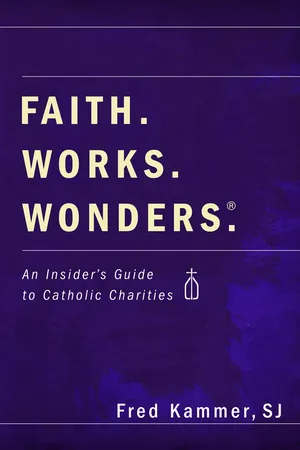
Written in preparation for the 2010 centennial of the national organization Catholic Charities USA, Faith. Works. Wonders. introduces the mission, scope, and impact of Catholic Charities agencies in communities across the nation. This book also describes the work, motivation, and spirituality of the three hundred thousand staff, board members, and volunteers in local Charities agencies; this network composes the largest voluntary social service network in the country. In addition, the author draws on the broad experience of Catholic Charities and his long association with Charities to explain the sometimes-surprising positions of the organization and its leaders in our continuing national discussions on social welfare, faith-inspired organizations, and the appropriate roles of the private and public sectors in promoting the common good and caring for the least fortunate.
Within the framework of the registered slogan of Catholic Charities of the archdiocese of Washington DC, the nine chapters in turn lay out
Faith-the mission, identity, and power of Catholic Charities rooted in the Scriptures, experience, history, and Catholic thought.
Works-the focus of agencies and people on service to people in need, advocacy and empowerment for justice and compassion, and "convening" religious and civic partners to create a better society.
Wonders-the who, what, and why of volunteers; the quest for quality and innovation; the stance of determined pluralism in the Church community and public square; and the miracle of virtue and spirituality born in the service of others.
Appendices provide 1) an outline of the history of Catholic Charities in the USA dating back to 1727 in the author's hometown of New Orleans, and 2) the principles developed by Catholic Charities and other voluntary-sector leaders for the protection of the sector in this country.
Information
Topic
Theology & ReligionSubtopic
Christian Theologypart one
Faith.
1
Mission
What We Do and Why
In the nine years that I travelled the country working with Catholic Charities staffs, board members, and volunteers, our days together often began with a prayer service arranged by the local agency. Invariably, the most common text used at these prayer services was the great judgment scene from Matthew’s Gospel:
When the Son of Man comes in his glory with all of his angels, he will sit on his royal throne. The people of all nations will be brought before him, and he will separate them, as shepherds separate their sheep from their goats.
He will place the sheep on his right and the goats on his left. Then the king will say to those on his right, “My father has blessed you! Come and receive the kingdom that was prepared for you before the world was created. When I was hungry, you gave me something to eat, and when I was thirsty, you gave me something to drink. When I was a stranger, you welcomed me, and when I was naked, you gave me clothes to wear. When I was sick, you took care of me, and when I was in jail, you visited me.”
Then the ones who pleased the Lord will ask, “When did we give you something to eat or drink? When did we welcome you as a stranger or give you clothes to wear or visit you while you were sick or in jail?”
The king will answer, “Whenever you did it for any of my people, no matter how unimportant they seemed, you did it for me.”
Then the king will say to those on his left, “Get away from me! You are under God’s curse. Go into the everlasting fire prepared for the devil and his angels! I was hungry, but you did not give me anything to eat, and I was thirsty, but you did not give me anything to drink. I was a stranger, but you did not welcome me, and I was naked, but you did not give me any clothes to wear. I was sick and in jail, but you did not take care of me.”
Then the people will ask, “Lord, when did we fail to help you when you were hungry or thirsty or a stranger or naked or sick or in jail?”
The king will say to them, “Whenever you failed to help any of my people, no matter now unimportant they seemed, you failed to do it for me.” 1

In the mid-1980s, Catholic Community Services, the Catholic Charities agency where I worked in the diocese of Baton Rouge, approved its first strategic plan with the following mission statement at its head: “Catholic Community Services of Baton Rouge proclaims the gospel vision of Jesus Christ as its mission by serving the needs of individuals and families, especially the poorest, and working with Church and community for justice, peace, and compassion in society.” Woven through this single sentence were three roles with long and complex histories in the world of Catholic Charities: “service, advocacy, and convening.” Also included were strong and principled themes from the centuries of Catholic Social Teaching—justice, peace, compassion, the importance of family, evangelization, the preferential option for the poor, and, of course, the Good News of Jesus of Nazareth. All across the country, the boards, staff, and volunteers of hundreds of Catholic Charities agencies and institutions had developed or would develop similar mission and vision statements whose fabric was woven from the same three core roles and the same principles that underlie Catholic social morality.
The National Conference of Catholic Charities (1910)
The formal “mission” story for Catholic Charities USA begins in 1910 on the campus of Catholic University of America (CUA). At the invitation of Bishop Thomas Shahan, CUA’s President, the National Conference of Catholic Charities (NCCC) was founded to promote the foundation of diocesan Catholic Charities bureaus, to encourage professional social work practices, “to bring about a sense of solidarity” among those in charitable ministries, and “to be the attorney for the poor.” The four hundred or so delegates from twenty-four states were predominantly laypeople, representative of the women and men who had founded the many charitable institutions in various ethnic communities, members of the Society of St. Vincent de Paul, and Catholic academics and public figures concerned about the poor in this society. President Taft hosted the closing ceremonies at the White House. The Proceedings recited the purposes as follows:
The National Conference has been created to meet a definite situation. It aims to preserve the organic spiritual character of Catholic Charity. It aims to seek out and understand causes of dependency. It aims to take advantage of the ripest wisdom in relief and preventive work to which persons have anywhere attained, and to serve as a bond of union for the unnumbered organizations in the United States which are doing the work of Charity. It aims to become, finally, the attorney for the Poor in Modern Society, to present their point of view and defend them unto the days when social justice may secure to them their rights.2
In the early years of the NCCC, an intense effort—especially by Msgr. John O’Grady, NCCC Executive Secretary (1920–1960)—focused on the development of the diocesan Catholic Charities bureau or agency as a vehicle for organizing and professionalizing the works of charity within various dioceses. By 1922 there were thirty-five central bureaus of Catholic Charities formed in cities or dioceses. By 1937 the number of diocesan bureaus had increased to sixty-eight in thirty-five states.
In a way, this diocesan-level development was a focus on the service role of Catholic Charities; and it was complemented by efforts to improve the quality of services in keeping with the newly developing field of social work. For example, in 1923 NCCC published A Program for Catholic Child-Caring Homes, a work of its Conference on Religious, to stimulate improvement of standards in existing homes. In 1934, The National Catholic School of Social Service was founded at Catholic University of America at the urging of NCCC with Msgr. O’Grady as its first dean. The reach of NCCC extended internationally as the first meeting of the International Conference of Catholic Charities (later Caritas Internationalis) is held in Rome in 1951. Msgr. O’Grady had been one of the planning committee for the founding of the international conference.
The second role of Catholic Charities—advocating for a more just society—was smelted in the social and economic caldron that was dominated by the depression, the New Deal, and World War II and its aftermath. NCCC and diocesan bureaus promoted social legislation based upon Catholic social principles, and Msgr. O’Grady became a major national voice on social reform. Two examples stand out. In 1935, the Social Security Act passed Congress for the first time, with strong support from NCCC for the concept of insurance benefits based upon rights as opposed to a needs test for benefits. The act provided the framework (and still does) for what are called social security benefits (for worker retirement, survivors, and dependents), workers’ compensation, unemployment compensation, and soci...
Table of contents
- Title Page
- Introduction
- Part One: Faith
- Part Two: Works
- Part Three: Wonders
- Appendix A: An Historical Outline
- Appendix B: The Profitization of Social Services
Trusted by 375,005 students
Access to over 1.5 million titles for a fair monthly price.
Study more efficiently using our study tools.
Frequently asked questions
Yes, you can cancel anytime from the Subscription tab in your account settings on the Perlego website. Your subscription will stay active until the end of your current billing period. Learn how to cancel your subscription
No, books cannot be downloaded as external files, such as PDFs, for use outside of Perlego. However, you can download books within the Perlego app for offline reading on mobile or tablet. Learn how to download books offline
Perlego offers two plans: Essential and Complete
- Essential is ideal for learners and professionals who enjoy exploring a wide range of subjects. Access the Essential Library with 800,000+ trusted titles and best-sellers across business, personal growth, and the humanities. Includes unlimited reading time and Standard Read Aloud voice.
- Complete: Perfect for advanced learners and researchers needing full, unrestricted access. Unlock 1.5M+ books across hundreds of subjects, including academic and specialized titles. The Complete Plan also includes advanced features like Premium Read Aloud and Research Assistant.
We are an online textbook subscription service, where you can get access to an entire online library for less than the price of a single book per month. With over 1.5 million books across 990+ topics, we’ve got you covered! Learn about our mission
Look out for the read-aloud symbol on your next book to see if you can listen to it. The read-aloud tool reads text aloud for you, highlighting the text as it is being read. You can pause it, speed it up and slow it down. Learn more about Read Aloud
Yes! You can use the Perlego app on both iOS and Android devices to read anytime, anywhere — even offline. Perfect for commutes or when you’re on the go.
Please note we cannot support devices running on iOS 13 and Android 7 or earlier. Learn more about using the app
Please note we cannot support devices running on iOS 13 and Android 7 or earlier. Learn more about using the app
Yes, you can access Faith. Works. Wonders. by Fred Kammer SJ in PDF and/or ePUB format, as well as other popular books in Theology & Religion & Christian Theology. We have over 1.5 million books available in our catalogue for you to explore.