- 162 pages
- English
- ePUB (mobile friendly)
- Available on iOS & Android
eBook - ePub
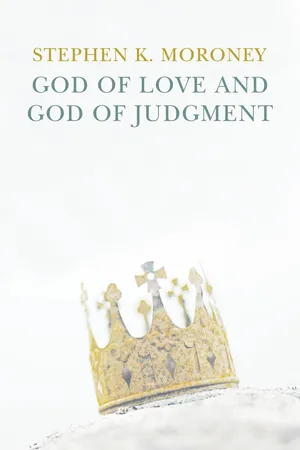
God of Love and God of Judgement
About this book
How can a God of love also be a God of judgment? If God loves everyone, what is the point of judgment? Does God change from being wrathful in the Old Testament to loving in the New Testament? Can we discern God's judgments in current events, such as hurricanes and personal tragedies? Is it ever right for humans to judge? These are not just daunting issues for theologians to ponder. They are urgent questions for everyone. Our answers profoundly affect how we relate to God and how we live with one another. Coming to grips with these issues is vital for our spiritual journeys.
Many people today emphasize God's love and downplay his judgment. The problem with this approach is that God's judgment is taught in Scripture from the beginning of Genesis to the end of Revelation, and it is a core part of the gospel preached by Jesus and his apostles. There are problems at the other end of the spectrum too, when we believe in a God of judgment who is not also a God of love. It is impossible for us to find spiritual peace when we live in constant dread of God, pictured as a harsh judge whom we can never please. This book calls us to embrace a more full, biblical image of God--one that joins his love and judgment together. Additionally, the book shows that, as those who are made in God's image, we can fuse love and judgment together constructively in our own daily lives.
Trusted by 375,005 students
Access to over 1.5 million titles for a fair monthly price.
Study more efficiently using our study tools.
Information
Topic
Theology & ReligionSubtopic
Christian Churchpart one
Judgment without Love
1
Thus Judgeth the Lord
Perils of Proclaiming God’s Judgment in Current Events
God’s Judgment and Catastrophes
Two weeks ago (as I write) we received a terrifying phone call from our older daughter, Grace, who was in the middle of a tornado—literally! She was calling while holding a pillow over her head and crouching with her roommate in the bathtub of their college dorm room at Union University (Tennessee). As my wife listened on her cell phone, the tornado ripped through the campus—blowing some of Grace’s friends out of their bathtubs, causing an estimated 40 million dollars in damage, and destroying approximately 70 percent of student housing. There were many serious injuries but no fatalities on campus. The university president stated publicly: “God providentially protected the lives of our students.” Some of the students, however, thought God might have sent the tornado to shake them out of their spiritual complacency and make them more serious about putting God first in their lives. A few even wondered quietly if the tornado might have been God’s hand of judgment.
Others do not wonder quietly to themselves but proclaim loudly in public that God’s hand of judgment is upon us. It happens every year or two. An earthquake strikes California and hundreds of websites shout that the seismic activity is clearly God’s judgment since its epicenter was near the hub of video pornography production. A hurricane hits the Gulf Coast and religious figures declare it is God’s judgment against gambling and other sinful practices in the area. Some say the most costly natural disaster in U.S. history, Hurricane Katrina, was God’s judgment on the depravity of New Orleans. Such pronouncements raise a question that people have grappled with for centuries: can we discern God’s judgment in the events of history and the events of our times?
Many Puritans believed we could. They often saw God meting out judgment in the terrible happenings of their day. What are usually considered natural disasters to us (droughts, earthquakes, and floods) were plainly signs of God’s wrath against sin, in the minds of many Puritans. Likewise, what we usually think of as personal misfortunes (financial ruin, serious illness, or “premature death”) were often believed by Puritans to be instances of God’s judgments. When something bad happened, the obvious explanation was that God was sending heavenly judgment for earthly sin.
In contrast to most Americans today (see chapter three), the Puritans had a strong sense of God as judge—an image often impressed on them from the pulpit. It has been estimated that in the course of a lifetime, the typical Puritan heard approximately 7,000 sermons totaling 10,000 hours of preaching. Those who began to nod off to sleep were prodded awake by parents or deacons! Many of the sermons spoke of God’s deep love, but others thundered God’s judgment. Just reading some of the sermon titles gives us a sense for their direct preaching on judgment. At the turn of the seventeenth century, published sermons included The Great Day of Judgment (Samuel Lee, 1692); Impenitent Sinners Warned of Their Misery and Summoned to Judgment (Samuel Willard, 1698); The Vain Youth Summoned to Appear at Christ’s Bar (Samuel Moody, 1707); and Persuasions from the Terror of the Lord (Cotton Mather, 1711). Only a few decades later, Jonathan Edwards preached his famous sermon, Sinners in the Hands of an Angry God (1741).
Tracing the Finger of God in Thomas Beard’s Theatre of God’s Judgments
Aside from the sermons they heard, many Puritans were also influenced by stories they read in Thomas Beard’s renowned book, The Theatre of God’s Judgments. First published in 1597, the book was reissued, revised, and expanded over the years.1 By the time it was published in abbreviated form in 1786, Puritan experts say that Beard’s work “had indisputably become a popular classic,” and it represented “the most widely popularized and commonly accepted Puritan view of providence.”2
According to this Puritan view of providence, God directs human affairs in such a way that “nothing in the world comes to pass by chance,” but rather “only and always by the prescription of his will.” Historical events show us how God rewards virtue and punishes vice. In this framework, punishment “follows sin as a shadow does the body.” So, when we read both “biblical history” and “secular history,” Beard said, we should diligently “mark the effects of God’s providence and of his justice.”3 As Beard traced the finger of God’s providence in history, the main lesson was that God judges sinners.
Beard’s book is basically a compilation of stories about what happened to people who broke the Ten Commandments. Nearly every section begins with biblical narratives of God’s judgments and then moves seamlessly into post-biblical history. Beard stated boldly that “there was never any that set themselves against the Church of God, but God set himself against them by some notable judgment.”4 Very often, in Beard’s stories, God’s punishment was tailored specifically to the perpetrator’s sin.
Thomas Arondel, who prohibited ministers from speaking the word of God, “had his own tongue so swollen that it stopped his own mouth”—leading to death by starvation. An official named Felix swore “he would ride up to his spurs in the blood of Lutherans,” but that night, “the hand of God so struck him, that he was strangled and choked with his own blood.” A cardinal who hung Christians was himself hung in his cardinal’s robes for all to see. When a man who murdered Christians was murdered in his own bed, “the just judgment of God showed itself.” From Beard’s perspective, these stories revealed “the wonderful judgments which the King of Kings has sent upon those that have in any place or country whatsoever resisted and strove against the Truth.”5
In Beard’s view, those who fell away by backsliding or apostasy (renouncing the faith) could expect similar judgments from God. One man who verbally recanted his faith in Christ was “struck dumb and so was justly punished in that very member wherewith he had offended.” After repudiating her faith with no remorse, a woman reportedly “chopped in pieces with her dainty teeth her rebellious tongue.” Because a man named Lucian denied his earlier profession of Christianity “like a foul mouthed dog,” fittingly “he was himself, in God’s vengeance, torn in pieces and devoured by dogs.”6
Biblical examples from the book of Acts are just the start of a longer pattern Beard saw for false teachers in the years ahead. When a bishop spoke “blasphemous words against the holy Trinity,” in the year 510, “a threefold thunderbolt came from above and struck him dead in the same place,” according to Beard’s report. Mohammed, founder of Islam, was said to be judged for his heresies when “the Lord cut him off by the falling sickness.” In Beard’s narrative, the Anabaptists were also judged as “God scourged and plagued many of them” for “their monstrous and damnable heresies.” According to Beard, God’s judgments against various popes over the years included having their eyes pulled out, dying in prisons, dying of hunger, as well as being smothered to death, killed with the sword, stoned, poisoned, and stifled by the devil.7
While most of Beard’s book focuses on the judgment of individuals, he also described God’s judgments against groups of people. He said that at times God judges “one by one” but “other times altogether in a heap.” According to Beard, in the middle of the third century, “the just hand of God” struck the Roman Empire with ten years of “plague and pestilence.” And, while “the greatness of the plague touched also the Christians somewhat, yet it scourged the heathen idolaters much more.” Over a millennium later, God judged the Eastern ...
Table of contents
- Title Page
- Preface
- Acknowledgments
- Part One: Judgment without Love
- Part Two: Love without Judgment
- Part Three: Love and Judgment Together
- Conclusion
- Bibliography
Frequently asked questions
Yes, you can cancel anytime from the Subscription tab in your account settings on the Perlego website. Your subscription will stay active until the end of your current billing period. Learn how to cancel your subscription
No, books cannot be downloaded as external files, such as PDFs, for use outside of Perlego. However, you can download books within the Perlego app for offline reading on mobile or tablet. Learn how to download books offline
Perlego offers two plans: Essential and Complete
- Essential is ideal for learners and professionals who enjoy exploring a wide range of subjects. Access the Essential Library with 800,000+ trusted titles and best-sellers across business, personal growth, and the humanities. Includes unlimited reading time and Standard Read Aloud voice.
- Complete: Perfect for advanced learners and researchers needing full, unrestricted access. Unlock 1.5M+ books across hundreds of subjects, including academic and specialized titles. The Complete Plan also includes advanced features like Premium Read Aloud and Research Assistant.
We are an online textbook subscription service, where you can get access to an entire online library for less than the price of a single book per month. With over 1.5 million books across 990+ topics, we’ve got you covered! Learn about our mission
Look out for the read-aloud symbol on your next book to see if you can listen to it. The read-aloud tool reads text aloud for you, highlighting the text as it is being read. You can pause it, speed it up and slow it down. Learn more about Read Aloud
Yes! You can use the Perlego app on both iOS and Android devices to read anytime, anywhere — even offline. Perfect for commutes or when you’re on the go.
Please note we cannot support devices running on iOS 13 and Android 7 or earlier. Learn more about using the app
Please note we cannot support devices running on iOS 13 and Android 7 or earlier. Learn more about using the app
Yes, you can access God of Love and God of Judgement by Stephen K. Moroney in PDF and/or ePUB format, as well as other popular books in Theology & Religion & Christian Church. We have over 1.5 million books available in our catalogue for you to explore.