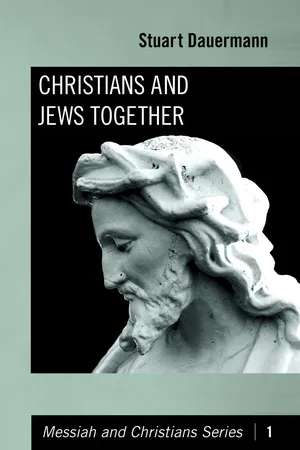
In Christians and Jews Together, Stuart Dauermann challenges Christians and Jews to discover new ways to partner together in serving what God is up to in the world. He imaginatively connects the thinking of Paul the Apostle with the Prophet Ezekiel, forming a previously unexplored bridge between Jews and Christians. This is an excellent resource for Christians seeking new ways to understand and share their faith within the context of deep respect for their Jewish neighbors, relatives, and friends.
- 42 pages
- English
- ePUB (mobile friendly)
- Available on iOS & Android
eBook - ePub
Christians and Jews Together
About this book
Information
Topic
Theology & ReligionSubtopic
Christian Theology“Make It Plain”
(Habakkuk 2:2)
Although Ezekiel’s vision applies to all Israel, increasingly, Messianic Jews are calling it the New Messianic Jewish Agenda because it undergirds our vision for a new kind of Messianic Judaism.1 For us, all aspects of this agenda are interdependent parts of God’s plan for our people. For example, we are committed to covenantal Jewish life and to faith in Yeshua.2 Neither should be neglected. This kind of Messianic Judaism is built on rediscovered scriptural foundations long buried, yet vital to God’s continuing purposes for our people.
This vision may seem irrelevant to you as a Christian. It may strike you as nothing more than a quaint religious opinion unrelated to or even contradictory of Christian truth as you know it. “But wait!” as the infomercials put it. This vision becomes very exciting once it is seen against the wider context of what God is up to in the world, which mission theologians term the missio dei (the mission of God). Once its context and implications are unpacked, the New Messianic Jewish Agenda changes everything. Exploring this vision and its implications for the Church and for the Jewish people will be one of the big “Aha! moments” of your life. So let’s explore it together, and “make it plain.”
There is nothing timid or conventional about the Kingdom of God nor about new paradigms like this one. C. S. Lewis reminds us that Aslan isn’t a tame lion. South African Mission Theologian David Bosch, who exposed and resisted the evils of apartheid at the risk of his life, was no tame lion himself. He applies paradigm theories native to the field of science to the world of theology and mission, and shows how disruptive they can be:
[A shifting of paradigms] seldom happens without a struggle, however, since scientific communities [and theological traditions] are by nature conservative and do not like their peace to be disturbed, the old paradigm’s protagonists continue for a long time to fight a rearguard action. . . . Proponents of the old paradigm often just cannot understand the arguments of the proponents of the new. Metaphorically speaking, the one is playing chess and the other checkers on the same board.
. . . This explains why defenders of the old order and champions of the new frequently argue at cross-purposes. Protagonists of the old paradigm, in particular, tend to immunize themselves against the arguments of the new. They resist its challenges with deep emotional reactions, since those challenges threaten to destroy their very perception and experience of reality, indeed their entire world.3
Remember my friend Marcia. Not everyone in her church and almost no one on her mission field understood her decisions or appreciated her sacrifice. If you are going to investigate these new ideas, even if they are God’s new ideas, you too may be misunderstood. Despite this risk, I invite you to follow along as I point out a Kingdom controversy most people have yet to consider.
How Great is the Great Commission?
Consider the term, “the Great Commission.” This is the name the Church attaches to Yeshua’s command to “go into all the world and preach the gospel” (Mark 16:15). Few pause to consider that the Bible never refers to the Great Commission by that name. The term “great” is an evaluative term registering the Church’s estimation of the commission. And certainly it is a great commission that has informed and spurred heroic service for nearly two thousand years. But the term is a new one. The first person to use the term “the Great Commission” was probably Dutch missionary Justinian von Welz (1621–1688). And it wasn’t until the nineteenth century that the Great Commission was popularized, by missionary giant Hudson Taylor, who connected the term with Matthew 28:19–20.
No less an authority than the Apostle Paul gives ample evidence that there is something greater than the Great Commission.
But it really shouldn’t be called “the Great Commission,” as though this is God’s final word to His people. No less an authority than the Apostle Paul gives ample evidence that there is something greater than the Great Commission. How so?
The Greater Commission
In the Letter to the Romans, chapters nine through eleven, Paul is trying to understand the purposes of God for Israel and the nations. He is troubled by what he encounters in his travels: a general Jewish disinterest, even hostility to the gospel, which contrasts markedly with widespread Gentile acceptance of it. As a loyal and committed Jew, and against the background of Scripture’s glorious promises concerning the descendants of Jacob, Paul is agonizing to understand both this mysterious turning away and its implications. While some are quick to suggest that Israel’s hardening proves God is finished with her—Paul knows this simply cannot be true. He comes to see that Jewish resistance to the gospel is neither universal (it is “a hardening in part”)4 nor permanent (it lasts only “until the fullness of the Gentiles has come in, and so all Israel will be saved”).5 Paul pronounces a verdict of “by no means!” over the proposition that God is through with the Jews.6
Paul pronounces a verdict of “by no means!” over the proposition that God is through with the Jews.
In Romans 11:12, he terms this Jewish indifference to the gospel as both stumbling and loss, while anticipating a brighter future for Israel, saying: “But if their transgression means riches for the world, and their loss means riches for the Gentiles, how much greater riches will their fullness bring!” Recognizing that the partial hardening that has happened to Israel is not final, he looks forward to their eventual full inclusion, which he terms “their [Israel’s] fullness.” Adopting his logic to our own discussion then, if the fullness of the Gentiles is the Great Commission, then the fullness of Israel, which Paul terms “greater riches,” is rightly ter...
Table of contents
- Title Page
- Introduction
- “Write the Vision”
- “Make It Plain”
- Running with the Vision
- Glossary
- Biblical Support for the New Messianic Jewish Agenda
Trusted by 375,005 students
Access to over 1.5 million titles for a fair monthly price.
Study more efficiently using our study tools.
Frequently asked questions
Yes, you can cancel anytime from the Subscription tab in your account settings on the Perlego website. Your subscription will stay active until the end of your current billing period. Learn how to cancel your subscription
No, books cannot be downloaded as external files, such as PDFs, for use outside of Perlego. However, you can download books within the Perlego app for offline reading on mobile or tablet. Learn how to download books offline
Perlego offers two plans: Essential and Complete
- Essential is ideal for learners and professionals who enjoy exploring a wide range of subjects. Access the Essential Library with 800,000+ trusted titles and best-sellers across business, personal growth, and the humanities. Includes unlimited reading time and Standard Read Aloud voice.
- Complete: Perfect for advanced learners and researchers needing full, unrestricted access. Unlock 1.5M+ books across hundreds of subjects, including academic and specialized titles. The Complete Plan also includes advanced features like Premium Read Aloud and Research Assistant.
We are an online textbook subscription service, where you can get access to an entire online library for less than the price of a single book per month. With over 1.5 million books across 990+ topics, we’ve got you covered! Learn about our mission
Look out for the read-aloud symbol on your next book to see if you can listen to it. The read-aloud tool reads text aloud for you, highlighting the text as it is being read. You can pause it, speed it up and slow it down. Learn more about Read Aloud
Yes! You can use the Perlego app on both iOS and Android devices to read anytime, anywhere — even offline. Perfect for commutes or when you’re on the go.
Please note we cannot support devices running on iOS 13 and Android 7 or earlier. Learn more about using the app
Please note we cannot support devices running on iOS 13 and Android 7 or earlier. Learn more about using the app
Yes, you can access Christians and Jews Together by Stuart Dauermann in PDF and/or ePUB format, as well as other popular books in Theology & Religion & Christian Theology. We have over 1.5 million books available in our catalogue for you to explore.