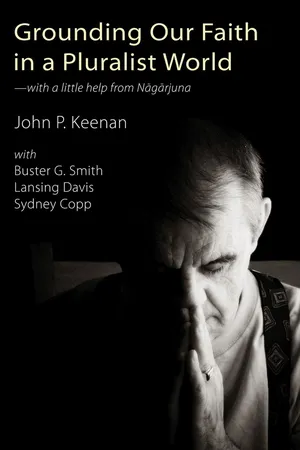
eBook - ePub
Grounding Our Faith in a Pluralist World
with a little help from Nagarjuna
- 136 pages
- English
- ePUB (mobile friendly)
- Available on iOS & Android
eBook - ePub
Grounding Our Faith in a Pluralist World
with a little help from Nagarjuna
About this book
This book draws upon the Mahayana philosophy developed within Buddhism, employing it as a means to empty our usual alternatives for viewing the world's many religions--whether exclusivism, inclusivism, or pluralism. The aim is to free people from clinging to intellectual positions, enabling them gently but committedly to affirm their vernacular tradition as it is practiced on the ground. It critiques the above three options, and introduces the Mahayana philosophy of emptiness and dependent arising, along with its distinction between ultimate truth and conventional truth. It then applies this philosophy to an urgent question that bedevils modern people: how to practice one's chosen faith in the awareness of many other honored and attractive paths, both elegant and efficacious.
Information
Topic
Theology & ReligionSubtopic
Christian Church1
A World of Many Faiths
When Faith Meets Faith1
Our ancestors in the rural communities and city streets of the Western world, like those in villages and metropolises around the globe, lived primarily within bounded worlds of monocultural assumptions—assumptions that supported, and were supported by, a particular religious faith and practice.
They of course did sometimes encounter people of other faith traditions but did not often speak with them about religion. Let sleeping theologies lie, they seemed to think. Disagreements indeed there were, even between different denominations of the same faith tradition—here Catholic and Protestant, conservative and liberal, Orthodox and Reformed, there Sunni and Shiite, Nichiren and Zen. Still, within each religious culture and neighborhood there was broad agreement on a common set of philosophical assumptions about the oneness of truth and the nature of authentic practice. There was no need to discuss differences, for the possession of religious truth allowed one to remain insular within the shared overarching pattern of a common cultural life of faith and practice.
That is to say, things remained, and still do remain, harmonious wherever a cultural pattern of arm’s length religious tolerance is the norm. We build on the work of our ancestors, and Western culture has over time developed a broad consensus about tolerance toward the faith traditions of others. And so here in the West, even when incompletely enunciated, culturally irenic assumptions remain potent. Several centuries ago, our ancestors may have burned one another at the stake over words in a prayer book, but in this culture we have by now been schooled to live and let live, religiously speaking.
Nevertheless, truth still tends to be regarded as univocal so that any viewpoint is seen as either true or false. Co-religionists of other denominations or sects who profess an alternative understanding of our faith are thus looked upon, however unfortunately, as unfortunate. But patiently they are left to work out their salvation on their own. As for altogether different religions and foreign cultures, until recently these were far away, had little to do with our native culture, and were dismissed as obviously false (although possibly possessed of a grain or two of truth mixed into their morass of error). In today’s society, many such alien faiths have moved closer, into our cities and even sometimes into our neighborhoods. They are seen perhaps as simply unavoidably different, but their adherents are fellow citizens so long as they too affirm the overarching norms of cultural tolerance. No longer pagans, heathens, outsiders, infidels, or gentiles to one another, we must all practice our faith within a context of civilized tolerance.
The picture of the culturally bounded societies of our forbearers, each neatly conjoined to its particular religious tradition, has never been entirely true, of course—because the assumption of culturally well-defined traditions and independent religions is not true. Each and every tradition of faith, and each and every philosophic set of affirmations, has influenced others and has itself been influenced by a myriad of external factors.
Buddhism grew from within a Hindu worldview, and doctrines of transmigration, karma, and awakening are the common property of these two major traditions. Christian doctrine was grounded upon the Hebrew Scriptures, although it was regarded as the consummation of the Hebrews’ earlier covenant with God and did reinterpret notions of the Torah through the new revelation of Jesus.2 The Upanishads of India, which seem to have influenced the Greek philosopher Plotinus, may well have exerted a pull on his Neoplatonism and in turn had an effect upon early Jewish and Christian mysticism. Muslims accept Moses and Jesus as prophets leading up to Muhammad. They also have a tender devotion to Mary, the mother of Jesus (in contrast to Christian Protestants, who eschew such devotion as too “Roman”).
Pure Land Buddhist Japanese immigrants in Hawaii and California, seeking to be culturally American, for a time called their places of worship “churches” rather than “temples,” introduced organ music, installed pews, and formed Buddhist Youth Fellowships on the model of Protestant youth groups. Such historical influences of one religious tradition upon another have been far-reaching and in some instances surprising: The rosary was probably used first by Buddhists, adopted by Muslims as prayer beads, and then propagated among Roman Catholics by the mendicant and learned preacher St. Dominic (1170–1221), as an aid to meditation and a symbol of the true Christian faith.
Despite such mutual and global influences and regardless of the all-embracing modern culture of tolerance, religious traditions do tend to incarnate themselves within specific ethnicities and particular geographies, to identify boundaries, and to serve as the ground upon which groups of people define their reality and order their world. Often they are tied to sacred places and arise within some sacred geography. We humans are, as Genesis teaches, earthlings (ādām), from the earth (ādāmā) and located not globally everywhere, but in some neighborhood or other. Indeed, we feel compelled to construct localized functional worlds in order to live together, to live at all.
Times do change and sometimes a religion will come to be viewed as insufficient or invalid, an old superstition that needs to yield to a more enlightened awareness. Even then, its practitioners will likely feel compelled to seek some new path over familiar ground along which to reorganize their lives and avoid chaos and meaninglessness. In times of plenty and prosperity, the “old-time” religion may enjoy broad, if sometimes shallow, acceptance within the culture. But in periods of distress and suffering, the same religion may wither and die.
Or, in times of stress, a religion may—and often does—develop militant orientations, eschatological visions of a better future, and revolutionary justifications for political resistance in the name of faith. Violence is a common human response to distress and fear. It may be directed inward, in rejection of an accepted tradition, or outward, toward forces that threaten a still cherished religious faith. But, when faith and life itself appear to be threatened by primordial chaos and death, violence will seek a religious warrant.3 As Karl Barth knew so well, we human beings create religion to keep the chaos at bay.
In some cases, a religious tradition faced with challenges will eschew an extreme reaction and instead launch upon a creative effort to reclaim the ground of that faith, coming home to the cultural landscape of its source. This entails going to ground in its revelations, for faith comes from the revealing impetus of the Spirit, of the Buddha realm, of God, through seers and prophets, from the awakened ones. In my neighborhood, it came from the Holy Spirit. But all religions with equal vigor proclaim themselves to be founded upon primal experiences and revealed manifestations of deep insight into life and truth. We humans nurture those basic revelations within our particular cultures and languages so that they grow over time into traditions that serve as barriers against the ever-present possibility of chaos and meaninglessness.
Sadly and frequently, however, in our commitment to revelation, we forget that it is we ourselves who have received these revelations, that it is we humans who have nurtured and recorded them, forming them into the monuments of elegance and truth that they are. By the very receiving of revelation, we mold and construct our understanding and our society. But in our urgent desire to affirm absolute and unconditioned truth, often we fail to acknowledge that our revealed worldviews are in fact also the cultural products of human endeavor. We want to proclaim the truth to be wholly and just-as-it-is revealed: God speaks, and we but listen, thrilled by the happy fact that God speaks our language.
Confident that our religion as practiced is fixed and formulated by such revelation, we human beings forget that we ourselves are the creators of religious institutions and conventions, and indeed of language itself. In consequence, we lose any sense that our religion can change its structure if so desired.4 This kind of believing creates bastions of forgetful comfort, which underpin our life as lived and protect us alike from states of mental instability and from life insight. We assiduously seek such comfortable havens of certainty, because, as philosopher and sociologist Émile Durkheim observed, when religion “no longer fulfills its function . . . confusion and uneasiness result.”5 Fearing that unease, we replace thinking with faith. It is then that violence may show itself as the shadow side of religious conviction.
Although, undeniably, violence may, and does, sometimes appear as the dark side of religious commitment, the faith traditions—when practiced authentically—shine forth with the muted light of human endeavor. At their best, they strive to remain true to the inherited faith while drawing from their sacred writings new insights, ever more faithfully, in ever changing cultural circumstances, addressing ever new crises and opportunities.
But the task of addressing new circumstances has become more and more difficult. In a modern world where we are so aware of many different religions, the very plurality of faiths threatens our sense of stability and calls into question our own accepted sureties. This is our new crisis—and our new opportunity. The way in which we react to multiple truth systems can determine whether or not we can maintain our sense of religious place within our own tradition, and this in turn affects faith and practice. Some indeed may abandon faith altogether—either by rejecting what they now regard as a narrow-minded practice, or conversely by making faith itself into an absolute.
Awareness of a multiplicity of religions threatens any given tradition, and so throughout history we human beings have employed a variety of strategies to keep at bay the insistent awareness that our faith is in fact molded and formed within a cultural framework. Even though our tradition may be revealed, the terms in which it is expressed depend upon human ideas and orientations that are not themselves a part of the revelation.
As noted above, three broad approaches have been employed to address this vexing problem of many religions: The first is a sweeping, often exclusive, dismissal that does not bother much with trying to understand the other traditions. A more inclusive approach seeks to account for other faiths within a theological understanding of one’s own faith. The pluralist position—increasingly popular—recognizes the richness of other traditions and confesses that many different paths are equally valid and true.6
Exclusivism: possessing the true picture
In the past—and continuing into the present—a comm...
Table of contents
- Title Page
- Acknowledgments
- Preface
- Chapter 1: A World of Many Faiths
- Chapter 2: Toward a Workable Philosophy of Religions
- Chapter 3: The Useful Philosophies of Mahāyāna Buddhism
- Chapter 4: Grounding Our Faith in a Pluralist World
- Bibliography
Trusted by 375,005 students
Access to over 1.5 million titles for a fair monthly price.
Study more efficiently using our study tools.
Frequently asked questions
Yes, you can cancel anytime from the Subscription tab in your account settings on the Perlego website. Your subscription will stay active until the end of your current billing period. Learn how to cancel your subscription
No, books cannot be downloaded as external files, such as PDFs, for use outside of Perlego. However, you can download books within the Perlego app for offline reading on mobile or tablet. Learn how to download books offline
Perlego offers two plans: Essential and Complete
- Essential is ideal for learners and professionals who enjoy exploring a wide range of subjects. Access the Essential Library with 800,000+ trusted titles and best-sellers across business, personal growth, and the humanities. Includes unlimited reading time and Standard Read Aloud voice.
- Complete: Perfect for advanced learners and researchers needing full, unrestricted access. Unlock 1.5M+ books across hundreds of subjects, including academic and specialized titles. The Complete Plan also includes advanced features like Premium Read Aloud and Research Assistant.
We are an online textbook subscription service, where you can get access to an entire online library for less than the price of a single book per month. With over 1.5 million books across 990+ topics, we’ve got you covered! Learn about our mission
Look out for the read-aloud symbol on your next book to see if you can listen to it. The read-aloud tool reads text aloud for you, highlighting the text as it is being read. You can pause it, speed it up and slow it down. Learn more about Read Aloud
Yes! You can use the Perlego app on both iOS and Android devices to read anytime, anywhere — even offline. Perfect for commutes or when you’re on the go.
Please note we cannot support devices running on iOS 13 and Android 7 or earlier. Learn more about using the app
Please note we cannot support devices running on iOS 13 and Android 7 or earlier. Learn more about using the app
Yes, you can access Grounding Our Faith in a Pluralist World by John P. Keenan,Sydney Copp,Lansing Davis,Buster G. Smith in PDF and/or ePUB format, as well as other popular books in Theology & Religion & Christian Church. We have over 1.5 million books available in our catalogue for you to explore.