eBook - ePub
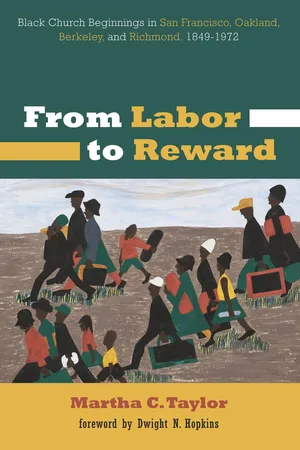
From Labor to Reward
Black Church Beginnings in San Francisco, Oakland, Berkeley, and Richmond, 1849-1972
- 266 pages
- English
- ePUB (mobile friendly)
- Available on iOS & Android
eBook - ePub
From Labor to Reward
Black Church Beginnings in San Francisco, Oakland, Berkeley, and Richmond, 1849-1972
About this book
From Labor to Reward is a pioneering, epic, and groundbreaking book that fills a huge void in American religious history, black religious history, and traditions of the black church. Until now, no other book has chronicled the rich religious experiences of black church beginnings in the Bay Area. Martha C. Taylor provides penetrating insight into the early makings of the black church in the Bay Area. With attention to detail, Taylor captures the joys, frustrations, and unity of black people who left the segregated Deep South, came to the Bay Area seeking freedom only to face similar adversities of segregation, racism, housing discrimination, KKK threats of violence, and other socio-political barriers. Remarkably, these early pioneers brought their culture, traditions, and experiences from the South and built a strong vibrant religious community. From Labor to Reward speaks for the legacy of African Americans who were gospel social activists using the church as the anchor. Multiple sources of research and interviews were gathered from church records, newspaper clippings, and other written sources to tell this unknown story. This book is sure to be a classic and a must read for all persons interested in history.
Information
Part I—Gold Rush Migration Era 1848–1900
The Black Experience in Early California Antebellum Years—1815–1861
If our people are to fight their way out of bondage, we must arm them with the sword and the shield and the buckler of pride-belief in themselves and their possibilities based on a sure knowledge of the past.
—Mary McLeod Bethune
The Gold Rush attracted men from all walks of life who wanted to strike it rich in the golden state of California. Word spread rapidly that one could get “rich overnight.” Men from all walks of life including farmers, slave owners, slaves, freed slaves and others simply picked up their meager belongings and headed West by horse or wagon train, determined to become wealthy. Among the blacks entering California were freed slaves, however the majority were slaves brought to California by their slave masters as property to prospect for gold in the mother lode country. For blacks, both freed slaves and slaves were accustomed to toiling from sun up to sun down. Thus sifting and picking for gold nuggets was far more appealing than picking cotton. Some of the slaves left families behind with the intent of buying their freedom. The spirit of the poor slaves was encouraged by the thought that eventually they would be reunited with their families and live with a sense of dignity and pride. The hope for freedom was the driving force that gave them determination to work.1.
By 1850, a contentious battle over whether California would be admitted to the union as a slave state or free state had turned into a heated battle. The country was evenly divided into fifteen northerly free states and fifteen southerly slave states. A settlement agreement was finally reached in the Compromise of 1850 admitting California to the union as a free state on September 9, 1850. For slaves and freed slaves it was an answered prayer, but not for long. A backlash started amongst disgruntled supporters of slavery and slaveholders who had already brought their slaves to California and wanted to ensure that they could continue to retain their slaves as property. The practice of slavery was fully in place. One of the provisions considered would prevent both slaves and freed slaves from coming to California. Several years later, proslavery politicians and supporters of slavery were successful in introducing a bill known as the California Fugitive Slave Act. The Bill protected slave owners and made it illegal for slaves to run away from their slave masters.2 The majority of slaves who could not read or write were not informed of the law and were left in the dark. By 1852 the number of slaves in California exceeded 2,200. The population growth along with activists who were becoming vocal about California being a free state was problematic for supporters of slavery. Legislators, mostly Democrats who supported slavery, used their legislative powers to manipulate revisions in the Fugitive Slave Law to protect slave owners. Slaves were not emancipated at the time California was admitted, leaving slave owners the right to retain their slaves as property.3 The southern practice of slavery continued in California though the state was a free state.
In the meantime, the early black pioneers to California were caught in the snares of quasi-freedom for freed slaves and slaves who were residing in a non-slave state that practiced slavery. Indeed, California may have appeared to be the Promised Land for freedom, however, uncovered history revealed otherwise.
Negroes for Sale in “Free” California
California entered the union in September 9, 1850 as a free state, however, two years after its admission, an ad appeared in the San Francisco Herald newspaper June 1852: “NEGRO FOR SALE:—I will sale at public auction a Negro having agreed to said sale in preference to being sent home. I value him at $300 but if any or all of his abolition brethren wish to show that they have the first opportunity of releasing said Negro slave from bondage by calling on the subscriber at the Southern House previous to that time, and paying $100.00.”4
Stephen Hill, a slave from Arkansas was brought to California by his slave owner, Wood Tucker prior to the Gold Rush. Tucker later returned to Arkansas and, according to Hill, had given him his freedom papers. Unexpectedly in August 1954, some men claiming to represent Tucker attempted to abduct him, claiming he was a fugitive slave. Hill’s freedom papers were later found in his cabinet and eventually he was set free, but not without a fight. There were numerous cases that tested the Fugitive Slave Law, but none as well known as the Archy Lee case.5
Archy Lee
The Archy Lee fugitive slave trial was the most famous and celebrated fugitive slave case in California. Archy Lee was brought to California by his slave owner, Stovall. After living in California for some time, Archy Lee was hired out by Mr. Stovall. At some point the Stovall’s wanted to return to Mississippi with Archy Lee against his will. Initially the court ruled in favor of Lee because Stovall was not considered a transient because of the length of time he had lived in California. The California Supreme Court ruled that the Fugitive Slave Law applied in the favor of slaveholders who considered California a temporary home and could then reclaim their slave as property. Stovall’s attorneys argued that Stovall never intended to live in California though evidence suggest otherwise as he had also opened a school. Lee’s freedom was revoked pending an appeal. Numerous people including white abolitionists came to the defense of Lee. Prominent San Francisco blacks Mammy Pleasant and George Washington Dennis helped to raise more than $50,000 for Lee’s legal defense.6 Several years later, the case was heard by Judge Robert Robinson on January 7, 1858. Lee was represented by the well-known antislavery lawyer Joseph W. Winans, Judge Robinson ruled in favor of Archy Lee to be a free man. Lee was later arrested on a warrant. Archy Lee was finally declared free April 4, 1858.7
There was much legal wrangling with regards to the case and the language of the Fugitive Slave Law. Stovall’s attorneys argued that Lee was in violation of the 1850 National Fugitive Slave Law, and for a favorable verdict. The matter was brought before United States Commissioner William Penn Johnson who had jurisdiction over federal matters. Much to the surprise of the Stovall team, Colonel Baker of the US Commissioner’s office ruled that Archy Lee had not crossed state lines, he was not a fugitive, and that his request for freedom came inside of California, therefore Mississippi slave laws did not apply in California.8 The greatest evidence in favor of Lee was that Stovall had opened a school in California showing that he was not merely a transient but also had established a...
Table of contents
- Title Page
- Foreword
- Preface
- Acknowledgments
- Introduction
- Part I—Gold Rush Migration Era 1848–1900
- Part II—First Great Migration, 1910–1939
- Part III—Great Migration 1940–1970
- Part IV—Civil Rights Era and beyond—1950s–1972
- Epilogue
- Bibliography
Trusted by 375,005 students
Access to over 1.5 million titles for a fair monthly price.
Study more efficiently using our study tools.
Frequently asked questions
Yes, you can cancel anytime from the Subscription tab in your account settings on the Perlego website. Your subscription will stay active until the end of your current billing period. Learn how to cancel your subscription
No, books cannot be downloaded as external files, such as PDFs, for use outside of Perlego. However, you can download books within the Perlego app for offline reading on mobile or tablet. Learn how to download books offline
Perlego offers two plans: Essential and Complete
- Essential is ideal for learners and professionals who enjoy exploring a wide range of subjects. Access the Essential Library with 800,000+ trusted titles and best-sellers across business, personal growth, and the humanities. Includes unlimited reading time and Standard Read Aloud voice.
- Complete: Perfect for advanced learners and researchers needing full, unrestricted access. Unlock 1.5M+ books across hundreds of subjects, including academic and specialized titles. The Complete Plan also includes advanced features like Premium Read Aloud and Research Assistant.
We are an online textbook subscription service, where you can get access to an entire online library for less than the price of a single book per month. With over 1.5 million books across 990+ topics, we’ve got you covered! Learn about our mission
Look out for the read-aloud symbol on your next book to see if you can listen to it. The read-aloud tool reads text aloud for you, highlighting the text as it is being read. You can pause it, speed it up and slow it down. Learn more about Read Aloud
Yes! You can use the Perlego app on both iOS and Android devices to read anytime, anywhere — even offline. Perfect for commutes or when you’re on the go.
Please note we cannot support devices running on iOS 13 and Android 7 or earlier. Learn more about using the app
Please note we cannot support devices running on iOS 13 and Android 7 or earlier. Learn more about using the app
Yes, you can access From Labor to Reward by Martha C. Taylor in PDF and/or ePUB format, as well as other popular books in History & Ancient History. We have over 1.5 million books available in our catalogue for you to explore.