eBook - ePub
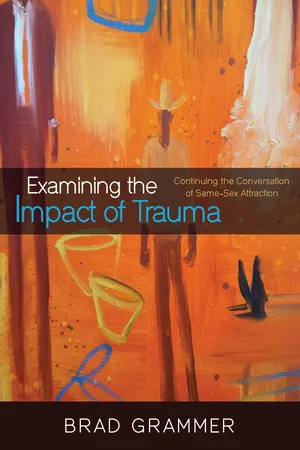
Examining the Impact of Trauma
Continuing the Conversation of Same-Sex Attraction
- 164 pages
- English
- ePUB (mobile friendly)
- Available on iOS & Android
eBook - ePub
About this book
Through twenty-five years of walking alongside those in conflict with their sexuality, Brad has come to understand what is at the heart of same-sex attraction: trauma. Little is understood about the concept of trauma and only recently has the method of trauma-informed care come to the forefront of helping others. People often react negatively to the concept of trauma being at the heart of any kind of gender identity or sexual confusion. Christians also struggle to understand and provide loving help to those who have sought to overcome attractions they do not desire. Believers need to be equipped with a deeper understanding of the foundations of same-sex attraction, whether they face these desires themselves or have loved ones for whom they care. An integral part of helping those with same-sex attraction is learning what we all have in common in experiences with trauma and our reactions to it. Brad draws from his own story, as well as his ministry experience, to add to the discussion in hopes of filling in the gaps that remain unfilled on the issue of same-sex attraction.
Information
Topic
Theologie & ReligionSubtopic
Christlicher Dienst1
First, My Own Story
I grew up in a Christian home. My parents were faithful Christians. They remained married until my mother died a couple of years ago, so I grew up in a family where my parents were both present. My mother and father were neither abusive nor were they addicted to alcohol or drugs. They remained faithful to one another and continually provided for my brothers and me. One element that was lacking in my family, however, was our inability to emotionally connect well with each other.
My father was emotionally very distant. Rarely did he spend time with my brothers and me. We rarely spoke to each other. When I checked with my brothers about what they remembered with regard to relationship with my father, they both stated that they pictured him sitting at the dinner table staring. Whenever he wanted something passed to him, he would point at it and grunt, meaning that we needed to pass the food to him. I can count on one hand the number of times my father spent time with me, just he and I.
One specific memory I have of my father was when I was six years old. My father was driving me to the grocery store because it was my birthday. Just he and I were in the car, and I believe I remember this memory because it was the first time I really felt a strong desire for him to speak to me. In addition, I wanted to talk to him but felt completely frozen. All the way to the store and back, not one word was exchanged between us. Understanding child development now, I know that silence always communicates a negative message to a child, whether the parent desires to do so or not. A child longs to be pursued and sought out, to be known and understood. Because my father did not practice these behaviors, I concluded he did not love me. I grew up feeling distant, unloved, and unaccepted.
Growing up in the church, I heard weekly of God’s love for me. Since I felt so unloved elsewhere, I was really drawn to Jesus.
During my school years, I enjoyed learning but did not connect well socially with boys my age. Often I would be called “sissy” and left out of games they would play at recess. From third grade on, I began to feel very lonely in school. Only when I went home would I feel safe and accepted by my mother.
When I was in seventh grade, my family moved from Illinois to Nebraska because my father took a new job. This move was very traumatic for me. The teasing I previously received at school progressed to abuse. Every day was a frightening experience for me. Most days I would cry myself to sleep and be sick to my stomach in the morning. I was not outgoing and did not make friends easily. From seventh to ninth grade, I ate lunch by myself at school every day.
Alfred Adler was a well-known Australian psychotherapist and founder of the school of individual psychology. In writing about Adlerian thought, Thomas Sweeney published a book discussing this form of counseling. He explains that Adlerians believe that children are usually excellent observers, but they are often poor evaluators and interpreters of their experiences.1
Throughout my childhood and adolescent years, I observed well. Boys who were good in sports were the ones who got acceptance and attention. Those who were aggressive and tough were safe from being ridiculed and harmed physically, and were affirmed for being tough. My conclusion was that if I was a real boy, I needed to be good at sports, aggressive, muscular, emotionally cold and distant. This was an inaccurate conclusion about masculinity, but, again, children are poor interpreters. From what I observed, I truly was not a male. My body said one thing but everyone else communicated that I was not a boy; and I took their counsel to heart.
All of this emotional turmoil caused me to question where God was and why no one else at church seemed to wonder about God’s abandoning them. No one else at church seemed to have problems because rarely did anyone share a problem. Perhaps there might be a prayer request about someone’s physical illness but there were no prayer requests for struggling with depression or sexual behavior outside of God’s plan.
By this point, the rejection I felt from my father and males at school consistently communicated to me that males were not safe and that I was not one of them. This also influenced how I felt about God. Since I saw him in a male image, I concluded that he was cold and distant as well. I became very depressed and despondent about my life. At times I was suicidal and wondered why I was here.
My sexual desires developed, as it does normally for teenagers, and I was frightened because my attractions were exclusively for men. Boys called me a “fag” in junior high and high school. I didn’t even know what the term fag meant until I looked it up in the dictionary. Hearing what they called me frightened me because I never told anyone that my attractions were toward males and yet they seemed to know. Feeling rejected and not feeling like I fit in caused me to question my gender identity. I never progressed to the point of calling myself homosexual, but my attractions were exclusively for the same sex. Calling myself “gay” would be like putting a nail in the coffin for me because I could never see myself being happy as a gay person. The way I was treated by males proved that I could not live a happy life.
In my second year of college I came to a crossroads. I made a bargain with God that if he didn’t change my life, I would kill myself. At that time, I spoke with the youth pastor of my church whom I trusted enough to be honest for the first time in my life. I met with him and shared how I felt about my life, how depressed I was, how rejected I felt, and all the guilt I felt about my sexual struggles. I was not courageous enough to say to whom my sexual attractions were directed but said my struggle was with masturbation. He shared with me that I did not have to be good enough for God, that the very reason I needed God was because I could never be good enough and that I needed Jesus to make me righteous before God. Ephesians 2:8–9 became very clear to me as this youth pastor spoke. This passage states, “For it is by grace you have been saved, through faith—and this not from yourselves, it is the gift of God—not by works, so that no one can boast” (NIV).
I went home and asked Christ into my life. I grew up Baptist and had been baptized as an eleven-year-old, but I had little understanding of what it meant to be saved.
After I asked Christ into my life, my life changed dramatically. I didn’t know the first thing to do, but God had a plan. The youth pastor I shared with left the church and someone else took his place. The new youth pastor was a young believer himself and had just graduated from college. We were acquainted with each other but I had no relationship with him.
He asked me one Sunday if he could disciple me. I was attracted to him so I said yes. My intentions were not pure, but little did I know how God would take my impure intentions and use them for good. This youth pastor was the first man who loved me in a godly, healthy way. Never had a man cared for me so well. He taught me how to read the Bible and pray with complete vulnerability with God. He would hug me and tell me he loved me. None of this was unhealthy. He never struggled with same-sex attractions. In fact, he was open about his struggle with lust for women. Healthy physical affection was part of his normal world but it was completely unfamiliar to me. I loved the affection and ate it up, feeling that it was one of the ways he affirmed me on a regular basis. He was the first of several men that God led into my life.
After following Christ for thirty years and growing spiritually, I can honestly say that I am completely free from same-sex attractions. When I state this, I’m not saying I have attractions and just don’t act upon them. I’m saying that I can look at men and no longer imagine them being naked or fantasize about having sex with them. My heart no longer pounds when I’m around an attractive man, wishing I could have him or be like him. I no longer feel like an outsider with men but firmly believe I am a man.
My relationships with the godly men God led in my life were the most significant aspect of healing in that part of my life. At the time I did not understand fully what I needed but God knew and provided men who knew how to love well and disciple me in my faith. Their love was essential in meeting my emotional needs that had been unmet for years. Looking back on my life, as well as reading others’ testimonies about coming out of homosexuality, I saw that God was healing the parts of my heart that were at the foundation of why I developed same-sex attractions in the first place.
As I grew spiritually in my church, I became very involved in ministry. I served as a youth intern for a year and led a Bible study for international students the following year. After I graduated from college, I spent a summer in Japan on a mission project with Campus Crusade for Christ (now called Cru). When I returned, I worked in a home for runaway teenagers and a boys’ group home. I’ve been an infant-toddler teacher and a preschool teacher as well. My undergraduate degree is in human development.
Once I knew that I wanted to work in full-time ministry, I decided to go to Moody Bible Institute in Chicago. I took one full year of courses and graduated with a certificate of biblical studies. My original plan was to go overseas and be a missionary, but God changed my path. I eventually became involved in full-time ministry with Breakthrough Urban Ministries in Chicago. Little did I know that God had a plan to use what was once broken in me—my sexuality—to help others who were struggling and desiring transformation in their own lives.
For six years I worked with men involved in prostitution on the streets of Chicago and went into gay bars, sharing the gospel of Jesus Christ. Starting out with Emmaus Ministries, our tactic was not to approach anyone in the bars but to simply be present and pray for opportunities to share the gospel. We also wanted to offer help to males seeking to get out of the world of prostitution, drugs, and homelessness.
After a couple years of doing street outreach, men in my church began telling me they had unwanted same-sex attractions and asking if I could help. Initially I began one-on-one discipleship with these men, but eventually so many men approached me that I started a couple of support groups for sexual strugglers. In addition, I was contacted by a chaplain who ministered in Cook County Jail. He was seeking someone to help him minister to men who professed a faith in Christ yet struggled with sexuality issues or had AIDS, and were looking for support. So I led a support group there during my time of ministry in Chicago.
While I was in ministry in Chicago, I met my wife, Laura, at the church I attended. We dated and got married in 1993. In 2015 we celebrated twenty-two years of marriage. During this time, we had two sons and I have had the privilege of watching firsthand what boys need in order to grow up and become healthy men. I was nervous about having boys, but God knew what he was doing when he blessed me with these two awesome sons. Even though I’ve been free from same-sex attractions, being married and being a parent has taught me a lot more about the maturation process of a believer. I have much to learn about what it means to love people, including my wife and sons. Constantly growing and learning is the norm for believers, not growing and then resting in the fact that you are complete.
My wife is originally from Indianapolis, so we would drive back and visit family in Indy. One time I sensed God leading us to minister in Indiana, and my wife stated that she had no intention of moving. So I struck a bargain with God that if this was his desire for us as a family, then he needed to make that clear to my wife and convince her. I didn’t bring the subject up again for six months but just prayed. After six months, my wife came to me and stated that she felt compelled to move to Indiana. I knew that God was calling us there.
We moved to Indiana in 1998, and for eight years, I was executive director of Hope & New Life Ministries in Indianapolis, Indiana. Through this ministry, I led support groups for Christian men and women seeking help with sexual addiction issues, predominantly unwanted same-sex attractions. In addition, I continued doing a lot of public speaking about homosexuality that I had begun in Chicago. Part of my ministry responsibility, I believed, was educating churches and ministries on the issue of sexual brokenness.
The pastor of the church where I was an elder approached me at one point, encouraging me to consider being a pastor. After much leading and prayer, God opened the door for me to pastor a small, Sunday evening church plant out of my home church. A normal Sunday evening service encompassed anywhere from forty to seventy regular attendees. About 40–50 percent of those coming were homeless, 10–20 percent were individuals struggling with same-sex attractions, 40–50 percent non-white, 50–70 percent single, and the rest of us a mix. Never had I been in such a diverse group of people in church. I used to tell friends or anyo...
Table of contents
- Acknowledgments
- Introduction
- Chapter 1: First, My Own Story
- Chapter 2: Traumas? What, Me?
- Chapter 3: Life Shouldn’t Be This Difficult!
- Chapter 4: The Born-Gay Myth
- Chapter 5: The Way Life Should Be
- Chapter 6: The Drive for Completion
- Chapter 7: The Mystery of Hate
- Chapter 8: The Church: The Bad and the Ugly
- Chapter 9: The Church: The Good News
- Chapter 10: Redemptive Suffering
- Chapter 11: How God Meets Us in Suffering
- Chapter 12: Be Not Afraid—Listening to an Angry Culture
- Chapter 13: Elevating the Conversation
- Chapter 14: Love Starts in the Family
- Chapter 15: The Journey Out
- Conclusion
- Further Reading on Same-Sex Attraction
- Bibliography
Trusted by 375,005 students
Access to over 1.5 million titles for a fair monthly price.
Study more efficiently using our study tools.
Frequently asked questions
Yes, you can cancel anytime from the Subscription tab in your account settings on the Perlego website. Your subscription will stay active until the end of your current billing period. Learn how to cancel your subscription
No, books cannot be downloaded as external files, such as PDFs, for use outside of Perlego. However, you can download books within the Perlego app for offline reading on mobile or tablet. Learn how to download books offline
Perlego offers two plans: Essential and Complete
- Essential is ideal for learners and professionals who enjoy exploring a wide range of subjects. Access the Essential Library with 800,000+ trusted titles and best-sellers across business, personal growth, and the humanities. Includes unlimited reading time and Standard Read Aloud voice.
- Complete: Perfect for advanced learners and researchers needing full, unrestricted access. Unlock 1.5M+ books across hundreds of subjects, including academic and specialized titles. The Complete Plan also includes advanced features like Premium Read Aloud and Research Assistant.
We are an online textbook subscription service, where you can get access to an entire online library for less than the price of a single book per month. With over 1.5 million books across 990+ topics, we’ve got you covered! Learn about our mission
Look out for the read-aloud symbol on your next book to see if you can listen to it. The read-aloud tool reads text aloud for you, highlighting the text as it is being read. You can pause it, speed it up and slow it down. Learn more about Read Aloud
Yes! You can use the Perlego app on both iOS and Android devices to read anytime, anywhere — even offline. Perfect for commutes or when you’re on the go.
Please note we cannot support devices running on iOS 13 and Android 7 or earlier. Learn more about using the app
Please note we cannot support devices running on iOS 13 and Android 7 or earlier. Learn more about using the app
Yes, you can access Examining the Impact of Trauma by Bradley D. Grammer in PDF and/or ePUB format, as well as other popular books in Theologie & Religion & Christlicher Dienst. We have over 1.5 million books available in our catalogue for you to explore.