eBook - ePub
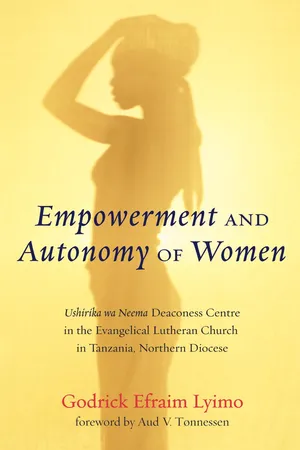
Empowerment and Autonomy of Women
Ushirika wa Neema Deaconess Centre in the Evangelical Lutheran Church in Tanzania, Northern Diocese
- 166 pages
- English
- ePUB (mobile friendly)
- Available on iOS & Android
eBook - ePub
Empowerment and Autonomy of Women
Ushirika wa Neema Deaconess Centre in the Evangelical Lutheran Church in Tanzania, Northern Diocese
About this book
The emancipation and empowerment of women has been a worldwide phenomenon of concern to many countries and organizations within the twentieth and twenty-first centuries. Although Tanzania, as a country, and the Evangelical Lutheran Church in Tanzania (ELCT) Northern Diocese, as an institution, have embraced the idea of gender equality, most women in Tanzania have yet to experience this in full.
This book is, therefore, based upon an understanding of the church as participating in God's mission, which is rooted in a context of equality and as such stands in a better position to empower women to overcome some of the patriarchal practices that have put them on the margin of attaining full humanity. Therefore, the book examines how Ushirika wa Neema Deaconess Centre contributes to the empowerment of women in the Evangelical Lutheran Church in Tanzania (ELCT) Northern Diocese and fosters gender awareness in the church and the entire community.
Ushirika wa Neema Deaconess Centre provides women with opportunities, such as the means for independent income, for education, for professional training, and for learning life skills. These opportunities change women's self-esteem, as well as raise their self-confidence and respect in the church and community.
Information
Topic
Theology & ReligionSubtopic
Christian Churchchapter 1
Introduction
Background and Motivation
The emancipation and empowerment of women has been a worldwide phenomenon of concern to many countries and organizations within the twentieth and twenty-first centuries. Although Tanzania as a country and the Evangelical Lutheran Church in Tanzania–Northern Diocese (ELCT-ND) as an institution have embraced the idea of gender equality, most women in Tanzania have yet to experience this in full. This book is, therefore, based upon an understanding of the church as participating in God’s mission which is rooted in a context of equality and as such stands in a better position to empower women to overcome some of the patriarchal practices that have put them on the margin of attaining full humanity. Therefore, the book will examine how ELCT-ND through Ushirika wa Neema Deaconess Centre empowers women and influences gender awareness in the church and society.
Women’s empowerment seeks to enable women to identify their potential and contribute to the life of church and society. Empowerment influences many changes in women’s lives, such as access to income, education and professional jobs, which increase their contribution and participation in the church and society. However, Tanzanian women, like many other women in the world, continue to struggle for economic, social, political and spiritual empowerment in order to get rid of oppressive patriarchal cultures. As Oduyoye1 argues, within many relationships in which African women engage, she is placed at a lower level due to the hierarchies of patriarchy. This accord with Fiorenza2 who argues that the status of women even in the churches which ordain women is still low compared to her male counterpart within an oppressive patriarchal structure. Therefore, women are often disempowered; thus, women’s empowerment is a vital tool to promote positive change in women’s lives.
The Diocese has put much effort addressing women’s concerns in the church and society. The empowerment of women has been an important topic in the ELCT-ND. The Diocese has declared its desire to participate in the global efforts that address women’s concerns and tackle sources of oppression and discrimination. This decision was made in the general assembly meeting of the ELCT in 2009, which affirmed the promotion of women’s empowerment in order to influence gender equality in the church and society. In line with this argument, Oduyoye3 argues that women’s empowerment is a vital aspect to foster mutual relationships because God created women and men equally human, made them stewards of creation and gave them authority to manage it jointly.
Ushirika wa Neema (UWN) Deaconess Centre is one among the institutions used by the Northern Diocese to promote women’s empowerment. It offers women opportunities to become deaconesses. They work among the women in the diocese. Therefore, this book seeks to investigate how Ushirika wa Neema Deaconess Centre contributes to the empowerment of women in the Diocese. In order to do this, I will study the work they do and discuss in what ways this contributes to the empowerment of women in the deaconess movement, as well as women who are assisted by them. The deaconess centre is historically new in the history of the ELCT-ND. I will therefore also examine the history of deaconess ministry in the diocese and especially look at the motivations behind it. Was the issue of empowerment part of the motivation? And I will identify and discuss challenges which face deaconesses in Chagga patriarchal society.
In 2010 I was invited to preach at Ushirika wa Neema deaconess chapel. After the sermon, the chaplain shared with me how both deaconesses are practicing diaconal services to the community as well as all the activities they are engaging in. He showed me some projects which are conducted by Ushirika wa Neema Deaconess Centre. These projects include domestic agriculture, animal keeping and the Montessori Kindergarten College. He further explained how women from different parishes visit the Centre in order to learn various life skills which improve their standard of living. Since then I developed an interest to learn how Ushirika wa Neema Deaconess Centre can contribute to the empowerment of women in the church and society. As Bryman states, “Academics conduct social research because there is development in society that provides an interest point of departure for the investigation of what is going on in the society.”4 I asked the chaplain to lend me a book on deaconess ministry in the Evangelical Lutheran Church in Tanzania—Northern Diocese so that I could learn more about their contribution to women’s empowerment. Unfortunately he had no book about the Ushirika wa Neema Deaconess Centre. I decided to go to the Christian Bookshop which is owned by deaconesses and look for any published book on the deaconess ministry in Evangelical Lutheran Church in Tanzania—Northern Diocese. I didn’t find any book on this theme. This motivated me to explore how Ushirika wa Neema can contribute to the empowerment of women in the Diocese and their history in order to document it and make it known to people in the church and community. It will be useful for both the current and the future generations to know the contribution of Ushirika wa Neema to the women’s empowerment as well as origin of the deaconess ministry in the Evangelical Lutheran Church in Tanzania—Northern Diocese.
Purpose and significance
The main purpose of this book is to investigate how Ushirika wa Neema Deaconess Centre contributes to the empowerment of women in the Evangelical Lutheran Church in Tanzania—Northern Diocese. In order to address this purpose, the book also explored the origin and formation of the deaconess ministry in the Evangelical Lutheran Church in Tanzania—Northern Diocese and analyzed the challenges which deaconesses at Ushirika wa Neema face in the Chagga patriarchal society. To reach that purpose I have developed the following objectives: First, to explore how the Ushirika wa Neema Deaconess Centre contributes to the empowerment of women in the Evangelical Lutheran Church in Tanzania –Northern Diocese. I am especially concerned with the work they perform and the way they engage in the local community in order to facilitate the empowerment of women within the movement as well as in the local community. Second, to examines the history of the deaconess ministry in the Evangelical Lutheran Church in Tanzania—Northern Diocese. Here I emphasize the motivations behind the establishment of the Ushirika wa Neema with regard to the issue of empowerment of women. The focus will be on how the issue of empowerment of women play a role in the establishment of the centre. Third, to examines the challenges which the deaconesses at Ushirika wa Neema face in the Chagga patriarchal society. Although the deaconess centre has been supported by the church, it is also clear that the work of the centre and the empowerment of women could be seen by some as being in conflict with cultural traditions and social practices in the Chagga society, especially with regard to the more patriarchal habits and attitudes.
This book is important because of the following: first, it explores the contribution of deaconesses to the empowerment of women in the church and society. This might be useful to church leaders, to promote women’s empowerment, because the Evangelical Lutheran Church in Tanzania declared in her conference in 2009 to address the issue of gender equality. Second, it raises more awareness for government leaders concerning gender issues as they also declared that gender is a sensitive issue for the development of Tanzania. This book will facilitate more promotion of women to education in secondary schools and colleges, an issue which the government has started implementing, compared to previous times where priority was given to boys only. Third, it contributes to new knowledge about the origin and formation of the deaconess ministry in the Evangelical Lutheran Church in Tanzania—Northern Diocese. Fourth, the book is intended to help the women themselves, the church, informants and the society to understand the contemporary empowerment of women and the rapid changes of gender relations in every state of human life. This book is valuable to the readers as well as the entire church to learn how women respond to their contemporary challenges in a patriarchal society, such as challenging oppressive structures in church and community. Also, they will study how education offered at Ushirika wa Neema may be a vital tool for awakening women conscietization and consciousness, which are the fundamental factors in influencing gender awareness and empowerment of women in the society and church.
Generally, the book strongly calls all church authorities and governmental leaders to promote the empowerment of women in Tanzania and the world at large. Specifically in rural areas, where patriarchal cultures are still active, there is a need to continue teaching people to accommodate women leaders into their social structure and change the cultural concept that women are not leaders but are just custodians of the family. They should be helped to recognize the potential contribution of women leaders in their society.
Theoretical Framework and Methodology
In order to accomplish the writing of this book, it was necessary to employ feminist theoretical perspectives. I found it useful to apply the so-called Third-Wave Feminism which is concerned with how women are empowered and enabled to have new self-understanding of their value and roles. They see themselves as independent. Third-Wave feminism is a feminist movement that began in the 1990s to the present. It involves economic, political, social, and personal empowerment of women. Also, it focuses more on the individual empowerment of women than on activism. It promotes women to build meaningful identities in the complex contemporary world. Therefore, I will use this theory to find out if the work of deaconesses at Ushirika wa Neema contributes to an increased independency of women, both those who work as deaconesses and those who are assisted by them. However, I look at it from different perspectives such as economical, social and family. More detail information and concepts of so-called Third-Wave Feminism and the empowerment theories are discussed in chapter five.
Since little is written about the history of Ushirika wa Neema and there are few written sources that explain the work and motivation of the centre, I have chosen a qualitative research method based on interviews. This gave me the opportunity to learn both what the deaconesses do and how their work is understood by people involved in it and close observers of it.
The study employed the qualitative research strategy because the goal of qualitative research is to understand a particular social situation, event, role, group or interaction. In line with this argument, Marshal5 affirms that qualitative research fosters engagement in everyday life between researcher and respondents. The researcher interacts with respondents and acquires significant information.
The data obtained from the field is not usually expressed in numerical terms. This does not mean that numerical figures are never used in this study, but most of the data is qualitative. That is to say, most of the analysis is done by description or word.6 On the other hand, Creswell po...
Table of contents
- Title Page
- Foreword
- Preface
- Acknowledgments
- Abbreviations
- Chapter 1: Introduction
- Chapter 2: Women and Gender Issues
- Chapter 3: Understanding the Context
- Chapter 4: History of Ushirika wa Neema Deaconess Ministry
- Chapter 5: Third-Wave Feminism and Empowerment Theories
- Chapter 6: The Empowerment of Women by Ushirika wa Neema Deaconess Centre
- Chapter 7: Summary, Conclusion, and Recommendations
- Appendix 1: History of the Evangelical Lutheran Church in Tanzania
- Appendix 2: Testimony of the First Missionaries at Ushirika wa Neema
- Bibliography
Trusted by 375,005 students
Access to over 1.5 million titles for a fair monthly price.
Study more efficiently using our study tools.
Frequently asked questions
Yes, you can cancel anytime from the Subscription tab in your account settings on the Perlego website. Your subscription will stay active until the end of your current billing period. Learn how to cancel your subscription
No, books cannot be downloaded as external files, such as PDFs, for use outside of Perlego. However, you can download books within the Perlego app for offline reading on mobile or tablet. Learn how to download books offline
Perlego offers two plans: Essential and Complete
- Essential is ideal for learners and professionals who enjoy exploring a wide range of subjects. Access the Essential Library with 800,000+ trusted titles and best-sellers across business, personal growth, and the humanities. Includes unlimited reading time and Standard Read Aloud voice.
- Complete: Perfect for advanced learners and researchers needing full, unrestricted access. Unlock 1.5M+ books across hundreds of subjects, including academic and specialized titles. The Complete Plan also includes advanced features like Premium Read Aloud and Research Assistant.
We are an online textbook subscription service, where you can get access to an entire online library for less than the price of a single book per month. With over 1.5 million books across 990+ topics, we’ve got you covered! Learn about our mission
Look out for the read-aloud symbol on your next book to see if you can listen to it. The read-aloud tool reads text aloud for you, highlighting the text as it is being read. You can pause it, speed it up and slow it down. Learn more about Read Aloud
Yes! You can use the Perlego app on both iOS and Android devices to read anytime, anywhere — even offline. Perfect for commutes or when you’re on the go.
Please note we cannot support devices running on iOS 13 and Android 7 or earlier. Learn more about using the app
Please note we cannot support devices running on iOS 13 and Android 7 or earlier. Learn more about using the app
Yes, you can access Empowerment and Autonomy of Women by Godrick Efraim Lyimo in PDF and/or ePUB format, as well as other popular books in Theology & Religion & Christian Church. We have over 1.5 million books available in our catalogue for you to explore.