eBook - ePub
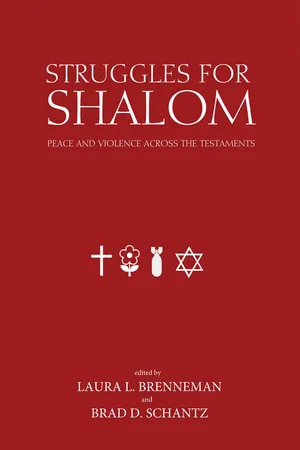
Struggles for Shalom
Peace and Violence across the Testaments
- 400 pages
- English
- ePUB (mobile friendly)
- Available on iOS & Android
eBook - ePub
Struggles for Shalom
Peace and Violence across the Testaments
About this book
Struggles for Shalom is a collection of essays by biblical scholars about peace, justice, and violence in ancient Jewish and Christian texts, written to honor the life work of Mennonite scholars Perry B. Yoder and Willard M. Swartley. In this volume, twenty-three authors--colleagues, former students, friends, and others influenced by Yoder's and Swartley's scholarship--add to the honorees' work in appreciation for their shared focus on biblical texts' lessons of peace. Specific texts and topics include Eccl 3:1-9 and time for war, Ezek 14:12-23 and God's retribution, Luke 22:31-61 and Peter's sword, the temple cleansing episodes in John 2 and Mark 11, sectarianism and violence in manuscripts from the Dead Sea, violence in creation in the Hebrew Bible, Chronicles as utopian literature, peace and violence in Paul's writings, and globalization in biblical studies. This collection is diverse and ambitious. For church and academy, and for anyone curious about what Scripture has to say about peace and violence, this book delivers focused study of peace and violence across the Testaments.
Contributors:
Wilma Ann Bailey
Jo-Ann A. Brant
Laura L. Brenneman
Jacob W. Elias
Reta Halteman Finger
Michael J. Gorman
Nancy R. Heisey
Paul Keim
Christopher Marshall
Safwat Marzouk
Douglas B. Miller
Ben C. Ollenburger
Dorothy M. Peters
David Rensberger
Andrea Dalton Saner
Brad D. Schantz
Mary H. Schertz
Steven Schweitzer
Willard M. Swartley
Jackie Wyse-Rhodes
Joshua Yoder
Perry B. Yoder
Thomas R. Yoder Neufeld
Paul Yokota
Gordon Zerbe
Information
1
Peace and Violence across the Testaments
Is violence the antonym of peace, as implied by the title of this book? I remember my former professor, Willard Swartley, posing this question. It is one to which he and I both return in this volume. Indeed, it is appropriate to recall it here, as this book honors two scholars, Swartley and Perry Yoder, who have thought about this question, among many others, in the study of peace and Scripture. Grateful for their work, I and the other contributors to this volume vigorously interact—and sometimes disagree—with their proposals. We are, after all, biblical scholars, that often irksome breed who delight in the contours of Scripture, rough and smooth. As an introduction to the present collection, I briefly consider meanings of peace and violence, propose the importance of a peace hermeneutic in biblical study, and preview the essays.
Dimensions of Peace and Violence
What are peace and violence, and how are we using these terms here? The authors in this book use these words in different ways. However, most of them use peace to signify a fullness of something rather than an absence of violence. The “absence definition” is how people typically think of peace. The critique of this view is that it is rather insubstantial and does not promote creative thinking about how to make positive change. Through research and experience in areas of conflict, peace practitioners demonstrate that lasting peace is most clearly indicated by the presence of justice in society. So peace can be described in two ways, as positive peace and negative peace.1 Negative peace—what the absence definition points to—is the lack of violence or its threat. Positive peace is an environment where resources for health, personal and community development, and happiness are commonly available (i.e., a condition of human flourishing). I believe that theologians and biblical scholars can benefit from knowing more about the conceptual models of peace that conflict transformation and resolution practitioners are developing.2
In his 1987 book, Perry Yoder notes that his experience in the Philippines shaped a new perspective. His project about shalom, started before he lived in the Philippines, changed as he was confronted with questions about what peace means in contexts of poverty and oppression. Very generally, Yoder characterizes peace as “a goal for which we should strive.”3 In claiming that peace has a wider meaning than lack of violence, Yoder describes discomfort with the “middle-class luxury”4 of seeing peace narrowly, as “the avoidance, personally or corporately, of doing physical violence,”5 which may allow people to believe that they are not involved in global violence. Yoder’s critique sharpens: “We have become too involved with criticizing violence and not involved with peacemaking—working to transform the present structure of injustice and violence into structures of peace and equity.”6 Yoder’s Shalom book grew out of his experience of listening to suffering people. His reading of the Bible was sensitized by their perspectives, and they influenced his conclusion that shalom as portrayed in the Bible is “active, it is struggle to bring about social, structural transformation. There should be no compromise with the evils of oppression and exploitation which impoverish, make helpless, and destroy human beings.”7
Swartley’s work shows basic agreement with Yoder’s, particularly in his robust definition of peace;8 however, his critique is not so pointedly against violence within social structures as it is concerned with the insidious quality of evil. With Scripture as his reference point, Swartley demonstrates that violent language often depicts the gospel of peace’s confrontation with and destruction of evil. This gives peace its fullness of definition; it is the active campaign waged against all that opposes God. The NT witness is that “Jesus comes to render evil powerless over human life”;9 indeed, his resurrection is proof of this victory.10
Violence, like peace, has various dimensions, and appeal to peace research provides definitional clarity. In its most common usage, violence refers to direct (or overt) destructive actions, from a punch to verbal abuse to acts of warfare. The broader terminology of structural violence, however, refers to the often invisible systems that hinder human flourishing. In theological terms, structural violence is everything that works against God’s intended shalom for the world.11 It is invisible to the extent that economic, legal, political, social, and cultural systems and patterns are unquestioned. But it is not invisible to all people, as those who are poor and in nondominant social groups are aware.
For Galtung, violence can be intended, unintended, manifest, and latent. Each of these types of violence can be personal and structural in nature; further, personal and structural violence can have physical and psychological aspects, which are perpetuated with objects or without objects.12 There is also a correlation between peace and violence: When there is an absence of direct violence, there is the presence of negative peace. When there is no structural violence (or social injustice), there is positive peace.13 Following this reasoning, in order to understand peace well, we must understand violence (and vice versa). I believe Perry Yoder’s contribution is to make this point as a biblical scholar, growing from his study of Scripture with sensitivity to the experience of those daily experiencing structural violence.
One final “take” on violence can further situate Swartley’s work in this conversation. Robert W. Brimlow, in a rigorous meditation on just war, describes violence as “the expression of the arrogance of selfhood,” acting as if “I were alone to act upon the universe [and thus as if] I have the power of God and I am God. That is the sin of violence.”14 This description of sin (which he also terms “evil”) captures the sense of revolt against God’s will that is Swartley’s antonym for peace in the Bible. Brimlow, a philosopher, posits violence as the ultimate rebellion against God. It is putting oneself and one’s desires ahead of all others and in the place of God. If one accepts Brimlow’s articulation, it is easy to see how evil (rebellion against God) and violence (exercising the power to act as if only I matter) are intimately connected. As the common refrain of biblical wisdom literature expresses it, the fool is the one who oppresses others and acts as if there is no God;15 the wise one ascertains the pattern of God’s will and the shalom justice therein.
The Case for a Peace Hermeneutic
So—according to this logic—to read Scripture wisely is to discern the pattern of God’s shalom justice. This, I contend, has been the consistent goal of Swartley’s and Yoder’s work and is the aim of the current project.
In a recent book, David Neville calls for a hermeneutic of shalom to accompany the church’s interpretive rules of faith and love in order to achieve “theological-moral . . . interpretive adjudication” in cases of ambiguity in biblical texts.16 This preference is justified, says Neville after a thorough examination of the Gospels, Acts, and Revelation, because “shalom has intrabiblical theological sanction and, from the perspective of human flourishing, has more intrinsic moral meaning than violence ever could.”17
With Neville, I believe that biblical texts (not only those of the NT) offer ample support for taking a peace hermeneutic as a theological-moral adjudicating lens. The essays in this volume attest to this, as do the collection of works by the honorees and by other contributors to these pages.18 However, I will push a bit further. I think that those of us in the academy and in churches who have a peace hermeneutic occupy a particular socia...
Table of contents
- Title Page
- Series Preface
- Foreword
- Acknowledgments
- Abbreviations
- Chapter 1: Peace and Violence across the Testaments
- Part One: Peace and Violence in the Hebrew Bible
- Part Two: Peace and Violence in the New Testament
- Bibliography
- Contributors
Trusted by 375,005 students
Access to over 1.5 million titles for a fair monthly price.
Study more efficiently using our study tools.
Frequently asked questions
Yes, you can cancel anytime from the Subscription tab in your account settings on the Perlego website. Your subscription will stay active until the end of your current billing period. Learn how to cancel your subscription
No, books cannot be downloaded as external files, such as PDFs, for use outside of Perlego. However, you can download books within the Perlego app for offline reading on mobile or tablet. Learn how to download books offline
Perlego offers two plans: Essential and Complete
- Essential is ideal for learners and professionals who enjoy exploring a wide range of subjects. Access the Essential Library with 800,000+ trusted titles and best-sellers across business, personal growth, and the humanities. Includes unlimited reading time and Standard Read Aloud voice.
- Complete: Perfect for advanced learners and researchers needing full, unrestricted access. Unlock 1.5M+ books across hundreds of subjects, including academic and specialized titles. The Complete Plan also includes advanced features like Premium Read Aloud and Research Assistant.
We are an online textbook subscription service, where you can get access to an entire online library for less than the price of a single book per month. With over 1.5 million books across 990+ topics, we’ve got you covered! Learn about our mission
Look out for the read-aloud symbol on your next book to see if you can listen to it. The read-aloud tool reads text aloud for you, highlighting the text as it is being read. You can pause it, speed it up and slow it down. Learn more about Read Aloud
Yes! You can use the Perlego app on both iOS and Android devices to read anytime, anywhere — even offline. Perfect for commutes or when you’re on the go.
Please note we cannot support devices running on iOS 13 and Android 7 or earlier. Learn more about using the app
Please note we cannot support devices running on iOS 13 and Android 7 or earlier. Learn more about using the app
Yes, you can access Struggles for Shalom by Laura Brenneman,Brad D. Schantz, Brenneman, Schantz in PDF and/or ePUB format, as well as other popular books in Theology & Religion & Biblical Criticism & Interpretation. We have over 1.5 million books available in our catalogue for you to explore.