eBook - ePub
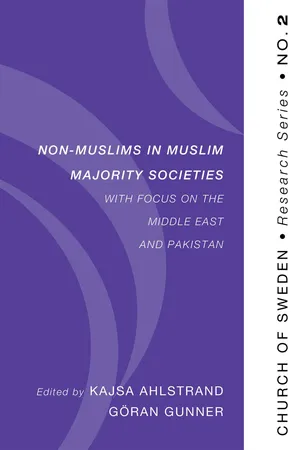
Non-Muslims in Muslim Majority Societies - With Focus on the Middle East and Pakistan
- 174 pages
- English
- ePUB (mobile friendly)
- Available on iOS & Android
eBook - ePub
Non-Muslims in Muslim Majority Societies - With Focus on the Middle East and Pakistan
About this book
In a world where almost all societies are multi-religious and multi-ethnic, we need to study how social cohesion can be achieved in different contexts. In some geographical areas, as in the Middle East and the Indian subcontinent, people of different religious belonging have, through the ages, lived side by side, sometimes in harmony and sometimes in dissonance. In other geographical regions, as in Scandinavia, societies have been quite religiously homogeneous but only recently challenged by immigration. The implication in both locations is that the relation between religious minority and majority is on the agenda.
In order to discuss the situation for Non-Muslims in Muslim majority societies, a consultation was convened with both Muslim and Christian participants from Pakistan, Palestine, Lebanon, and Sweden. Some of the participants work in academic settings, others in faith based organizations, some in jurisprudence and others with theological issues. This book is the result of that consultation; the articles are "works in progress," and they remain tentative. The intention with this anthology is to trigger reflection and further thinking. It presents articles that discuss issues such as freedom of religion, minority rights, secular and religious legislation, and inter-religious dialogue in Muslim majority societies.
Contributors: Kajsa Ahlstrand, Goran Gunner, Mustafa Abu Sway, Johan Garde, Yasmin Haider, Jan Hjarpe, M. Aslam Khaki, Bernard Sabella, Mehboob Sada, Guirguis Ibrahim Saleh, and Ahmad Salim
This book is the second volume in Church of Sweden Research Series.
Information
Subtopic
Église chrétienne1
The Status of Christians in the Islamic Worldview
Mustafa Abu Sway
To understand the relationship between Islam and Christianity, and why Islam accommodates Christians despite serious theological differences, there is a need to explore the Qur’an and the Sunnah (i.e., whatever Prophet Muhammad, peace be upon him, has done, declared or approved as part of Islam), the primary two textual sources that form the Islamic worldview. It should be mentioned that in many theological and juridical cases the status of Christians is identical with that of the Jews.
Islam forms at once a continuum of the history of revelation and its culminating phase. Being the final revelation, it is entrusted with guarding the message of pure monotheism. This prototype religion that stresses the oneness of God was revealed to every single prophet or messenger. Despite unbridgeable post-revelational Jewish and Christian theological constructs, it is imperative for a Muslim to believe in their original revealed books [i.e., the Torah, the Zabur (Psalms) and the Injil (Gospel, in the singular)] and in their prophets including Moses and Jesus, peace be upon them. This is why Islamic theology and law (i.e., Shari’ah) accord a special status for Jews and Christians and refer to them in the Qur’an as “People of the Book.”
In a tradition narrated in Sahih Muslim, Prophet Muhammad reflected on his relationship with the other prophets using inclusive language, saying:
My likeness among the prophets is as a man who built a house skillfully and beautifully, yet he left one place without a brick in one of the corners. People who saw [the house] were fascinated. Yet, they would exclaim why this brick is not in its place? He [the Prophet] said: I am that brick; I am the Seal of the Prophets.1
Islam also confirms the divine source of the different laws that were revealed to previous prophets and peoples:
And We have revealed to you the Book with the truth, verifying what is before it of the Book and a guardian over it, therefore judge between them by what Allah has revealed, and do not follow their low desires [to turn away] from the truth that has come to you; for every one of you did We appoint a law and a way, and if Allah had pleased He would have made you [all] a single people, but that He might try you in what He gave you, therefore strive with one another to hasten to virtuous deeds; to Allah is your return, of all [of you], so He will let you know that in which you differed.2
There are ample verses and traditions that reflect the same inclusive and pluralistic ethos that was manifested historically at one point in the millet-system during the Ottoman Caliphate. This historical development permitted Jews and Christians to organize themselves and lead autonomous religious and communal life within the Islamic State. Today, Christians continue to have their own court system dealing with family laws in many parts of the Muslim world.
Mary and Jesus
There are numerous chapters in the Qur’an that mention Jesus Christ’s story including chapter 19 which is named after his mother Mary (Arabic, Maryam), peace be upon her. She is the only woman to be mentioned by name in the Qur’an, which shows that she is highly esteemed in the Islamic worldview as in the following verse:
And when the angels said: O Mary! surely Allah has chosen you and purified you and chosen you above the women of the world.3
Jesus Christ himself is considered the word of God, to have performed miracles by leave of God and to have been rendered support by the spirit of the holy:
We have made some of these messengers to excel the others among them are they to whom Allah spoke, and some of them He exalted by [many degrees of] rank; and We gave clear miracles to Jesus son of Mary, and strengthened him with the holy spirit. And if Allah had pleased, those after them would not have fought one with another after clear arguments had come to them, but they disagreed; so there were some of them who believed and others who denied; and if Allah had pleased they would not have fought one with another, but Allah brings about what He intends.4
In addition, the following verse reflects how the Qur’an describes the nature of the Gospel using beautiful words:
And We caused Jesus son of Mary, to follow in their footsteps, confirming that which was [revealed] before him in the Torah, and We bestowed on him the Gospel wherein is guidance and a light, confirming that which was [revealed] before it in the Torah—a guidance and an admonition unto those who ward off [evil].5
There is tremendous love and respect for Mary and Jesus in the Islamic worldview and the hearts and minds of Muslims. This, however, is never translated into divinization, something the Qur’an repeatedly and completely rejects:
And when Allah will say: O Jesus son of Mary! did you say to men, Take me and my mother for two gods besides Allah he will say: Glory be to Thee, it did not befit me that I should say what I had no right to (say); if I had said it, Thou wouldst indeed have known it; Thou knowest what is in my mind, and I do not know what is in Thy mind, surely Thou art the great Knower of the unseen things.6
Non-Believers
The Qur’an recognizes as true believers those who believe in the oneness of God, without associating anything or anyone with Him, for “there is nothing whatever like unto Him.”7 None of His creation has divine nature. Therefore, angels and human beings, including all messengers, are devoid of any divine attributes. They are His servants, nothing more. The Qur’an responds to claims of Jesus’ divinity, because he had no father, by reminding people of the example of Adam who neither had a father nor a mother, but yet without divinization. From a Qur’anic perspective, it is all about God’s Omnipotence.
This is why in Islamic Shari’ah, despite the convivencia paradigm that Islam advocates in relation to the People of the Book, the Qur’an categorizes as disbelief several Christian theological constructs as in the following verses:
They indeed have disbelieved who say: Lo! Allah is the Messiah, son of Mary. Say: Who then can do aught against Allah, if He had willed to destroy the Messiah son of Mary, and his mother and everyone on earth? Allah’s is the Sovereignty of the heavens and the earth and all that is between them. He createth what He will. And Allah is Able to do all things.8
Certainly they disbelieve who say: Surely Allah is the third [person] of the three; and there is no god but the one Allah, and if they desist not from what they say, a painful chastisement shall befall those among them who disbelieve.9
And the Jews say...
Table of contents
- Title Page
- Contributors
- Introduction
- Chapter 1: The Status of Christians in the Islamic Worldview
- Chapter 2: The Problem of Jurisdiction in the Contemporary Nation-State
- Chapter 3: The Use of the Concept Minority
- Chapter 4: Non-Muslim in Middle Eastern Muslim Societies
- Chapter 5: Faith Based Organizations and the Configuration of Civil Society in the MENA-perspective
- Chapter 6: The Status of Non-Muslims in a Palestinian State
- Chapter 7: Managing Christian-Muslim Relations in Pakistani Setting
- Chapter 8: Non-Muslim Women in Pakistan
- Chapter 9: Islamization of Laws in Pakistan and its Effect on Minorities
- Chapter 10: Non-Muslims in an Islamic State
- Chapter 11: Possible Strategies for Religious Communities under Threat1
- Bibliography
Trusted by 375,005 students
Access to over 1.5 million titles for a fair monthly price.
Study more efficiently using our study tools.
Frequently asked questions
Yes, you can cancel anytime from the Subscription tab in your account settings on the Perlego website. Your subscription will stay active until the end of your current billing period. Learn how to cancel your subscription
No, books cannot be downloaded as external files, such as PDFs, for use outside of Perlego. However, you can download books within the Perlego app for offline reading on mobile or tablet. Learn how to download books offline
Perlego offers two plans: Essential and Complete
- Essential is ideal for learners and professionals who enjoy exploring a wide range of subjects. Access the Essential Library with 800,000+ trusted titles and best-sellers across business, personal growth, and the humanities. Includes unlimited reading time and Standard Read Aloud voice.
- Complete: Perfect for advanced learners and researchers needing full, unrestricted access. Unlock 1.5M+ books across hundreds of subjects, including academic and specialized titles. The Complete Plan also includes advanced features like Premium Read Aloud and Research Assistant.
We are an online textbook subscription service, where you can get access to an entire online library for less than the price of a single book per month. With over 1.5 million books across 990+ topics, we’ve got you covered! Learn about our mission
Look out for the read-aloud symbol on your next book to see if you can listen to it. The read-aloud tool reads text aloud for you, highlighting the text as it is being read. You can pause it, speed it up and slow it down. Learn more about Read Aloud
Yes! You can use the Perlego app on both iOS and Android devices to read anytime, anywhere — even offline. Perfect for commutes or when you’re on the go.
Please note we cannot support devices running on iOS 13 and Android 7 or earlier. Learn more about using the app
Please note we cannot support devices running on iOS 13 and Android 7 or earlier. Learn more about using the app
Yes, you can access Non-Muslims in Muslim Majority Societies - With Focus on the Middle East and Pakistan by Kajsa Ahlstrand,Göran Gunner, Ahlstrand, Gunner in PDF and/or ePUB format, as well as other popular books in Théologie et religion & Église chrétienne. We have over 1.5 million books available in our catalogue for you to explore.