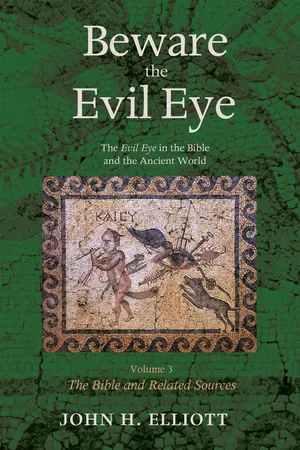
eBook - ePub
Beware the Evil Eye Volume 3
The Evil Eye in the Bible and the Ancient World—The Bible and Related Sources
- 378 pages
- English
- ePUB (mobile friendly)
- Available on iOS & Android
eBook - ePub
Beware the Evil Eye Volume 3
The Evil Eye in the Bible and the Ancient World—The Bible and Related Sources
About this book
The Evil Eye is mentioned repeatedly throughout the Old Testament, Israel's parabiblical writings, and New Testament, with a variety of terms and expressions. The Old Testament (Greek Septuagint) contains no less than fourteen text segments involving some twenty explicit references to the Evil Eye (Deut 15:9; 28:54, 56; Prov 23:6; 28:22; Tob 4:7, 16; Sir 14:3, 6, 8, 9, 10; 18:18; 31:13; 37:11; Wis 4:12; 4 Macc 1:26; 2:15; Ep Jer 69/70). At least three further texts are also likely implied references to an Evil Eye (1 Sam 2:29, 32; 18:9), with some other texts as more distant possibilities. The Evil Eye is mentioned also in the Old Testament Pseudepigrapha, the Dead Sea Scrolls, and the writings of Philo and Josephus--all of which are discussed in the following pages.
Evil Eye belief and practice continued in the early Jesus movement. Jesus mentions the Evil Eye on more than one occasion (Matt 6:22-23; Luke 11:33-36; Mark 7:22). Paul makes explicit and implicit mention of the Evil Eye in his letter to the Galatians (3:1; 4:12-20). Possible implicit references to the Evil Eye are also examined. Both the common and the distinctive features of biblical Evil Eye belief are identified, along with its operation on multiple levels (biological/physiological, psychological, economic, social, and moral) and its serving a variety of purposes.
The numerous references to the Evil Eye in Israel's rabbinic writings and those of postbiblical Christianity (second-sixth centuries CE), together with the material evidence from this period, are examined in volume 4.
Trusted by 375,005 students
Access to over 1.5 million titles for a fair monthly price.
Study more efficiently using our study tools.
Information
Topic
Theology & ReligionSubtopic
Biblical Studies1
The Old Testament, Parabiblical Literature, and Related Material Evidence Concerning the Evil Eye
Introduction
The Evil Eye was known, feared, and denounced in Israel and was mentioned often in its scriptures and parabiblical writings. Features of the belief and its accompanying practices in Israel and the Jesus movement are strikingly similar to those of other cultures of the Circum-Mediterranean world. Preceding volumes of Beware the Evil Eye have presented in detail evidence of Evil Eye belief and practice in Mesopotamia and Egypt (Vol. 1) and Greece and Rome (Vol. 2). This material describes the Mediterranean and Near Eastern matrix within which the biblical evidence of Evil Eye belief is properly understood—the focus of the present volume.1 Israel and the Jesus movement, as will be shown, shared many aspects of Evil Eye belief and practice of their neighbors, albeit with distinctive emphases and differences to be discussed in due course.
The Evil Eye is mentioned repeatedly throughout the Old Testament, Israel’s parabiblical writings, and New Testament, with a variety of terms and expressions. The Old Testament (Greek Septuagint) contains no less than fourteen text segments involving some twenty explicit references to the Evil Eye (Deut 15:9; 28:54, 56; Prov 23:6; 28:22; Tob 4:7, 16; Sir 14:3, 6, 8, 9, 10; 18:18; 31:13; 37:11; Wis 4:12; 4 Macc 1:26; 2:15; Ep Jer 69/70). This last text, the Epistle of Jeremiah 69/70, is the sole explicit biblical mention of an amulet specifically aimed at countering the Evil Eye (prosbaskanion, an anti-Evil Eye safeguard positioned in a cucumber patch). At least three further texts are also likely implied references to an Evil Eye (1 Sam 2:29, 32; and 18:9), with some other texts as more distant possibilities.2 The Evil Eye is mentioned also in the Old Testament Pseudepigrapha, the Dead Sea Scrolls, and the writings of Philo and Josephus—all of which are discussed below.3 The numerous references to the Evil Eye in Israel’s rabbinic writings (second–sixth centuries CE) and the material evidence from this period are examined in Vol. 4, chap. 1. Evil Eye belief and practice in the Jesus movement is examined in chapter 2 of this present volume; evidence of the belief in post-biblical Christianity through Late Antiquity is treated in Vol. 4, chap. 2.
The Matrix of Biblical Evil Eye Belief and Behavior
To understand the biblical Evil Eye texts, it is essential to be aware of the physical, economic, social, and cultural environment in which Evil Eye belief and practice has been found to emerge and flourish. Beliefs and practices are products of, and responses to, the circumstances and conditions in which they emerge. The biblical communities of ancient Israel and early Christianity were among those cultures where Evil Eye belief originated and flourished, according to historical anthropologists. This includes Mesopotamia, Egypt, the ancient Near East, Greece and Rome, and the lands bordering on the coast of the Mediterranean Sea. The ecological conditions, economic and social circumstances, and cultural world of the Israelites, in general terms, were similar to those of their neighbors in many respects and were equally conducive to Evil Eye belief and practice.
The cultures of these areas, as characterized by anthropologists Vivian Garrison and C. M. Arensberg,4 involve not only systems of writing and literary production, but also “complex stratified societies possessed of both milk animals (or nomadic herding populations) and grain fields (or stable peasant agricultural communities).”5 The “symbiosis of part-cultures (landlord, bureaucrat, agriculturalist, herder, artisan) . . . the destructive effect of the nomadic herders upon settled village and state societies,” and “the periodic redistribution of peasant fields typical of these societies created an environment of constant tension and conflict, suspicion and uncertainty.”6 The concept of an Evil Eye was a symptom of these conditions, tensions, and uncertainties: a ...
Table of contents
- Illustrations
- Preface
- Acknowledgments
- Abbreviations
- Chapter 1: The Old Testament, Parabiblical Literature, and Related Material Evidence Concerning the Evil Eye
- Chapter 2: The New Testament Concerning the Evil Eye
- Bibliography
Frequently asked questions
Yes, you can cancel anytime from the Subscription tab in your account settings on the Perlego website. Your subscription will stay active until the end of your current billing period. Learn how to cancel your subscription
No, books cannot be downloaded as external files, such as PDFs, for use outside of Perlego. However, you can download books within the Perlego app for offline reading on mobile or tablet. Learn how to download books offline
Perlego offers two plans: Essential and Complete
- Essential is ideal for learners and professionals who enjoy exploring a wide range of subjects. Access the Essential Library with 800,000+ trusted titles and best-sellers across business, personal growth, and the humanities. Includes unlimited reading time and Standard Read Aloud voice.
- Complete: Perfect for advanced learners and researchers needing full, unrestricted access. Unlock 1.5M+ books across hundreds of subjects, including academic and specialized titles. The Complete Plan also includes advanced features like Premium Read Aloud and Research Assistant.
We are an online textbook subscription service, where you can get access to an entire online library for less than the price of a single book per month. With over 1.5 million books across 990+ topics, we’ve got you covered! Learn about our mission
Look out for the read-aloud symbol on your next book to see if you can listen to it. The read-aloud tool reads text aloud for you, highlighting the text as it is being read. You can pause it, speed it up and slow it down. Learn more about Read Aloud
Yes! You can use the Perlego app on both iOS and Android devices to read anytime, anywhere — even offline. Perfect for commutes or when you’re on the go.
Please note we cannot support devices running on iOS 13 and Android 7 or earlier. Learn more about using the app
Please note we cannot support devices running on iOS 13 and Android 7 or earlier. Learn more about using the app
Yes, you can access Beware the Evil Eye Volume 3 by John H. Elliott in PDF and/or ePUB format, as well as other popular books in Theology & Religion & Biblical Studies. We have over 1.5 million books available in our catalogue for you to explore.