eBook - ePub
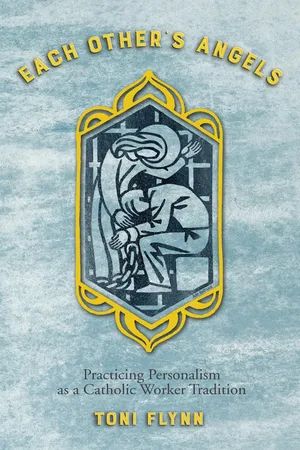
Each Other's Angels
Practicing Personalism as a Catholic Worker Tradition
- 158 pages
- English
- ePUB (mobile friendly)
- Available on iOS & Android
eBook - ePub
Each Other's Angels
Practicing Personalism as a Catholic Worker Tradition
About this book
Each Other's Angels: Practicing Personalism in the Catholic Worker Tradition introduces readers to author Toni Flynn's vision of justice and compassion, informed by the Scriptures and inspired by the Catholic Worker Movement of Dorothy Day and Peter Maurin.
Part memoir and part tribute to various people she encountered on the margins of society, this book shows readers how seemingly insignificant and ineffectual efforts to be an angel to others can turn out to be signs of God's grace.
Following Jesus, going to places of cultural darkness and brokenness, Toni inevitably takes us through troubling and troublesome terrain--the desert, homeless encampments, jails and prisons, and seedy hotels.
As you will see, Toni fearlessly exposes her flaws while forging a conduit of compassion that connects her to the wounded human condition and allows her--and her readers--to hope for a better world where everyone is tended to and appreciated.
Information
Topic
Theology & ReligionSubtopic
Christian TheologyPart I
Overviews
Come Follow Me
A Catholic Worker Introduction
For those of you who are wondering, the Catholic Worker is not an enterprise, not an organization, not a program, not a project. Like the sea, the wind, a Tango dancer, wild geese in flight, it is—in essence—a movement.
The aim of the Catholic Worker is to live in accordance with the justice and love of Christ. The sources of inspiration are the Hebrew and Greek Scriptures as handed down from the Catholic Church, and stories—recorded and retold—about the lives of the saints.
The Catholic Worker Movement began simply enough on May 1, 1933, in New York City, when a young Catholic convert (formerly a Bohemian journalist influenced by communistic ideals) named Dorothy Day teamed up with a French philosopher (a brilliant man in constant need of a bath!) named Peter Maurin to publish a newspaper called—you guessed it—The Catholic Worker.
The newspaper raised issues (and still does to this day) related to the scriptural promises of justice and mercy, the call to love the least of these (meaning Christ in the guise of the poor and marginalized), and the necessity of journalistic integrity in opposing the greed, oppression, and violence that haunts societies at home and abroad.
Before long, Dorothy was attracting volunteers and opening up a ‘House of Hospitality’ in New York City where the poor could come in from the streets, share meals, and feel welcome. She further dedicated herself to prayer, daily Mass, Benedictine spirituality and to an occasional arrest and jail term for non–violently resisting war and social injustice, the effects of which she saw as the exact opposite of love.
None of this was easy. “There are always answers”, Dorothy said, “they are just not calculated to soothe.” She was fond of quoting Dostoyevsky’s Father Zossima: “Love in action is a harsh and dreadful thing compared to love in dreams.”
Meanwhile, Peter broadened the tasks of assistance and resistance to include a better way of living via poetic vignettes and round table discussions promoting a return to small farming communities and village life. “The future of the Church—of God’s people—is on the land.” He believed that the cause of excessive consumerist acquisition for some at the expense of poverty and despair for others lay in society’s alienation from the land.
Faithful consciences within the Catholic institutional structure, Dorothy and Peter were paradoxically radical and revolutionary challengers of the status quo of both Church and State—radical (from the Latin word ‘Radix’ meaning ‘root’) because they dug down to the roots of Christ’s gospel message. They heard the Sermon on the Mount, they took it seriously, and they practiced it.
Theirs was a revolution of love, restoring human dignity to the least of our brothers and sisters. Theirs was a revolution of justice, exposing the societal systems that forfeited the spiritual virtues of compassion and mercy. Theirs was a green revolution fostering a respect for the earth itself, a renewed sense of the connectedness between people and the land.
Today, there are over 200 Catholic Worker Communities in the Americas, Europe, New Zealand, Australia and Africa. They are as diverse as the pilgrims who begin them, as committed to the experiments of voluntary poverty, non–violent resistance, community, the Works of Mercy, personalism (a Catholic Worker term preferred over capitalism and communism), manual labor, respect for the land, and prayer.
Catholic Workers do not aspire to be successful. There is not much concern over failure. It is all about being a moving presence. It is all about faithfulness. Perhaps Catholic Workers are fools. If so, it is about the foolishness of trying to do what the rich man in the gospel story could not do when Jesus invited him to leave all that is familiar, get rid of unnecessary possessions, give to the poor, and follow . . .
Personalism, Emmanuel Mounier, and the Catholic Worker Movement
Excerpts from a publication of Casa Juan Diego, Houston Catholic Worker, by Mark and Louise Zwick, August 1, 1999
Emmanuel Mounier, (French philosopher, 1905–1950) articulated the ideas of personalism, of human persons whose responsibility it is to take an active role in history, even while the ultimate goal is beyond the temporal and beyond human history. Mounier articulated it as a “philosophy of engagement . . . inseparable from a philosophy or transcendence of the human model.” (Mournier, Be Not Afraid, Harper and Brothers).
People have found in the personalism of the Catholic Worker Movement a new vision and a way of life, a way to simply live the Gospels and their Catholic faith, and a model for a communitarian and personalist non-violent revolution to change the social order. Sometimes discouraged about the possibility of making any changes in our world, many have found in Peter Maurin and Dorothy Day people who are examples, witnesses to a vital, lively faith and holiness which translates into hospitality for the poorest of the poor and all the works of mercy, into work for peace, not waiting for the government or other agency structures to ponderously begin to do something, but who simply try to act as Jesus did, or as He asks His followers to do in the Sermon on the Mount and Matthew 25:31.
Peter Maurin introduced personalism and the ideas of Emmanuel Mournier to Dorothy Day and to the Catholic Worker Movement . . . however, when he introduced Mounier to the Worker, he did not present him as the very beginning of personalism in the Catholic Church. As Dorothy Day later mentioned, “Peter is always getting back to Saint Francis of Assisi, who was truly the ‘great personalist.’” Peter knew that Mounier was bringing together the best of personalist ideas from the history and theology of the Church for this century.
To Mounier we owe the Catholic Worker emphasis on personal responsibility in history (not withdrawal from the world) applied by Maurin and Dorothy Day to the daily practice of the works of mercy . . . Mounier emphasized engagement in the world for the Christian, action, not isolation . . . For personalists it is unthinkable that life, freedom and economics could be separated from responsibility, ethics and spiritual values. Love, rather than individualism, is the key.
St. Benedict and Dorothy Day
St. Benedict of Nursia was a Sixth century Italian monk who, after living by himself in a cave, founded and formed a monastic community, wrote and implemented a Rule for living wholesomely and prayerfully, day in and day out, within the structure of a monastery. The Rule of St. Benedict establishes a way of life rooted in the Gospel and grounded in scriptural principles of charity, humility, stability and faithfulness. Benedict had an uncanny understanding of human nature – its strengths as well as its weaknesses – and he knew well the need for balance in everyday life.
Benedictine monasteries have preserved and forwarded civilization over the centuries. They thrive to this day throughout the world and their spirituality has relevance to contemporary culture as well as speaking personally to individuals who long for an alternative to a materialistic way of thinking and being. Monastic life invites men and women to learn the value of work, prayer, study, community and the unique quality of hospitality that welcomes each guest as Christ. Some 1500 years after Benedict, there are still men and women who have completed formation and taken permanent vows to live in monasteries as brothers, priests and nuns.
Oblates are men and women dedicated to living out similar monastic values, remaining in their own residences as lay, clerical, single or married Christians who, after a period of formation, profess the “Act of Oblation” which establishes a formal association between them and a particular monastic community. Dorothy Day, some time after converting to Catholicism, embracing pacifism and co-founding The Catholic Worker Movement, became a Benedictine Oblate at St. Procopius Abbey in Lisle, Illinois in 1955. She was fifty-eight years old. It is easy to realize that long before she became an oblate, Dorothy was already reflecting, in her work with the poor and by her own prayer life, a kinship with Benedictine values and practices.
As for this author, it was no accident that I founded The High Desert Catholic Worker near St. Andrew’s Benedictine Abbey in Valyermo, California. I instinctively knew that I would not be able to sustain a Catholic Worker lifestyle without integrating monastic practices into my daily life. Like Dorothy, I too took an Act of Oblation well past my fiftieth year of life and still adhere to Benedictine practices and values, returning when I can to St. Andrew’s Abbey and frequenting The Monastery of the Living Christ in San Luis Obispo California, near my current home.
A Few Words About the High Desert Catholic Worker
The High Desert Catholic Worker began as a notion in my imagination. In 1999, I took a leap of faith. I quit my job at a retreat center on the California Central Coast and, with startup money from the Los Angeles Catholic Worker and generous friends, rented a desert house in Pearblossom about a seven–minute car drive from St. Andrew’s Benedictine Abbey in Valyermo. At 3000 feet above sea level, the area is breathtakingly beautiful, blessed with Joshua trees, aromatic sage, phenomenal rock formations, wide vistas and clear skies. The region is also unmercifully hot in summer, with rattlesnakes, scorpions, fire ants and mountain lions inhabiting the terrain.
Manna House, as it was named, evolved into a modest retreat house. One or two at a time, weary inner city Catholic Workers from L.A. and Orange County, would arrive to enjoy the solitude and vastness of the high desert, attend Mass at the Abbey and have a room of their own wherein to sleep, read, rest and renew themselves for a few days.
Ministries began simply with the help of a few volunteers from nearby towns. Twice a week, we served coffee, bottled water, tortillas and oranges to Spanish speaking day laborers who gathered near the Pearblossom Highway, waiting for offers of farm or construction work. We also gleaned fruit from neighbors’ trees and distributed them to people living in nearby shacks and trailers. We held monthly peace vigils at Mohave’s Edwards Air force Base and we regularly joined in the prayer life of the Abbey.
Serving as the HDCW volunteer facilitator for six years, I published a newspaper, Locusts and Wild Honey, mailing it locally and nationally to almost a t...
Table of contents
- Foreword
- Author’s Preface
- Acknowledgements
- PART I: Overviews
- PART II: The Essays
- Afterword
Trusted by 375,005 students
Access to over 1.5 million titles for a fair monthly price.
Study more efficiently using our study tools.
Frequently asked questions
Yes, you can cancel anytime from the Subscription tab in your account settings on the Perlego website. Your subscription will stay active until the end of your current billing period. Learn how to cancel your subscription
No, books cannot be downloaded as external files, such as PDFs, for use outside of Perlego. However, you can download books within the Perlego app for offline reading on mobile or tablet. Learn how to download books offline
Perlego offers two plans: Essential and Complete
- Essential is ideal for learners and professionals who enjoy exploring a wide range of subjects. Access the Essential Library with 800,000+ trusted titles and best-sellers across business, personal growth, and the humanities. Includes unlimited reading time and Standard Read Aloud voice.
- Complete: Perfect for advanced learners and researchers needing full, unrestricted access. Unlock 1.5M+ books across hundreds of subjects, including academic and specialized titles. The Complete Plan also includes advanced features like Premium Read Aloud and Research Assistant.
We are an online textbook subscription service, where you can get access to an entire online library for less than the price of a single book per month. With over 1.5 million books across 990+ topics, we’ve got you covered! Learn about our mission
Look out for the read-aloud symbol on your next book to see if you can listen to it. The read-aloud tool reads text aloud for you, highlighting the text as it is being read. You can pause it, speed it up and slow it down. Learn more about Read Aloud
Yes! You can use the Perlego app on both iOS and Android devices to read anytime, anywhere — even offline. Perfect for commutes or when you’re on the go.
Please note we cannot support devices running on iOS 13 and Android 7 or earlier. Learn more about using the app
Please note we cannot support devices running on iOS 13 and Android 7 or earlier. Learn more about using the app
Yes, you can access Each Other's Angels by Toni Kathleen Flynn,Julie Matey Conway in PDF and/or ePUB format, as well as other popular books in Theology & Religion & Christian Theology. We have over 1.5 million books available in our catalogue for you to explore.