- 110 pages
- English
- ePUB (mobile friendly)
- Available on iOS & Android
eBook - ePub
About this book
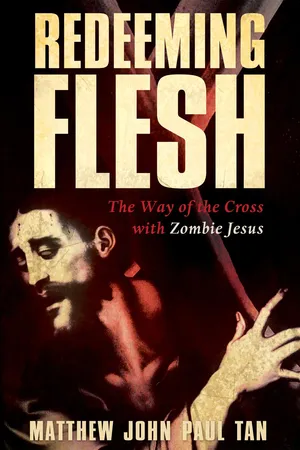
Why are zombies consuming the popular imagination? This book--part social analysis, part theological critique, and part devotional--considers how the zombie can be a way to critically situate our culture, awash with consumer products. Matthew Tan considers how zombies are the endpoint of social theory's exploration of consumer culture and its postsecular turn towards an earthly immortality, enacted on the flesh of consumers.
The book also shows how zombies aid our appreciation of Christ's saving work. Through the lens of theology and the prayer of the Stations of the Cross, Tan incorporates social theory's insights on the zombie concerning postmodern culture's yearning for things beyond the flesh and also reveals some of social theory's blind spots. Turning to the Eucharist flesh of Christ, Tan challenges the zombie's secularized narrative of salvation of the flesh, one where flesh is saved by being consumed and made to die. By contrast, Jesus saves by enacting an alternative logic of flesh, one that redeems the zombie's obsession with flesh by eucharistically giving it away. In doing so, Jesus saves by assuming the condition of the zombie, redirecting our logic of consumption and fulfilling our yearning for immortality.
Information
Topic
Theology & ReligionSubtopic
Christian Theology1
Introduction
What is presented here is part speculative theology, part social critique, and part devotional, focusing on the trope of the zombie. The launch point of this work will be “Zombie Jesus,” which centers on the whimsical claim that Jesus, having exhorted all to eat his flesh and risen from the dead, was history’s first zombie. “Zombie Jesus” first emerged as an exclamation by one of the characters, Hubert J. Farnsworth, in an episode of the Matt Groening animated TV series Futurama in 1999 entitled “When Aliens Attack.” Though the character himself was not shown in Futurama, “Zombie Jesus” has since become immortalized in a smorgasbord of memes, comedy skits, and zombie walks around the world. In this inquiry, “Zombie Jesus” will act as a touchstone for a broader inquiry into the reasons behind the prominence of the zombie in popular culture, and how the Christian might engage the motif of the zombie at a cultural level, in light of its popularity among Christian and non-Christian consumers of popular culture alike. This work will also highlight how the Christian might engage the zombie at a theological level, and make the zombie not only a part of his or her consumption of popular culture, but also a way towards cultivating a greater appreciation of the saving work of God.
Readers might wonder how anyone can yield anything of theological, or even devotional, significance from something as whimsical as a zombie. Indeed, readers might even be scandalized at the thought that anything of benefit to the spiritual life can be gained from the meme of “Zombie Jesus,” especially when one considers that the meme was initially used to poke fun at Christianity’s assertion of the centrality of the resurrection and Jesus’ injunction to eat his flesh as the indispensable means to have eternal life.1 In and of itself, the “Zombie Jesus” meme might be at worst offensive to those within the Christian fold, or at best amusing to those outside it. Even at its best, however, we may feel that the meme does not provide any great cultural, let alone theological, insight. It is submitted here, however, that “Zombie Jesus” can be a useful launch point into a more comprehensive investigation of the zombie as a pop cultural phenomenon, a phenomenon that now incorporates into its purview movies, television series, video games, and even nineteenth-century Gothic literature.
This study will incorporate some elements of this phenomenon, but also highlight its cultural salience with reference to other practices within pop culture more generally. The inquiry will then widen to integrate the insights into the zombie gleaned by cultural theory and theology. It will argue that, with the aid of the former, “Zombie Jesus” can act as an endpoint of a highly potent social critique that has the zombie as an indispensable touchstone. The book will show how the monstrosity of the zombie is not a bizarre category that sits outside the warp and woof of material culture, but is an integral part of that culture. In other words, material culture is indeed monstrous and there lurks in postmodern culture a death of flesh that parallels that of the flesh of the zombie. This book will also assert, however, that the aid of the latter can afford this inquiry something more than a mere critique of the material processes of a pop cultural form. This is important since confining the inquiry to critique risks merely describing the way that cultural form functions and even reifying and reinforcing its practices, institutions, and semiotics. The inclusion of theology into an investigation into a zombie meme will hopefully serve two important purposes. The first is to highlight the possibilities of the discipline of not only speculating on the things transcendent, but also in making unique contributions to immanent critique. In doing so, this work hopes to highlight aspects of the yearnings that swirl within pop cultural forms that pop cultural analysis might miss. Secondly, it is hoped that integrating both theology and immanent critique will also highlight the highly visceral operations of the economy of salvation, of Christ’s role in that economy, and of the effects of that role on the reader. For Christ’s saving work is not merely operative at the level of the emotions or even at some vague “spiritual” level. Christ saved, the Gospel of John remind us, by taking on our flesh2 and, as the incarnate Word, Christ saved also by taking on the futility of our flesh, a point made in Paul’s letter to the Romans.3 Thus, the saving action of Christ not only gives life in an abstract sense, but also “gives life to your mortal bodies,”4 at the level of our flesh and through the action of his own flesh.
In order to substantiate this claim, this book will be structured as three inquiries. In order to better appreciate the cultural potency of the zombie in the West, the first inquiry will look at the genealogy of the zombie from its entry into the literature of the anglosphere in the mid-eighteenth century to the present day. This particular inquiry will show how the stage was set for the zombie’s entry into our imagination through the writings of the “Graveyard Poets,” with their focus on death and the grave, as the name suggests. It will show how the dead, and later the undead, were not merely instruments for our humor, but functioned as a form of critique on the welfare of souls. Whether such a critique succeeded is debatable, but what is beyond debate is a legacy of cementing the motif of death—and our ability to come to grips with death—in the popular imagination. This first inquiry will also show how, far from disappearing in the so called “Age of the Enlightenment,” critique through the motif of death lingered on in Gothic literature in the more familiar forms of the undead, and continued on well into the twentieth century, in what is known as the “Romero Zombie,” named after the movies Night of the Living Dead5 and Dawn of the Dead,6 directed by George Romero. This genealogical exploration will then take the inquiry into the zombie in the direction of an immanent critique, a “Zombie-Kritik” if you will. Here, the book will consider the literature that looks to the zombie as a critique of modern metaphysics and postmodern culture as well as a warning of where that lifeworld might end up if these conditions persisted. This aspect of the inquiry will be by no means exhaustive, but will merely highlight key observations. In making this critique, the book will submit that the spectacle of the zombie is not just another whimsical artifact of a public fascination with horror, nor is the zombie a mere monster fundamentally set apart from the viewer of the spectacle. Rather, the focusing of social and cultural theory onto the zombie will show the extent to which the monstrosity of the zombie is actually a reflection of the consumer culture that produced it. The book will suggest that the zombie is not just the endpoint of the urge to consume that which swirls within pop culture. The act of consumption is also part of a project within postmodern culture to create a meeting point between heaven and earth, a site of what Bruno Latour calls “alternation between transcendence and immanence.” With reference to what Freudian psychoanalysis calls the “death drive”—and what the Slovenian Marxist Slavoj Žižek more pointedly calls “undeadness”—this part of the inquiry will explore how postmodern culture creates an amalgam of transcendence and immanence by enlisting the very flesh of the consumer, molding that flesh into the flesh of a “postmodern angel,” to borrow the terminology of Graham Ward. Whilst an angel may not sound anywhere near as grotesque as the zombie, this chapter will nonetheless show how, at a metaphysical as well as a cultural level, it is the very process of transforming ordinary flesh into the angelic that leads to the death of all flesh.
Vital though this critical inquiry may be, this work argues that there are aspects of the zombie—and by extension, the practices within the pop cultural form—that get missed in an investigation using social theory alone. Given the limitations of the first inquiry in isolation, a second inquiry will seek to highlight some of these blind spots by enlisting the aid of the discipline of theology. The aim of the decidedly theological nature of this second inquiry is twofold. First, it hopes to highlight aspects of immanent critique that might be missed even by immanent critique itself. It will do this by juxtaposing an indispensable characterization of the zombie—the flesh-eating horde—with two important theological categories, namely ecclesiology (a theory of the church) and liturgy (a theory of public worship). With the former, this book will show how the act of gathering provides a means of explaining the potency of the zombie, not at an individual level, but at the level of the collective. It will show how the zombie is defined not by virtue of its individuality, but by virtue of its collectivity. This book will show how, even if the act of gathering might be canvassed in the coverage of the phenomenon of the zombie, that phenomenon nonetheless betrays a lingering yearning for a collective identity, even if that identity threatens to overwhelm or erase the individual subject. This is not only done as a way to articulate one’s identity as an identity shaped by others, but also as a way to articulate the means by which one is saved by others. This salvific aspect of incorporation into a collectivity is expressed as a zombified form of ecclesiology which can only be deciphered and critically engaged by means of a theological grammar. It will show how ecclesiology can assist in understanding the zombie, not only in terms of a crude collectivity, but also in evaluating the success with which that collective relates to and harmonizes with the particularity of individual bodies.
As shall also be seen, ecclesiology will dovetail into a consideration of liturgy. The book will highlight how the act of consuming flesh by a zombie horde has parallels to another act of consuming flesh by a collective, one that is done in churches across the world—the Eucharistic liturgy. It is precisely at this juncture that the flesh of the zombie comes into contact with the Word made flesh and the remainder of the book will consider the trope of the zombie through the lens of the Eucharist. It will be at this Eucharistic juncture where the monstrosity of the zombie is fully revealed. However, the book will also show how that very monstrosity becomes undone by a Eucharistic logic. Monstrosity is overcome, not by plastering over the rotting flesh of the zombie, but by incorporating the dying flesh of the horde into the living flesh in the body of Christ. This joining of flesh is undertaken, not by a divine erasure of the “death drive,” but by a divine entry into it, redirecting it. The Eucharist will thus act as the vital touchstone in our main assertion—that the grammar of the saving work of Christ is brought about not through a violent overcoming of the zombie, but by Christ himself taking on the condition of a zombie, giving flesh, so to speak, to the line by St. Paul, who talks of Christ as “he who knew no sin [and] became sin on our behalf.”7 This line of inquiry makes the Eucharist a vital element because it highlights how Christ takes on the zombified condition by handing over his flesh to be consumed by the horde. Nevertheless, it is precisely because it is Eucharistic that the consumption of his flesh only becomes a prelude to an absorption of that zombified flesh into his living body.
Having laid out the contours of a Eucharistic engagement with the zombie, the third and final inquiry will show how this salvific process of consumption by Christ, is not merely another bizarre foray into the sometimes hermetically sealed world of postmodern theology. This final inquiry will take the analyses of the previous two inquiries out into the texture of spiritual devotion, and integrate the theoretical reflections drawn fr...
Table of contents
- Acknowledgements
- Chapter 1: Introduction
- Chapter 2: The Zombie Is Us
- Chapter 3: The Zombie Is Jesus
- Chapter 4: The Stations of the Cross and Christ’s Zombification
- Bibliography
Trusted by 375,005 students
Access to over 1.5 million titles for a fair monthly price.
Study more efficiently using our study tools.
Frequently asked questions
Yes, you can cancel anytime from the Subscription tab in your account settings on the Perlego website. Your subscription will stay active until the end of your current billing period. Learn how to cancel your subscription
No, books cannot be downloaded as external files, such as PDFs, for use outside of Perlego. However, you can download books within the Perlego app for offline reading on mobile or tablet. Learn how to download books offline
Perlego offers two plans: Essential and Complete
- Essential is ideal for learners and professionals who enjoy exploring a wide range of subjects. Access the Essential Library with 800,000+ trusted titles and best-sellers across business, personal growth, and the humanities. Includes unlimited reading time and Standard Read Aloud voice.
- Complete: Perfect for advanced learners and researchers needing full, unrestricted access. Unlock 1.5M+ books across hundreds of subjects, including academic and specialized titles. The Complete Plan also includes advanced features like Premium Read Aloud and Research Assistant.
We are an online textbook subscription service, where you can get access to an entire online library for less than the price of a single book per month. With over 1.5 million books across 990+ topics, we’ve got you covered! Learn about our mission
Look out for the read-aloud symbol on your next book to see if you can listen to it. The read-aloud tool reads text aloud for you, highlighting the text as it is being read. You can pause it, speed it up and slow it down. Learn more about Read Aloud
Yes! You can use the Perlego app on both iOS and Android devices to read anytime, anywhere — even offline. Perfect for commutes or when you’re on the go.
Please note we cannot support devices running on iOS 13 and Android 7 or earlier. Learn more about using the app
Please note we cannot support devices running on iOS 13 and Android 7 or earlier. Learn more about using the app
Yes, you can access Redeeming Flesh by Matthew John Paul Tan in PDF and/or ePUB format, as well as other popular books in Theology & Religion & Christian Theology. We have over 1.5 million books available in our catalogue for you to explore.