- 312 pages
- English
- ePUB (mobile friendly)
- Available on iOS & Android
eBook - ePub
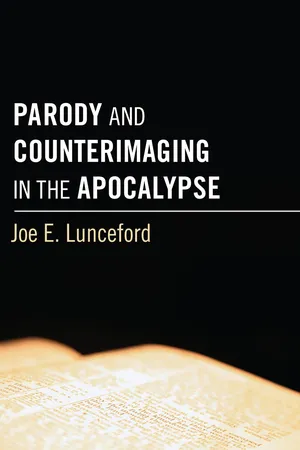
Parody and Counterimaging in the Apocalypse
About this book
As numerous scholars have noted, The Revelation was first received orally. Directed not merely to the intellect, its author deliberately employed different literary schemes and devices to evoke the imagination of his audience. In this new study, Joe Lunceford examines the specific use of parody and counterimaging in The Revelation, arguing that this often overlooked device was an essential means by which its author engaged the imagination of his readers and hearers.
In light of the best of recent scholarship on The Revelation, Lunceford examines over thirty uses of this device--most notably the contrasting images of the "evil trinity" of dragon, beast from the sea, and beast from the earth and the Holy Trinity.
Information
Part One
Counterimaging
1
Kings of the Earth
. . . and from Jesus Christ the faithful witness, the first-born from the dead (ones) and the ruler of the kings of the earth . . .
(Rev 1:5)
And the kings of the earth and the great ones and the military commanders and the wealthy ones and the strong ones; also every slave and free (person) hid themselves inside the caves and rocks of the mountains.
(Rev 6:15)
And one of the seven angels who had been holding the seven bowls came and spoke with me saying, Come—I will show you the judgment of the great prostitute who is sitting upon many waters, with whom the kings of the earth committed fornication and those inhabiting the earth were intoxicated with the wine of her fornication.
(Rev 17:2)
And the woman which you saw is the great city which reigns over the kings of the earth.
(Rev 17:18)
. . . because she gave all the nations to drink from the wine of her fornication and the kings of the earth committed fornication with her and the merchants of the earth were made wealthy from the power of her sensuality.
(Rev 18:3)
And the kings of the earth who committed fornication and lived sensually with her will weep and mourn over her when they see the smoke of her burning.
(Rev 18:9)
And I saw the beast and the kings of the earth, and their soldiers, gathered together to do battle with the one sitting upon the horse and his soldiers.
(Rev 19:19)
And the city has no need of the sun or moon to shine in it because the glory of God enlightens it and the Lamb is its lamp; and the nations will walk about by means of its light, and the kings of the earth will bring their glory into it.
(Rev 21:24)
In this chapter I will deviate from the general pattern I established in the Introduction, because in this case there is not only a positive and negative usage of the term but also one that is possibly neutral. Moreover, it is possible in this instance to keep the passages in the order in which they appear in Revelation without any shift between the positive and negative usages of the phrase.
In Rev 1:5 we confront a threefold designation of Jesus as the faithful witness, firstborn from the dead, and ruler of the kings of the earth. Only two individuals are designated as faithful witnesses in Revelation: Jesus and Antipas (Rev 2:13). Both witnessed through giving their lives, anticipating the later-developed usage of martys, or “witness,” as martyr in the contemporary sense. As Mounce has noted, “Throughout the Revelation the word is associated with the penalty of death which results from a firm and constant witness (cf. 2:13, 11:3, and 17:6).”1 And while Aune may be correct in asserting that the exalted Jesus is the one who guarantees the truth of the revelation to John rather than the human Jesus,2 I would respond that any absolute separation of the two may be true for such scholars as Bultmann but not for the Christian Testament. The exalted Jesus is the faithful witness because the historical Jesus witnessed to the point of giving his life.3
As for the second designation, firstborn from the dead, Sweet points out that for Jews who believed in resurrection, the resurrection was a corporate event rather than individual resuscitation. Hence Jesus’s resurrection would have been understood by his first followers—all Jews—as proleptic of the general resurrection.4 This understanding is probably in accord with Paul’s reference to Jesus as the “firstfruits” of resurrection (1 Cor 15:20, 23).
The third designation, ruler of the kings of the earth, will be the particular focus of this study. Krodel is not far wide of the mark in asserting that the basic issue of Revelation turns on the question of the identity of the true ruler of this world and the proper object of worship.5 The title “ruler of the kings of the earth” was claimed by Roman emperors, but John is juxtaposing Jesus as the true ruler of the kings of the earth over against the false claims of Rome.6 This title contains a rather obvious allusion to Ps 89:27 (LXX 88:28). The larger context of that psalm is an exposition of God’s promise to establish the seed of David in perpetuity. The Seer used the words of this psalm to express the developing understanding of Jesus’s identity.7 John, along with early Christian tradition in general, understood Jesus to be the ultimate fulfillment of the promises made to David.
The root of the word archōn, translated “ruler” in this passage, may mean either “to rule” or “to begin.”8 Both “have preeminence over” and “source” lie within the range of usages of this word. While the former is probably intended here, we should not overlook the possibility that the Seer is presenting the exalted Jesus as the source of all human kingship. This usage would agree with the understanding of Paul (Rom 13:1–4) and the author of 1 Peter (1 Pet 2:13–14).
Crucial to this study is the determination as to whether “kings of the earth” is a positive or negative category. As Beale points out, and exposition of the following passages will confirm, the predominant use of the term in Revelation is negative. Beale is probably correct in claiming that this passage does not present Jesus as ruling over his redeemed people but over defeated enemies.9 ...
Table of contents
- Title Page
- Acknowledgments
- Introduction
- Part One: Counterimaging
- Part Two: Parody
- Conclusion
- Bibliography
Trusted by 375,005 students
Access to over 1.5 million titles for a fair monthly price.
Study more efficiently using our study tools.
Frequently asked questions
Yes, you can cancel anytime from the Subscription tab in your account settings on the Perlego website. Your subscription will stay active until the end of your current billing period. Learn how to cancel your subscription
No, books cannot be downloaded as external files, such as PDFs, for use outside of Perlego. However, you can download books within the Perlego app for offline reading on mobile or tablet. Learn how to download books offline
Perlego offers two plans: Essential and Complete
- Essential is ideal for learners and professionals who enjoy exploring a wide range of subjects. Access the Essential Library with 800,000+ trusted titles and best-sellers across business, personal growth, and the humanities. Includes unlimited reading time and Standard Read Aloud voice.
- Complete: Perfect for advanced learners and researchers needing full, unrestricted access. Unlock 1.5M+ books across hundreds of subjects, including academic and specialized titles. The Complete Plan also includes advanced features like Premium Read Aloud and Research Assistant.
We are an online textbook subscription service, where you can get access to an entire online library for less than the price of a single book per month. With over 1.5 million books across 990+ topics, we’ve got you covered! Learn about our mission
Look out for the read-aloud symbol on your next book to see if you can listen to it. The read-aloud tool reads text aloud for you, highlighting the text as it is being read. You can pause it, speed it up and slow it down. Learn more about Read Aloud
Yes! You can use the Perlego app on both iOS and Android devices to read anytime, anywhere — even offline. Perfect for commutes or when you’re on the go.
Please note we cannot support devices running on iOS 13 and Android 7 or earlier. Learn more about using the app
Please note we cannot support devices running on iOS 13 and Android 7 or earlier. Learn more about using the app
Yes, you can access Parody and Counterimaging in the Apocalypse by Joe E. Lunceford in PDF and/or ePUB format, as well as other popular books in Theology & Religion & Biblical Criticism & Interpretation. We have over 1.5 million books available in our catalogue for you to explore.