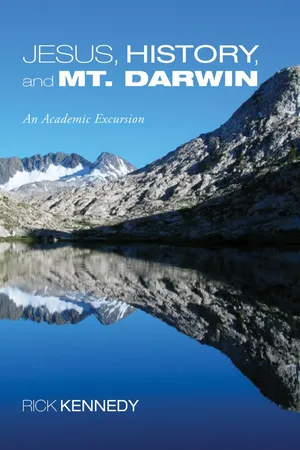
Written in the genre of Henry David Thoreau’s travel-thinking essays, Jesus, History, and Mount Darwin: An Academic Excursion is the story of a three-day climb into the Evolution Range of the High Sierra mountains of California. Mount Darwin stands among other mountains near fourteen thousand feet high and that are named after promoters of religious versions of evolutionary thinking. Rick Kennedy, a history professor from Point Loma, uses the climb as an opportunity to think about general education and how both the natural history of evolution and the ancient history of Jesus can find a home in the Aristotelian diversity of university methods. Kennedy offers the academic foundations for the credibility and reliability of accounts of Jesus in the New Testament, while pointing out that these foundations have the same weaknesses and strengths that ancient history has in general. Natural history, Kennedy points out, has a different set of strengths and weaknesses from ancient history. Overall, the book reminds students and professors of the wisdom in being humble.
- 112 pages
- English
- ePUB (mobile friendly)
- Available on iOS & Android
eBook - ePub
About this book
Information
Topic
Scienze socialiSubtopic
Teologia cristiana1
The Plan
Back in the 1970s, I learned to love university life. I eventually became a professor of history. I started out a Bible-trusting Christian and have not lost my faith. This book is about the reasonableness of biblical Christianity in universities. By reasonableness, I mean the warranted credibility, if not the persuasiveness, of Christian claims about ancient history. This book is also about Darwinism and natural history. Darwin seems to have lost whatever Christian faith he might have once had, and his ideas about distant natural history are often pitted in classrooms against the more recent ancient history of Christianity. There are many ways people in universities try to get at the tensions between Christianity and Darwinism. Here I want to sidestep most of them. I want to think about two histories, two types of history that can stand side by side even if they are contradictory in many ways. I especially want to sidestep any notions that science is about facts and Christianity about values. Here I treat both as sophisticated systems based on evidence, facts, and inferences. Both use reasonable methods standing within long academic traditions. Both make assertions about what happened in the past.
For Christianity, history is primal. At universities, the struggle with Darwinism is best dealt with at the primal level of history. Darwin was a natural historian proposing that long ago certain things happened—species evolved by a mechanism of variation and selection He then inferred that since the creation of new species did not need God, then it is best to assume that God was not involved.
Christianity is founded on events in human history. St. Paul in 1 Corinthians 15 stakes the truth of Christianity three times on a historical event reported by eyewitnesses. “If Christ has not been raised, our preaching is useless and so is your faith.” Again, “If Christ has not been raised your faith is futile.” Paul further declares, “You have believed in vain,” if you do not believe what is “of first importance: that Christ died for our sins according the scriptures, that he was buried, that he was raised on the third day according to the scriptures.” The evidential base upon which to “hold firm” and “stand firm” is the testimony of eyewitnesses: first Peter, then the twelve, then five hundred, then James, then the apostles, then to Paul himself. Peter reminded a group of eyewitnesses in Acts 2 about events as the foundation to Christian revelation: “Listen to this: Jesus of Nazareth was a man accredited by God to you by miracles, wonders and signs, which God did among you through him.”
University culture is a Greek culture. “Greeks look for wisdom,” Paul noted, “but we preach Christ crucified.”1 What Paul was getting at here is that Greekish philosophy, theology, science, and natural history look for order and try to make sense of things by organizing. Paul wanted to make it clear that God was not to be put in a Greek box. On the other hand, Paul was probably not criticizing Greek historical methods that have affinities with Christianity. Herodotus and Thucydides, the founding fathers of Greek historical writing, were models for Luke and Paul. When it comes to evangelism, Greek methods of history help establish Christ crucified. Greek history accepts the disorderliness of human history in ways that support the disorderliness of history presented in the Bible. In the Bible, God does not create like an engineer. God is not portrayed as a logician whose logic cannot be defeated. God’s ways and thoughts are not like the orderly expectations of academic philosophy, theology, science, or natural history. The preacher says: “Who can straighten what God has made crooked?”2 The academic study of human history is the study of crookedness, of things not going as logic would demand. Jesus is part of that crookedness.
I here apologize for the rest of this book. The goal is grand but the framework is small. Polybius, one of the Greek founders of the discipline of writing human history, ridiculed historians who only haunt libraries and are unwilling to travel to where they can survey the scene of events.3 I had read Darwin’s books, but wanted to survey the scene of Darwin’s life. I would have liked to have gone to Darwin’s house and to have seen his desk and garden. Better yet, I would have liked to have sailed through the Beagle Strait at the tip of South America north to the Galapagos. But, given the confines of my life, I decided that the best I could do was visit the High Sierra where there is a region dedicated to his theory and where his memory prevails: the Evolution Range above Evolution Valley.
This is a weekend book about a weekend trip. I write it out of a classroom obligation to be Greek and Christian, to help students be reasonable, rational, and honest about their faith in an age when universities have a powerful role in defining what is reasonable. I write with the hope that students will, in various ways, learn that the academic life is a journey and not a destination, that academic disciplines are divergent paths not all leading to one place, and that, in universities, it is reasonable to believe the history of Jesus along with the natural history proposed by Charles Darwin.
1. 1 Cor 1:15–20.
2. Eccl 7:13.
3. Polybius, Rise of the Roman Empire, XII, 25e–i.
2
Road Trip
The top of Mount Darwin is 13,831 feet above sea level at 37°10.02΄N, 118°40.22΄W. Getting to Mount Darwin from my small college in San Diego requires a six-hour drive veering slightly west of straight north. At the town of Bishop, the route turns southwest climbing to Lake Sabrina (elevation 9,128’ and pronounced by the locals: sabr-eye-na). The hike from Sabrina to Mount Darwin is a little over ten miles. A three-day weekend offers enough time for the excursion.
Six of us were to go up Mount Darwin, but then the Anaheim Angels won the American League playoffs. The first two games of the World Series would be on the Saturday and Sunday of our trip. My two students from Orange County dropped out. So we were four: two history teachers, forty-four and thirty-one years old, and two boys, thirteen and ten years old. The boys, Matthew and Steven, are mine. David Nieman, the fourth, teaches high school history at Santa Fe Christian School in San Diego.
Our excursion party left at nine, lunched at Astro Burger in the High Desert, and got to the ranger station in Bishop a little after three. By 4:30 pm we were at Lake Sabrina. Matt and Steve sat in the far back of the station wagon facing backwards. They read books and passed CDs up to the front for the stereo. Dave and I talked. The temperature was in the low seventies for most of the trip, and since the car’s air conditioner did not work, we drove with windows down. Few things are more fun than speeding down a two-lane desert highway, elbow in the breeze, backpacks loaded on top, mountains off in the distance. Having a window down—combined with the drone of the diesel engine—meant that conversation could not be dignified. Dave and I bantered back and forth mostly about teaching ancient world history and our methods for handling wild questions from our students about popular mysteries. Dave, after a minute of looking off to the row of huge signal dishes operated by the Owens Valley Radio Observatory, turned back toward me, yelling: “So! What do you think of UFOs?”

There is serious academic work on UFOs by scientists, psychologists, and historians.1 Any report of past events is grist for a historian’s mill. Part of our job is handling the wild stories that get reported. The classroom goal in such cases is not so much a conclusion about what did or did not happen; rather, the goal is methodical and consistent thinking about reports of wild happenings. Historians working within the longest traditions of their academic discipline have an obligation to be open-minded, hear the evidence, take into account context, apply scales of reliability, and come to tentative conclusions that are socially acceptable. Being reasonable about history is always negotiated. The goal is a “best explanation” or set of “best explanations”—with “best” being a general agreement among respectable people.
Dave and I discussed the evidence for UFOs flown, presumably, by extraterrestrial life forms, that we have heard about from TV shows, grocery store magazines, and a few books. The problem is not a lack of evidence. The problem is in methodical and consistent thinking about the evidence.
David M. Jacobs is a model historian on the subject. He teaches at Temple University and wrote Secret Life: Firsthand Accounts of UFO Abductions (1992). In the first chapter, he explains his method of inquiry and argues for the academic reasonableness of his conclusions. He gathered a large number of abduction accounts and analyzed the diverse testimonies for consistencies. He then assessed the character and bias of the testifiers. Consistent with the Aristotelian-humanist tradition, he advocates that readers should not dismiss hard-to-believe testimony of abductions without first seriously looking into the character and circumstances of the testifiers. The most dubious aspect of his method is that he uses hypnotism to get into the subconscious of the testifiers. He justifies using hypnotism by noting it is increasingly used in jurisprudence and other academic fields such as psychology. (The book is endorsed by a professor of psychology at Harvard University.) After making a case for the reasonableness of his methods and the reliability of his sources, he sticks his neck out to say that the evidence warrants belief that alien abductions are occurring.
Frankly, I don’t think his case is persuasive or even offers a probable account for the evidence. Deep in the argument is the speculation that the aliens want to keep their presence secret, thus justifying the need for the researcher to use hypnotism to get the needed evidence. I am willing to believe a lot of weird things. I think history is wilder than is presented in textbooks. However, I draw the line at secret conspiracies where the lack of evidence is evidence. We have a hard enough time getting at what people want to flat-out tell us. If an alien conspiracy of silence requires the use of hypnotism to be revealed, I am not convinced. On the other hand, I liked the book, learned a lot, and appreciated the methodical inquiry. Books like his make it exciting to be a historian.
Dave and I teach world history to people who often have wide-angle openness to information, theories, and assertions. We ourselves want to be such people. We want to encourage such openness. But we also have a duty to teach students to think in well-disciplined, methodical ways.
The story of Noah’s flood comes up in our history classe...
Table of contents
- Title Page
- Chapter 1: The Plan
- Chapter 2: Road Trip
- Chapter 3: Base Camp
- Chapter 4: Mount Darwin
- Chapter 5: Homeward
- Afterword
- Bibliography
Trusted by 375,005 students
Access to over 1.5 million titles for a fair monthly price.
Study more efficiently using our study tools.
Frequently asked questions
Yes, you can cancel anytime from the Subscription tab in your account settings on the Perlego website. Your subscription will stay active until the end of your current billing period. Learn how to cancel your subscription
No, books cannot be downloaded as external files, such as PDFs, for use outside of Perlego. However, you can download books within the Perlego app for offline reading on mobile or tablet. Learn how to download books offline
Perlego offers two plans: Essential and Complete
- Essential is ideal for learners and professionals who enjoy exploring a wide range of subjects. Access the Essential Library with 800,000+ trusted titles and best-sellers across business, personal growth, and the humanities. Includes unlimited reading time and Standard Read Aloud voice.
- Complete: Perfect for advanced learners and researchers needing full, unrestricted access. Unlock 1.5M+ books across hundreds of subjects, including academic and specialized titles. The Complete Plan also includes advanced features like Premium Read Aloud and Research Assistant.
We are an online textbook subscription service, where you can get access to an entire online library for less than the price of a single book per month. With over 1.5 million books across 990+ topics, we’ve got you covered! Learn about our mission
Look out for the read-aloud symbol on your next book to see if you can listen to it. The read-aloud tool reads text aloud for you, highlighting the text as it is being read. You can pause it, speed it up and slow it down. Learn more about Read Aloud
Yes! You can use the Perlego app on both iOS and Android devices to read anytime, anywhere — even offline. Perfect for commutes or when you’re on the go.
Please note we cannot support devices running on iOS 13 and Android 7 or earlier. Learn more about using the app
Please note we cannot support devices running on iOS 13 and Android 7 or earlier. Learn more about using the app
Yes, you can access Jesus, History, and Mt. Darwin by Rick Kennedy in PDF and/or ePUB format, as well as other popular books in Scienze sociali & Teologia cristiana. We have over 1.5 million books available in our catalogue for you to explore.