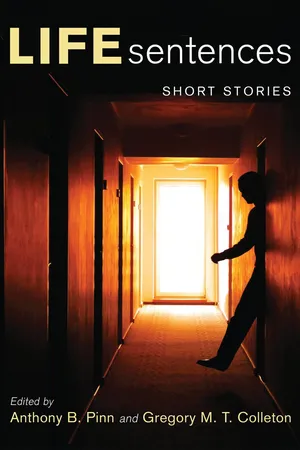
Whether from established authors or by writers new to fiction, the short stories in this volume explore life as change, using Ecclesiastes 3:1–8 as the lens.
The writers come from different backgrounds, perspectives, and levels of familiarity with the short story, but what ties them together is a willingness to creatively explore the raw and more uncomfortable dimensions of life—big events and small happenings—all bound up by a recognition of the inevitability and (dis)comfort of change. Each writer has a story to tell, a creative and imaginative angle on life as it happens somewhere to someone.
Life Sentences represents an experiment, a recognition of and confrontation with the depth of culture and culture’s life maps, with the ways in which the joys and troubles of life are given meaning. This collection attempts to address these large (and small) challenges and dynamics of life without the jargon of the professional philosopher or theologian but with the more “earthy” language of popular culture: the short story.
- 194 pages
- English
- ePUB (mobile friendly)
- Available on iOS & Android
eBook - ePub
About this book
Information
The Crossroad
S
By E. A. Bagby
The tongue’s curved pressure at the teeth, a gentle dental whistle-hiss of wind, sustainable, a remembered softness. Ess. Yes.
Sinful Caesar sniffed his snifter, seized his knees, and sneezed.
Silly Susie went ice-skating.
The ice was thin, the weather brisk.
Wasn’t Susie slightly stupid,
Her silly little *?
Asterisk was treacherous, but so was star. He stopped after little.
“Go on,” said Grace.
He shook his head.
“Mark.”
He shook his head again.
“Do you not get it? I thought you’d like—”
“I get it.”
“Well, say it then.”
“I can’t. You know I can’t. It’s”—he searched for the word—“it’s vain.”
“Vain?” she said, not understanding on purpose.
“Without a point,” he said triumphantly.
“Did you want to say pointless?”
He nodded. “But I didn’t.”
“Well, you should have.”
“But. I. Can’t.”
Grace started to say something, stopped, and took a long breath. Mark studied the tiny lines around her mouth and felt mean. He liked Grace. She tried. She talked to him; she listened to him. And she was beautiful in a strong, tough, experienced way, a way with which none of the girls at Valley View could compete, though a few of them tried. They smelled like smoke and went around with too much makeup on their babyish cheeks, and they said words they didn’t quite understand, roughening their voices to approximate those of movie stars. Mark had stopped being interested in them almost as soon as he had noticed them. His lack of interest had become irrevocable two years ago, when he met Lisa. He was 15 then and had panicked: would his kisses give him away? But to his infinite surprise and gratitude Lisa never mentioned it, only kept kissing him with a mysterious fervor. In the morning she said he was a good kisser, but she was worried about the age difference. (He had told her he was 20; she was a senior in college.) After Lisa he pushed his age up gradually. He usually said 23. They usually believed it. But Lisa was—he thought of her as the firtht.
“Do you want to know what I did last night?”
Grace paused before she said anything; he could see her waver between actually answering and commending him for saying last. “What did you do?” she said finally, in a tone that indicated that, whatever he had done, it would not be news.
“Went out,” he said. “Met a girl.”
Grace sighed, and leaned back in her chair.
“Went home with her,” said Mark.
“Do your parents know?”
“No. Why would I tell them?”
“What was her name?” said Grace, without real interest.
“Mel,” said Mark.
Grace regarded him, unblinking. Damn her.
“Melissa,” he said.
“Ah.”
“Ergo, I knew it wouldn’t be anything long-term,” said Mark in a hurry, “and I didn’t feel too bad—”
Grace interrupted: “Wait. I’m curious. What did you call her all night, if not Melissa?”
“Honey,” said Mark. “Or dear.”
“She didn’t mind that?”
He shrugged. “Women like that.”
“Women,” said Grace, with a faint smile, “like it when men remember their names.”
“I did remember her name.”
“Say it for me again, then.”
“Don’t you want to know what happened?”
“Say her name first.”
He did, quietly, slowly, carefully, contorting an unwilling tongue. It still came out wrong, and he went crimson at a sudden, unbidden memory of Melissa standing in her lamplit bedroom with her shirt off, cocking her head to one side and saying, “what?”
He had had no choice but to repeat the careless, unfortunate sentence: “I like kissing you.” He meant it; he loved kissing. You could communicate without saying a word. It was the only time he felt he was making himself known. He hushed the inevitable word as much as he could, slurring it softly.
She gave him a searching look, aimed not at his eyes but at the near side of his head. He knew. Looking for the hearing aid.
“Something the matter?” said Grace.
“No,” said Mark, trying to banish all traces of shame from his face.
“You sure?”
“Do you want to know what happened or not?”
“Mark. I’m not a therapist. I’m—” Grace remembered herself and lowered her voice. “Why don’t you say what I am?”
What kind of cruel joke were the words speech pathologist? No one who needed one could say so. Mark glowered.
“Go on.”
“You’re a—”
Grace’s face was relentless. He saw again Melissa, edged finely with lamplight, wondering and sad. Her mouth had been strong, decisive. But later her curious hands had crept over his ears, exploring, uncomprehending.
“Shpeech—”
“A what?” Grace hated his habit of slurring, said it would set him back. Not as much as other things, he thought.
“You’re a bitch,” he said.
Grace sat back in her chair. “Well.”
The warm curve of Melissa’s recumbent body. The two of them made an S, with their waists and their knees bent together. Other people called it spooning. He didn’t.
“Are you going to stay all night?” said Melissa, unconscious of the miracle of the word in her mouth.
“I can’t. I need to get home.”
“Oh.”
“I’m—”
“No, no, don’t be sorry. It’s all right.”
“I am, though.”
“Me too.”
He stood up and began to dress. She watched him from the bed. “You’re beautiful, you know.”
He let out a startled laugh. “You are too.”
“Not like you are.”
He sat next to her to put his shoes on. “You shouldn’t say anything like that.” Out before he could stop it, with a hard whoosh on say. Something about Melissa was disarming him. That was two careless slips in one night. Not, of course, that he could tell her that.
Her lips parted; she tested the next words before she said them. “Do you have a hearing problem?” she said.
“No,” he said, feigning astonishment. “Why?”
“My dad did, growing up,” she said, “and he slurs his esses like that.”
“Huh.” He laughed again. “Well, I had a bit to drink tonight.”
So easy: the possibility of truth rarely even crossed his mind. But what would he say, now? I had an accident when I was thirteen—fraught with problems. I fell down the—steps? stairs? basement staircase? all bad—and damaged a nerve at the back of my neck and lost—bad—destroyed—worse—killed my ability to control my tongue. I woke up and couldn’t talk. I had to learn to talk all over again. I learned everything but—
But you could not describe it without saying it. I learned everything but Eth.
“Are you going to tell me you’re sorry?” said Grace.
“I am.” He was, too. Grace wasn’t a bitch, and she was the last person he needed to offend.
“I ne...
Table of contents
- Title Page
- Contributors
- Introduction
- The Preparation
- The Journey
- The Crossroad
Trusted by 375,005 students
Access to over 1.5 million titles for a fair monthly price.
Study more efficiently using our study tools.
Frequently asked questions
Yes, you can cancel anytime from the Subscription tab in your account settings on the Perlego website. Your subscription will stay active until the end of your current billing period. Learn how to cancel your subscription
No, books cannot be downloaded as external files, such as PDFs, for use outside of Perlego. However, you can download books within the Perlego app for offline reading on mobile or tablet. Learn how to download books offline
We are an online textbook subscription service, where you can get access to an entire online library for less than the price of a single book per month. With over 1.5 million books across 990+ topics, we’ve got you covered! Learn about our mission
Look out for the read-aloud symbol on your next book to see if you can listen to it. The read-aloud tool reads text aloud for you, highlighting the text as it is being read. You can pause it, speed it up and slow it down. Learn more about Read Aloud
Yes! You can use the Perlego app on both iOS and Android devices to read anytime, anywhere — even offline. Perfect for commutes or when you’re on the go.
Please note we cannot support devices running on iOS 13 and Android 7 or earlier. Learn more about using the app
Please note we cannot support devices running on iOS 13 and Android 7 or earlier. Learn more about using the app
Yes, you can access Life Sentences by Anthony B. Pinn,Gregory Colleton, Pinn, Colleton in PDF and/or ePUB format, as well as other popular books in Literature & Literature General. We have over 1.5 million books available in our catalogue for you to explore.