- 200 pages
- English
- ePUB (mobile friendly)
- Available on iOS & Android
eBook - ePub
About this book
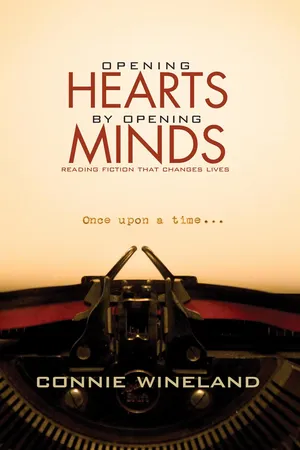
This book is for Christian readers of fiction who might experience difficulty trying to make an informed choice beyond what is being published by evangelical presses. Marketed to a specific target audience, evangelical fiction oftentimes leaves a reader with a strong emotional response but lacks the literary depth or the breadth of subject that could inspire life-changing spiritual growth. With this premise at the heart of her book, Connie Wineland includes her own story of conversion to Christianity by way of reading fiction. During her late twenties and early thirties, particularly while in graduate school, Wineland became immersed in literary and rhetorical studies while also practicing an Eastern form of religion as well as Native American spirituality. However, despite all her training in literary theory, her readings in Romantic, Victorian, modern, and postmodern literature (which she explains), as well as her personal interest in mythology and world religions, kept her questioning the existence of God and the possible nature of God.
Then, as a relatively new convert to Christianity, she faced several challenges at a small Christian college where she taught literature and writing courses. Eventually wanting to reach beyond the academic community, Wineland began a local Christian readers' group, which she ran for four years. She includes in this book resources and materials such as sample syllabi and study-guide questions, useful Web addresses, and plenty of how-to information for starting and running your own book club. Also included is an extensive list of annotated titles of recommended reading to get anyone started!
Information
Topic
Theology & ReligionSubtopic
Christian Church1
Why Read Fiction?
This would certainly sound like an idiotic question if you were answering it in regards to a child, but it becomes more legitimate when you are answering it in terms of why an adult should read fiction. It becomes even more legitimate when that adult is considering theological matters, which on the surface would seem to require serious reading of the Scriptures and other non-fictional texts only. The reason I pose the question in general terms instead of specifically asking “Why read Christian fiction?” is because many of the reasons for reading any type of fiction would be the same, and because after answering the first question, why read fiction, it is then that we may proceed to the specific nature of Christian fiction, and what, if anything, distinguishes it as a separate genre. And the reason I pose the question at all to an audience to whom this is probably a moot point, is because I know from personal experience that I have had to defend the answer to this on more than one occasion. The first time I had to was when I announced to my family my decision to major in English. My personal reasoning behind my choice of a major was because I liked to read more than do anything else, but of course I had to have a better answer than that when it became clear that I did not intend to major in Education and become a high school English teacher. Their assumption was that besides becoming familiar with a large body of literature, I wouldn’t learn anything that would truly benefit me in a future career. Since then I have had to address this issue for a countless number of college students who have been forced, as they saw it, to take a literature class.
I usually begin by asking exactly what is the power of fiction that we believe in it so absolutely when we are young, and when we are parents of young ones? Most of us know that fictional stories have elements of universal truths encased in them, so that making up characters or settings makes no difference to the truth that is being told. We all know that Jesus told stories. In fact, much of what He spoke of when he was teaching his disciples lessons that have made up the Gospels was told as parables, or stories. Stories tend to reach us as listeners and readers through our hearts. A textbook can give us facts to remember, to weigh and to digest, but most of us are moved far more readily when something touches our heart. This is why ministers often tell stories as part of their sermons. They know the power that a story can wield on the hearts of their listeners. This is why we tell our young children bible “stories.” We are not so afraid that they may not be getting all the facts and the proper theology, because we know that they are getting truths in a form that they can understand, and that all truths emanate from God. I don’t believe that Christ was a theologian in the sense of the word as what we know it to mean today. I believe that He taught theology, but that He put it in a form so that even the simplest minded could understand it. In fact, the Bible is full of poetry, and letters, and songs, all speaking the language of truth, all speaking to our hearts, and yet they are all types of writing that any “scholar” today would most likely shun as a way to teach anything that “really” mattered.
But beyond encasing historical truths about mankind and the universe, what else do we as adults value about fiction when it comes to children reading it? Of course we want our children to develop language skills, and so we allow for reading of almost anything in hopes that our children will be better speakers and writers. But what else do children get from reading besides that? What effect does reading have on their imaginations, and on their belief systems? Do you remember when you read fairytales? You did not have to be told that there was no such thing as talking animals and trees, or dragons, and elves and goblins, or big bad wolves that ate unsuspecting grandmothers. Okay, you might have had to be told that there was no such real place as Narnia, or Middle Earth, or Oz, if you were young enough, but instead of being disgusted and refusing to ever read another fictional work again, you were more likely regretful, and disappointed, but eager to find another wonderful place where laws of gravity and time didn’t apply. Or a place where the sky was green and the land blue, and where animals talked, and people could fly. You would have probably been very eager to visit a realm where you could know for certain who were the bad guys and who were the good guys (although many times they would often be disguised as their opposites at first), and a place where good would always win, though there would definitely be physical, emotional, and/or moral struggles. And beyond that, reading with our children gives us a chance to teach them how to discuss what they read. Many times as parents we sit down with our children and reflect together on what they just read, and then we lead them into more abstract thinking, or personal or moral application. However, there are some people who do not believe that reading fictional works too long into childhood, and especially into adulthood, is good for a person. There are parents who would wean their children off of such books, and guide them towards more realistic types of stories, hoping that they would eventually quit reading fiction altogether. I suppose that the danger I see in this is that God created us in His image, and part of being like God is having an imagination and the desire ourselves to be creators of sorts. When we stifle our imaginations, we deny that part of the godhood that lives in us. We as Christians believe that God is creating for us a new heaven and a new earth, and we in part believe that there will be things created for us that we are maybe not able to imagine as yet. And we know that creating is one of God’s greatest pleasures, and yet we live in a world where the creative mind and the strongly developed imagination are not encouraged because we have bought into the idea that anyone with an “overly active imagination,” or too much of a creative bent could not easily function or get along in this world of required conformity, and use of limited or repetitive skills. And so we discourage it in all its forms as much as possible, unless we believe that money can definitely be made from a particular creative endeavor. Even allowing children to play computer games for long periods of time, while teaching them hand-eye coordination, zaps their creativity. If the child grows up and wants to become a computer game designer, it will require both skill and imagination to create a new game that will keep the interest of the children of the next generation, who will require more visual stimulation and more action.
But putting the endeavor of making money aside, there is yet another reason for why developing an imagination of any kind, and opening our hearts to a possible reality of any kind other than the one we live in would be beneficial, and that has to do with faith. The language of faith is the language of the heart. In order to be able to believe the story of Christ’s incarnation and resurrection one finally has to have the ability to believe that what would seem like pure fiction is in fact truth. In order for us to believe stories about angels sitting around the throne of God and doing His work, and acting as His messengers, or even to believe stories about demons and their powers, we have to have an active and receptive imagination! In order for us to listen to Christ we have to have open and ready hearts, hearts that will recognize truth in story form. We know that the Bible is like a mirror, that when we read it we often glean different insights from it, depending on where we are in our lives, and what is going on in them. We know that the Bible cannot be read only with one’s intellect, though we never want to undervalue that, ever. But reading without an open heart can be just as disastrous. We know that we are to look to the Bible as the Word of God, and that God teaches us through circumstances, and through other people, and even through other venues. But we also need to understand that unless we reflect on the things that happen in our lives, we will gain very little, if any insight, and thus will grow very little spiritually. If we read the Bible, and yet do not reflect on what we read, we will not grow. Of course the act of reflection is an intellectual endeavor, but coexisting with the intellect as a part of that endeavor is the act of using our hearts to yield to the lesson, either in humility, or in gladness, or in any other emotion. Even when I teach critical thinking skills to college students in my writing and literature classes I sometimes wonder if I am possibly doing them a disservice in so far as they may become less naïve and less compliant, wanting to question more of what is presented to them, either in class, on the job, or in life. But ideally, isn’t that what we want? Plus, thinking critically is a skill that teaches individuals to approach all subjects and problems that present themselves in life with a broader perspective. And one of the easiest tools for teaching critical thinking skills is literature. Reading, then, even if it is a work of fiction, becomes a spiritual act if we read both critically and reflectively. I believe that all of this, our hearts, our minds, and our spirits, is tied up in the matter of faith.
Fiction can also speak what we feel. We do not as humans have to personally experience everything, but we can, through reading, share in the experiences of people different from us, and who are from lands different from ours, and who may even be from times that are different from our present time. We can share in their struggles, their hopes and their dreams; we can learn that we are not that different in our humanness from other people, and we can continue to define and examine ourselves by the characters that we read about in terms of their reactions to and interactions with their “life” circumstances. We know that Christ understood our weaknesses, though He did not have to experience our failures. We know that He commanded us to love God, and to love our neighbor as ourselves. Reading about people living lives that we may never live and thus may never understand, looking at them in terms of what motivated them to act in certain ways, what their weaknesses were and what caused them hurt, and what their strengths were and what were their rewards and why, is a good way to open up our hearts to people who are different from us. Thus we may be more readily able to love different people when we meet them in real life. I believe that reading fiction plays a strong role in helping us to do just that, if we do not use it as a form of escapism. Anything that God can use to enrich and expand people’s lives can also be used as a tool to distort and destroy. This being the case may be the number one reason that Christians throughout history have predominately chosen to avoid works of fiction. There has often been a general belief among conservative Christians that fiction is indeed nothing more than a form of escapism, or that it is just so much trash. This fear of books has also been precipitated by the fear of obscenity, profanity, depravity, and perversion that many Christians suspect is lurking behind the pages of secular fiction. However, any good work of literature, even fiction, has the power to strip us naked to the point where truth can be felt and seen! It can bring us into honest confrontation with ourselves, much like a mirror. We don’t have to limit our seeing and understanding to the Scriptures only, but we can look into the entire world of fiction, which at first may seem like an escape from reality, but which in all its power to reach one’s heart will eventually bring a person face to face with reality!
2
What is Christian Fiction?
The first time I tried to answer this question seriously was when I began teaching at a Christian college and was asked to teach a course in Christian literature. Since it was going to fulfill the literature requirement for several majors, I wanted the course to be as thought - provoking and challenging as any other literature course. At that time my background in that area of literature was limited to what I knew of the fiction titles listed in the Christian Book Distributors (CBD) catalog, and from my already extensive reading of everything by C. S. Lewis. However, that first semester I did not want to teach a course strictly using the works of Lewis, though later on I did. But what I wanted was to stretch my students and myself by exploring a variety of authors, both contemporary and historical, and to read in a variety of genres. To this end I decided to call on the help of a very good friend who was teaching at John Brown University in Arkansas. I asked him what he would include on a syllabus for a Christian literature course. As it turned out, another professor there had taught a course in Christian literature, and so she was kind enough to e-mail me a list of works that she had used. After looking it over I realized that she had been thinking about Christian literature as existing within a larger framework than what I was considering, and thus I began my quest to find an answer to the question, just what does define literature as being “Christian”?
Research into several books on the subject resulted in the conclusion that by definition it would have to be any literature that contained or supported a Christian perspective, or worldview. This definition does not always mean, however, that a work has to be overtly Christian. I remember the academic dean of the Christian college where I worked telling me that her rule of thumb was that any topic that was in the Bible (and try to find anything that is not discussed in there!) was acceptable in a literary work as long as sinful lifestyles were not being glorified or excused as right behavior, or thrown in for strictly entertainment purposes! She also included in that rule the use of cuss words and profanity for entertainment purposes. Unfortunately, it was in that environment that students in one of my composition classes refused to read Zen and the Art of Motorcycle Maintenance by Robert Pirsig because it contained language they found offensive. Written in 1974, it is a book about perception, reality, and values; it’s about learning to look at yourself and life differently, and incorporates into its context numerous references to Plato’s Phaedrus. The dean requested that I give her a count of the number of potentially offensive words, whereupon she would make the decision as to whether the percentage based on the total page count of 377 was too high. It was. Interestingly though, all but one of those same students had recently gone to see Dangerous Minds, a movie rated R for language about an English teacher in an inner-city high school who taught delinquents. While I learned through this experience that I myself had become desensitized to the use of “offensive” language, I also realized that those students’ righteous indignations were based on values other than refusal to fill their minds with words that offended them! It was being used as an excuse not to read! Had we made it through Pirsig’s book, we could have had a thought-provoking discussion of how one determines what is or is not of value, or rather what is or is not good. Another time I remember someone being upset by a book I chose was when a wife of one of our older students told me that she had trusted my judgment as to what was good, clean Christian reading, and so bought a book I was using in one of my courses to read on her own. She related to me that she was not able to make it through such a disgusting book, and was so upset by it that she flung it across her living room. The book was Maya Angelou’s I Know Why the Caged Bird Sings. Thankfully my class of predominately Afro-American (and Christian) female students did not share her same feelings! Angelou’s description of the childhood rape scene was an act of empowerment, of giving voice to her pain after having lived seven years of her childhood after that incident in silence. It’s a story that Maya Angelou has shared with millions, who find in her words the capacity for healing!
Unfortunately, there has been a long history of censorship of literature in America, as well as around the world, not only for religious reasons, but for political and social reasons as well. Many of the books included on the banned book list might astound even the most conservative Christian reader. For example, Uncle Tom’s Cabin was banned for challenging mainstream Christianity’s acceptance of slavery, for suggesting that it might be more Christian to go against the Fugitive Slave Law, and for making black characters more virtuous than their white counterparts. So, while it is an extremely pro-Christian novel, it upset the church and the clergy for many reasons. Books like Mark Twain’s Adventures of Huckleberry Finn, and Harper Lee’s To Kill a Mockingbird have been protested against due to racism and language. John Steinbeck’s The Grapes of Wrath was banned almost immediately for reasons of indecency, obscenity, and for its degrading portrayal of people and life. Even Oliver Twist, by Charles Dickens, was protested as being anti-Semitic for referring to the character of Fagin as “the Jew.” However, it has been argued that Dickens did not intend to defame or injure Jews, but that he was a product of an 1830s anti-Semitic culture. The list of censored books, which includes non-fiction as well as fiction, is quite lengthy. My point is that it is difficult to be the consummate judge of what constitutes good Christian reading.
What I knew from my studies in American literature (and British and any other world literature for that matter) was that historically, any author who wrote during a time when the culture in which he lived was predominately Christian, would have been influenced by Christian thought, whether he agreed with it or not. Therefore, there was almost always a strong sense of morality, and standards of decency, and thus whenever authors were not idealizing man’s behavior, they would have been critical of his immorality, oftentimes satirizing man’s religious hypocrisy. When people began to question the Church during the Renaissance period, and eventually even Christianity itself, as well as the belief in a Judeo-Christian God, which happened during what is called the Age of Reason, or the Enlightenment period, is when the idea of a Creator was no longer going to be taken for granted by the majority of educated writers. This could especially be demarcated in literature after the publication in 1859 of Darwin’s Origin of Species, probably the most influential non-Christian work ever published, which strongly put forth the theory of evolution. Before this, American authors for example, who had not ever considered themselves to be Christian, like Louisa May Alcott, Benjamin Franklin, and Emerson and Thoreau were still strongly influenced by Christianity. For example, many people have mistakenly quoted Ben Franklin when they thought they were quoting Proverbs, that was how influenced by his culture he was. E...
Table of contents
- Title Page
- Acknowledgements
- Introduction
- Chapter 1: Why Read Fiction?
- Chapter 2: What is Christian Fiction?
- Chapter 3: How Reading Changed My Life
- Chapter 4: Favorite Books from My Personal Library
- Chapter 5: Recommendations for Starting and Running a Christian Reader’s Group
- Chapter 6: Sample Syllabi and Discussion Guides
- Appendix A
- Appendix B
- Selected Bibliography
Trusted by 375,005 students
Access to over 1.5 million titles for a fair monthly price.
Study more efficiently using our study tools.
Frequently asked questions
Yes, you can cancel anytime from the Subscription tab in your account settings on the Perlego website. Your subscription will stay active until the end of your current billing period. Learn how to cancel your subscription
No, books cannot be downloaded as external files, such as PDFs, for use outside of Perlego. However, you can download books within the Perlego app for offline reading on mobile or tablet. Learn how to download books offline
Perlego offers two plans: Essential and Complete
- Essential is ideal for learners and professionals who enjoy exploring a wide range of subjects. Access the Essential Library with 800,000+ trusted titles and best-sellers across business, personal growth, and the humanities. Includes unlimited reading time and Standard Read Aloud voice.
- Complete: Perfect for advanced learners and researchers needing full, unrestricted access. Unlock 1.5M+ books across hundreds of subjects, including academic and specialized titles. The Complete Plan also includes advanced features like Premium Read Aloud and Research Assistant.
We are an online textbook subscription service, where you can get access to an entire online library for less than the price of a single book per month. With over 1.5 million books across 990+ topics, we’ve got you covered! Learn about our mission
Look out for the read-aloud symbol on your next book to see if you can listen to it. The read-aloud tool reads text aloud for you, highlighting the text as it is being read. You can pause it, speed it up and slow it down. Learn more about Read Aloud
Yes! You can use the Perlego app on both iOS and Android devices to read anytime, anywhere — even offline. Perfect for commutes or when you’re on the go.
Please note we cannot support devices running on iOS 13 and Android 7 or earlier. Learn more about using the app
Please note we cannot support devices running on iOS 13 and Android 7 or earlier. Learn more about using the app
Yes, you can access Opening Hearts by Opening Minds by Connie Wineland in PDF and/or ePUB format, as well as other popular books in Theology & Religion & Christian Church. We have over 1.5 million books available in our catalogue for you to explore.