eBook - ePub
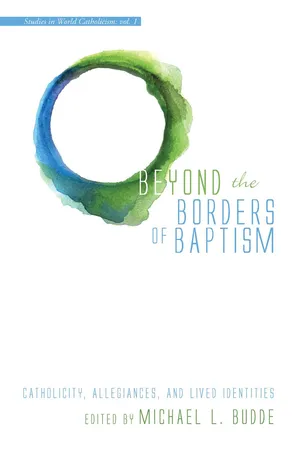
Beyond the Borders of Baptism
Catholicity, Allegiances, and Lived Identities
- 366 pages
- English
- ePUB (mobile friendly)
- Available on iOS & Android
eBook - ePub
About this book
People worldwide find themselves part of overlapping communities of identity and belonging--racial, political, cultural, sexual, ideological. Some identities, like brand loyalties, are chosen; some, like class identity, are imposed.
As followers of Jesus Christ, those called to live iln between the age that is and the age to come, Christians ask what it means to be part of the body of Christ, God's new creation from among the nations, in a world filled with other nations. "Who--and whose--are we?" There is no easy answer, no time at which Christians got it completely right. Yet such questions must be addressed, and the stakes are high. Matters of war and peace, exclusion and inclusion, who starves and who does not, the credibility of the gospel itself--all are caught up in the whirl of identities, allegiances imposed or refused, and questions about what "the church" might possibly mean in such circumstances.
In this book, a distinguished group of scholars from five continents asks, "How can the church respect the diversity of its members--many nations, cultures, and communities--while maintaining a coherent witness to the kingdom of God that is not undermined by more parochial ideologies or priorities?"
Chapter Contributors:
Braden Anderson
Maria Clara Lucchetti Bingemer
Michael Budde
Matthew Butler
William Cavanaugh
Jose Mario Francisco
Peter Galadza
Stanley Hauerwas
Daniel Izuzquiza
Slavica Jakelic
Pantelis Kalaitzidis
Eunice Karanja Kamaara
Emmanuel Katongole
Dorian Llywelyn
Martin Menke
Agbonkhianmeghe E. Orobator
A. Alexander Stummvoll
Information
Topic
Theologie & ReligionSubtopic
Christliche TheologiePart One
Identities, Allegiances, and Theological Reflections
1
Thinking Theologically about Identity and Allegiances: Parables of a “New We”
Do not conform yourself to this age, but be transformed by the renewal of your mind, that you may discern what is the will of God, what is good and acceptable and perfect. (Rom 12:2)
Introduction: Nyamata, 1998
The question of identity, allegiance, and being a Christian is not a speculative theological question. It is a concrete and urgent question, particularly in our time, living as we are after the 1994 Rwandan genocide. In less than a hundred days, close to a million Rwandans—mostly Tutsis—were killed by their neighbors and countrymen (mostly Hutus). The greatest irony of this genocide of our time is that it happened in one of the most Christianized countries in Africa, where at least 70 percent of the population was Catholics and 15 percent Protestant.1 This means that almost all of the victims and their killers were Christians, who had been baptized and often worshipped in the same churches where a number of the killings took place. The church of Nyamata was one such killing field. I visited the church of Nyamata in the summer of 1998, on my first visit to Rwanda after the genocide. Even though it had been four years since the genocide, the empty church carried fresh memories of what had happened here. The corrugated tin roof was pierced by bullet holes and bore visible bloodstains; the church basement, accessible down steep steps in the back, had been converted into a permanent catacomb. On either side of its very narrow hallways were racks of skulls, bones, coffins, and personal belongings of the more than eight thousand people who had been killed inside the church. The expansive main area of the church was empty. The altar’s white sheet covering still bore bloodstains. The tabernacle stood wide open; the marble baptismal font was chipped in a number of places, obviously by machetes intended for some of the victims.
As I stood in horrified silence in the empty church, a number of questions ran through my head. How could this have happened in this beautiful and deeply Christian country? Why was the Catholic Church never able to provide a bulwark against the slaughter of Rwandans by their neighbors, being instead, as some cases indicated, a contributing factor in the killing?2 The fact that the genocide started during Easter week added more irony and contradiction. For obviously, many of the victims had celebrated Christ’s Resurrection from the dead, thus becoming the first fruit of God’s new creation, here in this very church, together with the killers. Was all the talk of new identity, new life with God—words that describe the life of the Christian—nothing but mere spiritual platitudes that actually meant very little in the “real” world? What, then, is the relationship between one’s biological, national, racial, or ethnic identity and the reality of baptism? Does the blood of tribalism run deeper than the waters of baptism?
I begin with the vivid memory of Nyamata for two reasons. First, it is to make the point that any reflection about identity, allegiance, and being a Christian cannot proceed in an abstract fashion. It must always draw attention to a particular place (America, Africa, Rwanda—to the extent these notions are places) and begin by paying attention to the contradictions within which Christians find themselves as they engage the politics of their nations. But I also begin with the memory of Nyamata because it is now clear that what happened in Rwanda in 1994, while extreme and particularly intense, is by no means exceptional. For as Michael Budde notes, Christians readily kill other Christians in service to the claims of state, ethnicity, or ideology.3 Moreover, such killing has become so commonplace that we no longer see this as a scandal to the Christian gospel.4 That is why Rwanda does serve well as a mirror—indeed, as a metaphor—for the modern forms of tribalism that habituate Christians to live in ways that assume that bonds of tribalism, nationalism, racism, or ethnicity run much deeper than the waters of baptism.5 Accordingly, reflecting on Rwanda might provide us with much-needed lessons for learning how to think theologically about identity and belonging in our time.
Learning to Think Theologically about Identity: The Dialectical Task
Learning to think theologically about identity involves two interrelated tasks, an intellectual as well as a practical one. These interconnected tasks are nicely captured by Paul’s words in his letter to the Romans, when he warns his audience, “Do not conform yourself to this age, but be transformed by the renewal of your mind, that you may discern what is the will of God, what is good and acceptable and perfect” (Rom 12:2).
Time and occasion do not allow us to get into the historical, hermeneutical, and literary issues connected with Paul’s letter to the Romans and this particular recommendation. What is clear is that, comprised of both Jewish and Gentile Christians, the church of Rome experienced some “tensions.” In writing this encouraging letter to the Romans, Paul highlights the new life of hope and freedom in Christ that God’s love has given to all through God’s unmerited justification. As bearers of this new life, Roman Christians must learn to think of themselves in a “new” way—not as Gentile and Jewish in the first place, but as God’s new people, made such through God’s unmerited grace. It is within this context that he urges them to “not conform to this age” but to live transformed lives. What is of particular significance for us here is the way that Paul suggests that Roman Christians might be able to go about the business of “being transformed.” They do so, according to Paul, in two interconnected ways. First, it is by the “renewal of your minds.” What Paul recommends here is not a one-time “making up” of their minds but a “renewal,” which is to say an ongoing (trans)formation of their minds, which is realized through cultivation of the relevant habits of mind. This renewal is about developing the necessary mental capacities and categories to enable them to think rightly—that is, in a manner consistent with their new status as God’s people, made thus not through the law (the old categories) but through God’s grace.
Second, Paul shows that learning to think properly—while it is about developing the right mental capacities and categories—is not a detached intellectual exercise. Rather, it is dialectically connected to, and at the same time made possible by, relevant patterns of living. It is connected with the ability to “discern what is the will of God, what is pleasing, perfect, and true.” The key term here is “discern,” which various translations render differently: “to test and approve what God’s will is” (New International Version); “to learn and know God’s will” (English Standard Version); “to prove what the will of God is” (New American Bible).
What the various translations confirm is the practical dimension of discernment as a form of living out the will of God: what is good, acceptable, and perfect. Moreover, if these different expressions (“test,” “learn,” “know,” and “prove”) seem to reflect a certain tentativeness in Paul’s recommendation, they point to a crucial dimension of ad hoc discernment, experimentation, an ongoing negotiation of their new identity, which requires the formation of both relevant mental capacities and practical disciplines. These disciplines are at once as subversive (i.e., do not conform to the patterns of this world) as they are revelatory of what is good, pleasing, and perfect. Moreover, this way of understanding who they are and living in the world is a form of politics (“politics” here understood as the configuring of bodies in space and time).6 That is why, in the end, thinking correctly about Christian identity is about learning to see one’s body as both the site of resistance and the revelation of that new reality of God’s justification. Thus, in the opening words of Romans 12, which immediately precede the exhortation not to conform to this age, Paul states, “Therefore, I urge you, brothers and sisters, in view of God’s mercy, to offer your bodies as a living sacrifice, holy and pleasing to God—this is your true and proper worship” (Rom 12:1 NIV).
This is what learning to think theologically about identity, allegiance, and being a Christian is about. But I realize I have jumped ahead of myself. My intention in drawing attention to Paul’s exhortation to the Romans here was to highlight the two dialectical requirements of Christian identity: the cultivation of relevant mental capacities and categories on the one hand and, on the other, the formation of relevant practical skills and postures that enable one to negotiate one’s Christian identity in the world. Let me now try to highlight each of these dialectical requirements by drawing some crucial lessons from the Rwandan genocide, so as to provide more concrete and specific suggestions of what these might look like for us today.
Christian Identity as “Political” Identity
Rwanda forced me to rethink issues of ethnicity and nationalism and, overall, the status of so-called natural identities. The way the genocide in Rwanda was explained by Western media (and governments)—a myth that was reproduced throughout the world, including in Africa—was that the genocide in Rwanda was nothing but the playing out of age-old animosit...
Table of contents
- Acknowledgments
- Introduction
- PART ONE: Identities, Allegiances, and Theological Reflections
- PART TWO: History, Context, Theology, and Eschatology: Notes, Experiences, Suggestions, and Possibilities
- PART THREE: In Lieu of a Conclusion
- Bibliography
Trusted by 375,005 students
Access to over 1.5 million titles for a fair monthly price.
Study more efficiently using our study tools.
Frequently asked questions
Yes, you can cancel anytime from the Subscription tab in your account settings on the Perlego website. Your subscription will stay active until the end of your current billing period. Learn how to cancel your subscription
No, books cannot be downloaded as external files, such as PDFs, for use outside of Perlego. However, you can download books within the Perlego app for offline reading on mobile or tablet. Learn how to download books offline
Perlego offers two plans: Essential and Complete
- Essential is ideal for learners and professionals who enjoy exploring a wide range of subjects. Access the Essential Library with 800,000+ trusted titles and best-sellers across business, personal growth, and the humanities. Includes unlimited reading time and Standard Read Aloud voice.
- Complete: Perfect for advanced learners and researchers needing full, unrestricted access. Unlock 1.5M+ books across hundreds of subjects, including academic and specialized titles. The Complete Plan also includes advanced features like Premium Read Aloud and Research Assistant.
We are an online textbook subscription service, where you can get access to an entire online library for less than the price of a single book per month. With over 1.5 million books across 990+ topics, we’ve got you covered! Learn about our mission
Look out for the read-aloud symbol on your next book to see if you can listen to it. The read-aloud tool reads text aloud for you, highlighting the text as it is being read. You can pause it, speed it up and slow it down. Learn more about Read Aloud
Yes! You can use the Perlego app on both iOS and Android devices to read anytime, anywhere — even offline. Perfect for commutes or when you’re on the go.
Please note we cannot support devices running on iOS 13 and Android 7 or earlier. Learn more about using the app
Please note we cannot support devices running on iOS 13 and Android 7 or earlier. Learn more about using the app
Yes, you can access Beyond the Borders of Baptism by Michael L. Budde, Budde in PDF and/or ePUB format, as well as other popular books in Theologie & Religion & Christliche Theologie. We have over 1.5 million books available in our catalogue for you to explore.