eBook - ePub
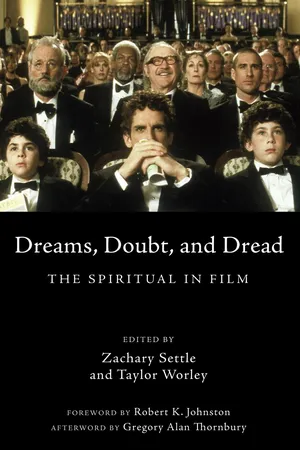
Dreams, Doubt, and Dread
The Spiritual in Film
- 222 pages
- English
- ePUB (mobile friendly)
- Available on iOS & Android
eBook - ePub
About this book
Films are modern spiritual phenomena. They function as such in at least three profound ways: world projection, thought experiments, and catharsis (i.e., as dreams, doubt, and dread). Understanding film in this way allows for a theological account of the experience that speaks to the religious possibilities of film that far extend the portrayal of religious themes or content. Dreams, Doubt, and Dread: The Spiritual in Film aims to address films as spiritual experiences. This collection of short essays and dialogues examines films phenomenologically--through the experience of the viewer as an agent having been acted upon in the functioning of the film itself. Authors were invited to take one of the main themes and creatively consider how film, in their experiences, has provided opportunities for new modes of thinking. Contributors will then engaged one another in a dialogue about the similarities and differences in their descriptions of film as spiritual phenomena. The intended aim of this text is to shift contemporary theological film engagement away from a simple mode of analysis in which theological concepts are simply read into the film itself and begin to let films speak for themselves as profoundly spiritual experiences.
Information
Subtopic
Art religieuxDread
Beyond Death?
Alejandro González Iñárritu’s Grief Trilogy
Now everything is quiet. I can no longer reach her. A frightful emptiness surrounds me. Everything I encounter impresses me with the contrast between visible, earthly reality and the puzzling absence of the one I love. I have lost the one human person loved by me without measure or comparison. I am caught up in the tedium of life. I am filled with disgust and emptiness over the rhythm of everyday life that goes on relentlessly—as though nothing had changed, as though I had not lost my precious beloved!
—Dietrich von Hildebrand, Jaws of Death, Gate of Heaven185
To have a friend, to look at him, to follow him with your eyes, to admire him in friendship, is to know in a more intense way, already injured, always insistent, and more and more unforgettable, that one of the two of you will inevitably see the other die.
—Jacques Derrida, “The Taste of Tears”186
Suffering is optional, but pain is inevitable.
—Alejandro González Iñárritu187
Introduction: Love, Loss, and Dread
With brutal clarity, Ludwig Wittgenstein reminds us, “My death is not an event in my life.” As many philosophers before and since have affirmed, we are never present to our own deaths. The reality of death is instead something we have to experience in the death of another.188 We must see our death in the death of the other; and many of the greatest works of art simply return us to this tragic truth. This, I understand, to be the function of dread in art. By their intimate attention to the reality of the other’s death and the enduring weight of human grief, the films of Alejandro González Iñárritu (Mexican, b. 1963) offer a renewed awareness of our fragility and impermanence.189 Their anxiety over death extends far beyond the flatly depressive. Rather, these films fill us with an animating dread—a dread that quickens our attention to what is left of our own lives. His is a dread with redemptive aims.
Beyond mere elegy, Iñárritu’s films catalyze feelings of dread through a subtle but poignant interplay of bodily presence and absence. By de-stabilizing the emotional distance felt by his protagonists between the lives of loved ones both present and gone, we are haunted by the emotional inversions embedded within our own experiences of love and loss. Such inversions emerge when we realize that being receptive and responsive to another entails being fully present to the reality of that other’s eventual departure. Or, to perceive the full loss in the death of another means to know and grasp their imagined presence in the event of their absence. Dread inhabits this experience of knowing absence in another’s presence and sensing presence in another’s absence. We must indeed find ourselves here and accept this emotional hesitancy, this feeling of being caught in the back-and-forth of time with and time without our loved ones. Iñárritu’s subtle power lies in presenting us with an arresting and elusive image of this experience. His films rehearse such moments of emotional instability, and in their mournful vertigo they restore us to the vain but all-too-human pursuit in attempting to stall the death of a loved one.
Iñárritu’s Trilogy of Grief
As one of the few remaining auteurs in contemporary commercial film, Iñárritu occupies a distinctive place in recent film history. His status in the pantheon of contemporary filmmakers is unique in that he fiercely guards his artistic choices and follows his creative pursuits without hesitation, and yet the accolades and awards continue to mount up, especially in the wake of 2014’s Birdman: Or (The Unexpected Virtue of Ignorance). Though he collaborates with some of the most creative figures in filmmaking today, much of the attention centers on Iñárritu himself because of the way in which he continues to play so many roles in the production of his films, often writing, directing, producing, and even editing these works. Simultaneously a business outsider and a critical darling, he continues to press questions of ultimacy and timeless significance while remarkably maintaining a richly emotional center to all his films. On this point, he remains unapologetic:
There is this apocalyptic urgency that has been treated with irony for years, and I try to stay away from irony, which I personally don’t like. Irony is a great tool to deal with things. It’s an intellectualization, a way to go above things, which can work. But I think that, in the last fifty years, pop culture has been a victim of an excess of irony, and anything earnest or truthful or emotional isn’t cool anymore. Every institution has collapsed. And if there’s nothing, if everybody agrees that the way to approach it is with a degree of irony, there is nothing else.190
For much of his career, Iñárritu has paired the un-ironic tone of his stories with a novel storytelling technique: the multi-linear, multiprotagonist drama. While films like Akira Kurosawa’s Rashômon and Robert Altman’s Short Cuts came before him and lots of filmmakers are still trying their hand at the format, no one has harnessed the pathos of the multiprotagonist film like Iñárritu. Effectively disorienting his audience and confounding their ironic sensibilities for a time, to experience Iñárritu’s films is to enter into a tangled web of imperfect lives mutually effected and shaped by each other’s frail choices. Reflecting on Babel, he explains how this jumbled approach to storytelling helps foreground the emotional essence of the films:
Babel is the culmination of my exploration of scrambled narrative patterns. It’s a fragmented emotional experience, which is, after all, what cinema is about. Movies rely on the juxtaposition of several elements that, from a rational point of view, shouldn’t provoke any kind of emotional reaction, but our brain links these two images, and there’s an emotion.191
While he ended the strictly multi-linear approach with Babel, the consistency of technique in his earliest films resulted in being designated a trilogy after the fact. This multiprotagonist trilogy (i.e., Amores Perros, 21 Grams, and Babel) has often been referred to as Iñárritu’s “death triology.”192 For the purposes of this engagement, we will limit ourselves to what we might label his grief trilogy (i.e., 21 Grams, Babel, and Biutiful). It is, after all, the emotional landscape and not the visual aesthetic that takes precedence in his work. We will therefore leave out his first experiment Amores Perros and his recent comedy Birdman. 21 Grams, Babel, and Biutiful are the best examples for how Iñárritu dramatizes the interplay of love and loss, the inversion of presence and absence—the dialectic of death, if you will. These films simulate the experience of the phantom limb as an emotional or spiritual reality. Death’s amputation can distort but not ultimately remove the emotional structure of Iñárritu’s characters. They are forced to re-negotiate themselves in relation to the world by means of navigating the force of these losses. When asked about the role of fate and chance in his films, Iñárritu responds from a primarily ethical rather than purely epistemological perspective. He concedes that we cannot tell the difference, but we must react and respond regardless. His films focus on how his characters respond to fateful or random tragedies:
We react to a crisis, to an illness, to a tragic event. We also generate things ourselves, but to a much lesser extent. These events force us to make decisions and confront us with our deepest feelings and our links with other human beings. . . . How does somebody react to an accidental and tragic event? Where’s the line between destiny and coincidence? It’s difficult to tell. But I personally think that it is our reactions to things that move the world. There is this sentence that my father used to say and that has always traumatized me. I used it in Amores Perros: “If you want to make God laugh, tell him your plans.”193
Within this trilogy of grief, Iñárritu’s use of the death theme shifts and contorts, manifesting complementary but distinct experiences of cathartic pain and suffering. In their own way, each of these films leaves us shaken and somehow also steeled against the loss of love around us. They make us freshly aware of death, attuned to the inevitable loss of all and yet already grasping their memory with us now.
21 Grams
While similar to its multiprotagonist antecedent and successor, 2003’s 21 Grams remains Iñárritu’s most austere and oppressively heavy film to date. Surpassing even the straightforwardly somber tone of Biutiful, this film also represents his most disorienting experience of cinematic time. While Amores Perros and Babel play with a sense of narrative simultaneity, 21 Grams is completely jumbled and non-sequential. We must forestall our reflex to order the narrative so as to reckon with the emotional weight of what its characters convey to us. Iñárritu explains his editing choices in this way: “I was looking for an emotional structure in a completely atemporal storyline.”194 What results is an experience of a sort of pure grief, a stark and severe grief that can present itself to us in harshly religious terms. The cruel convergence of the lives in this story forces its characters, and by extension the film’s audience, to ask impossible questions and probe into the sheer mystery of how such disparate lives would be bound together in tragedy and grief. To invoke such answers is to invoke the divine other.
When Jack Jordan, the recently released convict and newly converted believer, accidentally kills a father and his two daughters in a hit and run, three lives become inseparably bound together in the mutual implications of his crime. Shattered by the loss of her husband and children, Cristina Peck descends into a destructive spiral of self-abuse and lust for revenge. Paul Rivers and his chronically ill heart have a new lease on life because Cristina’s husband was an organ donor, but gratitude for his renewed health prompts him to seek out the donor’s story, which quickly leads to infatuation with his donor’s wife. Paul’s efforts to protect the wounded and fragile widow soon make him complicit in her attempted revenge against Jack. Though audiences can only piece together this picture of the thre...
Table of contents
- Title Page
- Contributors
- List of Illustrations
- Acknowledgments
- Foreword
- Introduction: Thinking How Film Feels
- Dreams
- Doubt
- Dread
- Afterword
Trusted by 375,005 students
Access to over 1.5 million titles for a fair monthly price.
Study more efficiently using our study tools.
Frequently asked questions
Yes, you can cancel anytime from the Subscription tab in your account settings on the Perlego website. Your subscription will stay active until the end of your current billing period. Learn how to cancel your subscription
No, books cannot be downloaded as external files, such as PDFs, for use outside of Perlego. However, you can download books within the Perlego app for offline reading on mobile or tablet. Learn how to download books offline
Perlego offers two plans: Essential and Complete
- Essential is ideal for learners and professionals who enjoy exploring a wide range of subjects. Access the Essential Library with 800,000+ trusted titles and best-sellers across business, personal growth, and the humanities. Includes unlimited reading time and Standard Read Aloud voice.
- Complete: Perfect for advanced learners and researchers needing full, unrestricted access. Unlock 1.5M+ books across hundreds of subjects, including academic and specialized titles. The Complete Plan also includes advanced features like Premium Read Aloud and Research Assistant.
We are an online textbook subscription service, where you can get access to an entire online library for less than the price of a single book per month. With over 1.5 million books across 990+ topics, we’ve got you covered! Learn about our mission
Look out for the read-aloud symbol on your next book to see if you can listen to it. The read-aloud tool reads text aloud for you, highlighting the text as it is being read. You can pause it, speed it up and slow it down. Learn more about Read Aloud
Yes! You can use the Perlego app on both iOS and Android devices to read anytime, anywhere — even offline. Perfect for commutes or when you’re on the go.
Please note we cannot support devices running on iOS 13 and Android 7 or earlier. Learn more about using the app
Please note we cannot support devices running on iOS 13 and Android 7 or earlier. Learn more about using the app
Yes, you can access Dreams, Doubt, and Dread by Zachary Thomas Settle,Taylor Worley, Settle, Worley in PDF and/or ePUB format, as well as other popular books in Théologie et religion & Art religieux. We have over 1.5 million books available in our catalogue for you to explore.