- 140 pages
- English
- ePUB (mobile friendly)
- Available on iOS & Android
eBook - ePub
About this book
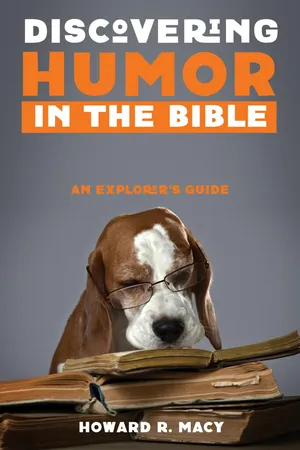
Some folks are surprised to find humor in the Bible; they don't think it has any. Others are embarrassed; they worry about being sacrilegious. Some laugh and don't tell anyone; others laugh out loud and share it with those around. However people respond, the Bible does, in fact, use humor. This book examines why it's there, why it matters, what it looks like, how to look for it, and what to do with it when you find it.
The author's goal is to help people become better Bible readers, growing in both skill and insight. So the book doesn't just display a collection of museum pieces, showing the treasures of other explorers. Instead, it offers readers tools and field guides to become explorers discovering on their own. It's a fun how-to manual, dealing with what is routinely overlooked in teaching about biblical interpretation. Individuals will enjoy reading it, but it's also a rich resource for reading groups, Bible study groups, and classes.
Information
Topic
Theology & ReligionSubtopic
Biblical StudiesI.
Discovering Humor
1.
Why Humor in the Bible?
Why would the Bible use humor? Why would you look for it there? After all, the Bible is a serious book; people look to it to guide their lives. It shows us how to relate to God and to each other. It’s supposed to tell the truth, not crack jokes.
Asking such questions is partly right, given some of the ways that we use humor in our culture. Many folks see humor as merely flippant or frivolous and they dismiss it as light entertainment. So it’s easy to forget that funny isn’t always just for fun. Also, people often use humor to belittle or to poke fun, and Bible readers sure don’t want to ridicule or discredit Scripture. Frankly, because so much of contemporary humor relies on insults and the rude and crude, it’s no surprise that some folks are jumpy about associating humor with the Bible.
Actually, humor at its best is a gift. It offers a gracious reality check to help us reflect on, or just get glimpses of, our powers, our limits, and our frailty. We need laughter when we discover, once again, that our best plans turn out to be losers. Or when catastrophes erupt when we have everything under control. Without humor we can get grim and get trapped in denial. With humor we can step back, look from another angle, and imagine new possibilities. A lot of the Bible’s humor celebrates—surprise! surprise!—that there is power and possibility that transcends our frailty.
But wait, there’s more! Humor can work wonders. Not only can it relieve stress, make you healthier, and help relationships run smoothly, it can tell the truth and make you smile. Oscar Wilde once called attention to humor as a health benefit: “If you want to tell people the truth, make them laugh, otherwise they’ll kill you.” Apart from not getting killed, however, I’m going to skip the health benefits here (you’ve probably seen tons of articles about that) and go directly to saying it’s fine if the Bible sometimes entertains you and even makes you laugh out loud.
A young man once told me how the Bible unexpectedly made him laugh out loud. He had become a Christian during his college years and decided that now he needed to read the Bible. So he started at the beginning, read lots of stories, ploughed through instructions about how to gather manna and offer animal sacrifice, through battles won and lost, and even more until he came to the story of David faking insanity by rolling on the ground and foaming at the mouth when the guards at an enemy town identified him (wrongly) as “the King of Israel.” The guards then took him to their King Achish, who said, “Can’t you see he’s crazy? Why bring him to me? Am I short on insane people that you’ve brought this person to go crazy right in front of me? Do you really think I’m going to let this man enter my house?” (1 Samuel 21:14–15 CEB). Suddenly, my friend laughed out loud! Here’s a priceless, throw-away laugh line. How could you not laugh? And how could the writer not include a line like “Am I short on insane people . . . ?” even if it’s not to make a theological point? I was glad my friend laughed, even though he had missed a lot more funny stuff on the way. (It’s funny, too, that crazy David later went to work for this king. And hoodwinked him. So the laugh also points to David’s shrewdness and the king’s gullibility.)
Humor engages us. It can capture us, pique our interest, and keep us involved. We like teachers and storytellers who have a sense of humor, who can draw us along with a funny word picture or turn of phrase. Sometimes they use humor to make our favorite characters even more endearing. For example, Abraham falls on the ground laughing (ROFL), not in awe, right in front of God when God tells him that at 100 years old he’ll be a father. Young David’s brothers trash-talk him when he brashly asks Israel’s soldiers why Goliath scares everyone. Funny stories of near escapes and mischievous exploits often add charm to our heroes.
Humor helps us remember, too. Laughter makes our brains stickier. That’s one reason that short sayings like proverbs often include funny images or word-play. I often remember the wise and funny advice, “If you wake your friend early in the morning by shouting ‘Rise and shine!,’ it will sound to him more like a curse than a blessing” (Proverbs 27:14, The Message). And who can forget stories about a short guy who scrambles up a tree to see Jesus or about the daring disciple who starts to walk on water then sinks like a rock?
Humor can also sneak up on you and whack you on the side of the head. Or slip in the back door of your thinking while you’re fiercely guarding the front. Or scramble your well-ordered ideas and leave you thinking, “Say what?!” Jesus often did that with parables. I suspect that Jesus’ disciples both smiled and scratched their heads wondering what in the world he meant by telling the story about a rich man who commended his dishonest manager for being clever (Luke 16).
Best of all, humor doesn’t just crack jokes, it tells the truth. Sometimes it’s the very best way, maybe the only way, to tell the truth. In the Bible that’s partly because God acts in such absurd and outlandish ways. “A good joke,” writes Frederick Buechner, “is one that catches you by surprise—like God’s, for instance. Who would have guessed that Israel of all nations would be the one God picked or Sarah would have Isaac at the age of ninety or the Messiah would turn up in a manger? . . . The laugh in each case results from astonished delight at the sheer unexpectedness of the thing. . . . When God really gets going, even the morning stars burst into singing and all the sons of God shout for joy” (Beyond Words, 162–63).
The Bible revels in its menagerie of unlikely heroes, of folks who said, “Who me? Do what!?” Its Hall of Fame shows off winners that made people say, “Who woulda thunk that he (or she!) would rescue us?!” It gives us tale after tale of comic reversals and narrow escapes. It tells stories of messy relationships, often awkward and funny. And as the Bible speaks of grace, that gift itself dazzles with absurdity and surprise. If we’re smart, we welcome it. How can we not laugh, too, and sing and shout for joy?
Comedy writers know that humor often grows out of tragedy plus time. Humor gives us perspective. Harrowing tales can become humorous stories without undercutting the tragedy and terror of the first moments. For example, 1 Samuel contains many episodes about the decline of Saul and the steady peril of David, who is betrayed and running for his life. The narrators keep the tragic core, but they also can make us laugh by showing the bigger-than-life absurdities in the stories and portraying David sometimes as an uncanny escape artist and trickster.
Think, too, of Belshazzar throwing a huge festival to celebrate his being invincible, the king of the cosmos. The storytellers had to be going for a laugh when they tell us that when Belshazzar saw a hand writing on the wall, “his limbs gave way [“the joints of his loins were loosened” (JPS)] and his knees knocked together.” The laugh takes nothing away from the terrifying moment. For Israel’s storytellers, humor heightens it and deepens the celebration of God’s liberating act.
I find both high-stake drama and humor in the story about Paul and Barnabas visiting the city of Lystra. After they healed a man crippled from birth, the astonished locals decided that Paul and Barnabas were the gods Zeus and Hermes, and they brought bulls and wreaths to make sacrifices to them. The missionaries barely kept them from it, all the while protesting, “People, what are you doing? We are humans too, just like you!” and speaking to them about God’s goodness. In a sudden turn, the crowd quit trying to sacrifice, stoned Paul instead, and left him for dead. He later got back up and walked to town—and left the next day. At one level this is a tragic story, filled with confusion and violence. At another, though, the joyful healing, the crowd’s lavish surge to worship, and the abrupt reversal toward stoning all share over-the-top surprises that can make us giggle.
Even though the Bible uses humor generously and for good reasons, a lot of folks miss it or even don’t want to see it. Of course, some folks may not have a sense of humor, but nobody will admit that, so we’re not going there. Yet some people with a great sense of humor can’t imagine that the Bible, serious as it is, would include humor, so they don’t expect it and don’t look for it. That’s more innocent than actively resisting the idea because what you believe about how the Bible has to work leaves humor out completely. If you’ve read this far, that probably doesn’t include you.
Many readers simply don’t know what to look for. If we think that humor in the Bible mostly looks like stand-up comedy or telling jokes, we won’t see much of that. Nor will we discover humorous writing in the styles of Mark Twain, Dave Barry, Patrick McManus, or Erma Bombeck. But humor has many devices and forms, which we’ll introduce shortly in this field guide. We’ll also suggest ways of reading that can help us see what’s there.
Sometimes people will miss the Bible’s humor because they know the Bible so well. It’s too familiar. They already “know” what’s there, so may read inattentively, a bit hurried and numb. Or they may read too intensely, trying to wring every drop of meaning out of the text. When people I’m with are convulsively serious, I love throwing in a non sequitur or a bit of silliness and watching it fly by completely unnoticed. Or seeing a delayed smile or brain sproing. This can happen in Bible reading, too. Readers who know the Bible well can learn to read with new eyes.
Other folks don’t know the Bible quite well enough. They may not know the longer storylines that provide context and background detail for individual stories. To see the humor in the sister fights between Leah and Rachel, for instance, it helps to know the backstory of how they both became Jacob’s wives and of how one became a baby factory while the other was barren. Similarly, knowing what a fighting family Joseph’s brothers were helps set up his quip when he sends them from Egypt to bring his father, “Don’t quarrel along the way.” Some readers may not have absorbed enough of cultures foreign to us to catch the glaring mistakes and awkwardness that both create and signal humor. For example, you have to understand how devoted a kosher kid Peter was when he had a vision in which he was offered, and told to eat, distinctly non-kosher foods—ham sandwiches, cheeseburgers, lobster, and more—a whole buffet full. Once you see how startling and outrageous it is, you can also see its humor. For that matter, it helps to know what kosher dietary laws meant to Jewish folk in his time. The good news is that readers who don’t know the Bible well can both expand their knowledge and sharpen their eyes.
Found humor versus created humor
Please remember that my goal here is not to introduce humor into the Bible or to joke about the Bible, but to discover where biblical writers have intentionally used humor. To honor that difference, I find it useful to distinguish between “created humor” and “found humor.” Created humor is when we play with the text in ways that make us laugh. Found humor is when we see how an author has used humor to make us laugh. Both are fine, in my judgment, but we need to honor the difference.
Probably most of us have used “created humor” in reading the Bible. Many of us have told jokes or asked questions about Noah, for example: What did he do with the termites? Who had to shovel out the bottom of the boat? What kind of crazy things did his neighbors say to him? Or we might have joked about eating manna for forty years and wondered about manna recipes—manna burgers, mannacotti, bamanna bread, etc. You may have wondered with me whether Abraham’s entourage objected when they learned the sign of the covenant was to be circumcision: “Say what?! Couldn’t we just shake hands?” Or maybe we’ve chuckled about Lazarus stumbling out of his tomb in grave clothes, smelling bad, and startled to see such a crowd. In some instances we may play with or elaborate a bit on the humor the writers have given us, a kind of middle ground, but we do need to know when we, not the author, have brought the humor.
Sometimes readers will laugh at names or practices that seem odd to them, but that mostly comes from the huge cultural distance between our time and theirs. When we were expecting our first child, I teased my mother that we would name him Maher-shalal-hash-baz, what Isaiah named one of his sons. I laughed; she was somewhere between amused and terrified. I’m not sure Isaiah’s kid ever laughed about it. Sometimes writers use names and name-changes in funny ways. For example, the Hebrew name Nabal means “fool” (some study Bible footnotes will tell you that), and the story about him in 1 Samuel 25 plays that to the hilt. But often when we laugh at names, we’re introducing created humor.
So also with cultural practices that seem odd to us. One that even the Bible needed to explain was how a guy took off his sandal and handed it to Boaz to seal a deal that let Boaz buy a field and take Ruth as his wife. I know a lot of folks have laughed at the prospect that we might take off our shoes to make a deal. We might rightly expect to find many ancient practices that make us giggle a bit.
By distinguishing between created and found humor we can learn to see where the biblical writers have intended to use humor and try to understand what they were up to.
2.
How Do You Read?
To see humor in the Bible, most of us need to change how we normally read. In the rush of our lives, many of us read quickly, skim, or even “retinize” the text, letting the image of the page bounce off the back of our eyeballs. We’ll breeze through the news, snag a weird or snarky headline, glance at sports scores or stock prices, and quickly check the obits to s...
Table of contents
- Acknowledgements
- Abbreviations
- Introduction: An Invitation
- PART I: Discovering Humor
- PART II: Field Guides for Explorers
- PART III: Reports from the Field
- Select Bibliography
Trusted by 375,005 students
Access to over 1.5 million titles for a fair monthly price.
Study more efficiently using our study tools.
Frequently asked questions
Yes, you can cancel anytime from the Subscription tab in your account settings on the Perlego website. Your subscription will stay active until the end of your current billing period. Learn how to cancel your subscription
No, books cannot be downloaded as external files, such as PDFs, for use outside of Perlego. However, you can download books within the Perlego app for offline reading on mobile or tablet. Learn how to download books offline
We are an online textbook subscription service, where you can get access to an entire online library for less than the price of a single book per month. With over 1.5 million books across 990+ topics, we’ve got you covered! Learn about our mission
Look out for the read-aloud symbol on your next book to see if you can listen to it. The read-aloud tool reads text aloud for you, highlighting the text as it is being read. You can pause it, speed it up and slow it down. Learn more about Read Aloud
Yes! You can use the Perlego app on both iOS and Android devices to read anytime, anywhere — even offline. Perfect for commutes or when you’re on the go.
Please note we cannot support devices running on iOS 13 and Android 7 or earlier. Learn more about using the app
Please note we cannot support devices running on iOS 13 and Android 7 or earlier. Learn more about using the app
Yes, you can access Discovering Humor in the Bible by Howard R. Macy in PDF and/or ePUB format, as well as other popular books in Theology & Religion & Biblical Studies. We have over 1.5 million books available in our catalogue for you to explore.