- 150 pages
- English
- ePUB (mobile friendly)
- Available on iOS & Android
eBook - ePub
About this book
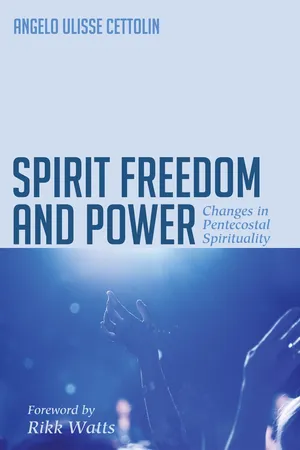
The Pentecostal movement emerged at the turn of the twentieth century emphasizing the need for Christians to have a powerful experience of the Holy Spirit. It advocated the return to a pristine early Spirituality in which empowerment by the Spirit was essential. Recently Pentecostal and Charismatic movements are playing down the classic expressions and moving towards more mainline approaches. As church movements develop they become more structured, less spontaneous and more routine. But is this always inevitable? The author explores a contemporary Pentecostal movement to discover whether a radical spirituality still can effectively interface with a complex twenty-first century world. This insightful research finds a Pentecostal spirituality that is flexible, adaptive and innovative and despite humble origins now is making inroads into the middle class. While tensions over charismatic freedom remain, the developing organizational structure is facilitating significant growth. Valuable lessons for Christians of all persuasions are found and some creative theological developments are suggested for church structure and for expanding traditional understandings of "baptism in the Holy Spirit."
Information
Topic
Theology & ReligionSubtopic
Christian Theology1
What Do We Mean by “Spirituality”?
Introduction
An empirical study into “spirituality” is initially confronted with the question of how to define the term. It may be the most ambiguous term in our time:
For those in the Church, some take the term for granted, some rigidly define it, and others seldom give it a thought. In broader circles, spirituality has come to mean an urge or power within us that drives us toward meaning for our lives.1
The English term “spirituality” may have been originally coined by Roman Catholic theologians to refer to a mystical relationship with God, but it is now commonly used to refer to a whole range of approaches existing in different branches of the church that allow a more personal and life-transforming relationship with the God that is revealed in Jesus Christ through the work of the Holy Spirit. In earlier centuries, Christians often used words like “devotion” or “piety,” but now these terms have developed a “flavor of other-worldly sentimentality.”2 In contrast, the term “spirituality” does not have the same connotation but is more inclusive of everyday life. Often the term is used to refer to levels of personal “spirituality.” People compare or measure themselves as being more or less spiritual than others and judge other people’s spiritual performance and state.3
Historical Use of the Term
In classical Greek thinking the philosophers saw all living things as possessing spirit (pneuma—the breath of life) and as having a soul or life principle (psyche). The soul was believed to be immaterial and to survive the death of the material body. Spirituality was the basis for human attributes of thought, language and rationality; it defined humanity.4
For Christians, on the other hand, the term “spirituality” leads first to a reflection on the person and work of the Spirit of God. It finds its root in the word “spirit,” which in biblical usage can refer to both the human spirit and the divine Holy Spirit. In the Old Testament, the word for “spirit” in Hebrew is ruach,5 and in New Testament Greek, pneuma.6 In ancient Israel as in ancient Greece, humans are considered to have the “breath of life” (ruach/spirit). However, the Old Testament provides another dimension of meaning because Israel’s God actually transcends the material world, which is his creation. The “Spirit of the Lord” (ruach elohim) is a manifestation of God’s power and wisdom.7 In the New Testament, although there is no direct Greek equivalent of the word “spirituality,” the Holy Spirit is often referred to as the transforming presence of God in the life of a believer.
Now, the Lord is the Spirit, and wherever the Spirit of the Lord is, he gives freedom. And all of us have had that veil removed so that we can be mirrors that brightly reflect the glory of the Lord. And as the Spirit of the Lord works within us, we become more and more like him and reflect his glory even more. (2 Cor 3:16–18 NLT)
It is right to speak of “Christian spirituality” as the term was in fact first used among Christians. Paul declares that the Holy Spirit assists us in our prayers and intercessions (Rom 8:26–27) and produces the qualities of a Spirit-controlled life (Gal 5:22–23). Paul also speaks of believers as spiritual or pneumatikos (1 Cor 2:13–15; 3:1; Gal 6:1). He makes the contrast with unbelievers whom he calls the psychikos, those without the Spirit.8 For New Testament exegete Gordon Fee, the evidence is
overwhelming that Paul, quite in keeping with first-century usage, never intended pneumatikos to refer either to the human spirit or to some vague idea like “spiritual,” which in English serves as an adjective meaning “religious,” “nonmaterial,” “spooky,” “nonsecular,” or “godly.” In every instance in Paul its primary referent is the Holy Spirit, even when contrasted with “material blessings” in 1 Corinthians 9:11.9
Fee goes on to clarify that God’s aim in our lives is “spiritual” in the sense that redeemed by the death of Christ, we might be empowered by his Spirit both “to will and do for the sake of his good pleasure.” True spirituality is nothing more or less than life in the Spirit:
One is spiritual to the degree that one lives in and walks by the Spirit; in Scripture the word has no other meaning, and no other measurement. . . . When Paul says to the Corinthians (14:27), “if any of you thinks he or she is spiritual,” he means, “if any of you think of yourselves as a Spirit person, a person living the life of the Spirit.” And when he says to the Galatians (6:1) that “those who are spiritual should restore one who has been overtaken in a transgression,” he is not referring to some special or elitist group in the church, but to the rest of the believing community, who both began their life in the Spirit and come to completion by the same Spirit.10
The failure to recognize the central role of spirituality in Paul has stemmed, in part, from the use of the lowercase English word “spiritual” to t...
Table of contents
- Preface
- Acknowledgments
- Introduction
- Abbreviations
- Foreword
- Chapter 1: What Do We Mean by “Spirituality”?
- Chapter 2: Early Pentecostalism
- Chapter 3: The Distinctiveness of Pentecostal Spirituality
- Chapter 4: Contemporary Pentecostal Spirituality
- Chapter 5: Assessing the Results
- Chapter 6: Reflections
- Chapter 7: Conclusion
- Bibliography
Trusted by 375,005 students
Access to over 1.5 million titles for a fair monthly price.
Study more efficiently using our study tools.
Frequently asked questions
Yes, you can cancel anytime from the Subscription tab in your account settings on the Perlego website. Your subscription will stay active until the end of your current billing period. Learn how to cancel your subscription
No, books cannot be downloaded as external files, such as PDFs, for use outside of Perlego. However, you can download books within the Perlego app for offline reading on mobile or tablet. Learn how to download books offline
Perlego offers two plans: Essential and Complete
- Essential is ideal for learners and professionals who enjoy exploring a wide range of subjects. Access the Essential Library with 800,000+ trusted titles and best-sellers across business, personal growth, and the humanities. Includes unlimited reading time and Standard Read Aloud voice.
- Complete: Perfect for advanced learners and researchers needing full, unrestricted access. Unlock 1.5M+ books across hundreds of subjects, including academic and specialized titles. The Complete Plan also includes advanced features like Premium Read Aloud and Research Assistant.
We are an online textbook subscription service, where you can get access to an entire online library for less than the price of a single book per month. With over 1.5 million books across 990+ topics, we’ve got you covered! Learn about our mission
Look out for the read-aloud symbol on your next book to see if you can listen to it. The read-aloud tool reads text aloud for you, highlighting the text as it is being read. You can pause it, speed it up and slow it down. Learn more about Read Aloud
Yes! You can use the Perlego app on both iOS and Android devices to read anytime, anywhere — even offline. Perfect for commutes or when you’re on the go.
Please note we cannot support devices running on iOS 13 and Android 7 or earlier. Learn more about using the app
Please note we cannot support devices running on iOS 13 and Android 7 or earlier. Learn more about using the app
Yes, you can access Spirit, Freedom and Power by Angelo Ulisse Cettolin in PDF and/or ePUB format, as well as other popular books in Theology & Religion & Christian Theology. We have over 1.5 million books available in our catalogue for you to explore.