- 106 pages
- English
- ePUB (mobile friendly)
- Available on iOS & Android
eBook - ePub
About this book
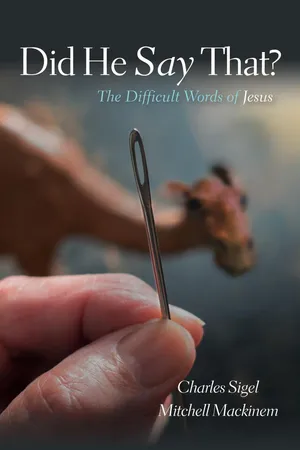
This book explores some of the "difficult" sayings of Jesus. They are "hard" sayings because through the centuries these sayings challenge the church and continue to challenge us. This study explores both how the church through its history has handled these sayings and what these sayings may say to us today. Over the centuries there have been many attempts to soften these saying to make them more palatable to the contemporary church. This book explores these alternatives while allowing the reader or class to come to their own answers about the meaning of these passages. Through careful examination of the wording, key terms, historical context, and the historical attempts to understand the "hard" saying, this book will allow the reader or class to explore the saying in greater detail and clarity.
Information
Topic
Teología y religión1
How to Read the Bible
There are many different ways to read the Bible. Some people will read a passage in English and then just take that passage in whatever way it strikes them. People have successfully the read the Bible this way for many years.
Others are what we call “cherry pickers.” They will look at a passage (for example, one about giving money) and track down every line in the entire Bible that refers to that passage. Then they will pull these many passages together to create some sort of unified picture.
Historians read the Bible as a historical narrative documenting the life and times of people who lived in a specific place. Classical scholars might see the Bible as shining a small light on the ancient world. In fact, there are as many approaches to reading the Bible as there are people.
Basic Assumptions
For us, the Bible is the inspired word of God in matters of faith and life. By “inspired” we mean the traditional idea that God breathed his life-giving breath into the word. From this beginning, we start with several basic assumptions about what we think the Bible is and how we might approach it.
First, the Bible is a long document written by many people over thousands of years. It is a story of the relationship between God and humans. We believe it is the story of how God has reached out to humankind over the millennia. We do not believe it to be a historical narrative, although history is in the narrative. We do not believe it to be a book of wisdom, although wisdom is certainly found there. It is not a blueprint for government, although there is much to be learned about governing. We do not believe it is a business document, although business leaders would do well to pay attention. It is a book of faithful people engaged in their ongoing quest to be in relationship with God and to understand God in their own lives.
Second, each book in the Bible reflects the person(s) who composed it, the time it was written, the audience for whom it was intended, and, most importantly, the understanding of God at that time and in that place. The earliest of the gospels, according to many scholars, is the Gospel of Mark, which was written around sixty years after the birth of Christ. The last of the four gospels is John’s, which was written at least one hundred years after the birth of Christ. Between the writing of the Gospel of Mark and the writing of the Gospel of John, the Romans had destroyed the temple, the Romans had killed Jews by the tens of thousands, the Gentiles had moved into Israel, and John’s world in general had become very different from the world of Mark. Their respective Gospels reflect these differences.
Third, the Bible was not composed in English. The Bible was written in Hebrew, Aramaic, and Greek. People have since translated these ancient languages into English. As with any translation, there are difficulties. Some Greek words do not translate well. Some English words carry connotations that would not have been there in the Greek. If many Aramaic and Greek words simply do not translate over into English, then there will be many legitimate versions based on different translations of the Bible. Remember, a committee produced the King James Bible, and the same is true for most popular Bible translations and versions.
Fourth, there is no one definitive, original Bible. There are no “original” books or letters. For every book of the Bible, there are hundreds and often thousands of ancient copies of the text. These copies were made by hand by scribes and do not fully agree with each other. It is often the case that 80 percent of the manuscript is consistent with all other known versions, 10 percent is close to other translations, and the remainder add or subtract words and phrases that do not match the other manuscripts. For the majority of these competing texts, any discrepancies tend to be quite small. For example, verb tenses and spelling are among the most common differences. Occasionally we find significant differences, however, making it difficult for scholars to try to piece together what the original document said.
Taken as a whole, the Bible is a living document full of humanity. It is not a fully transcribed, easily translated, and understandable book. The Bible warrants careful and thoughtful exploration and examination.
How to Read the Bible: The Basics
We suggest a simple approach to reading the Bible. There are five steps to reading any specific biblical passage. A passage need not be a single line but can instead be a collection of sentences that form a specific whole. In Greek, we call this a logion. As we go through this book together, you will see that we use the same basic approach:
1. What does the passage say?
2. How does that passage fit within its textual context?
3. What would the people of that day have heard?
4. What does this passage tell us about God?
5. What does this passage say to us, today?
After a brief explanation of these steps, we will look at a specific passage to see how each step might be applied.
In order to understand what a passage says, it is important for us to understand the many different ways its words can be translated and used. Remember that words not only have denotations, which are precise meanings or definitions, but also connotations, which are the word’s associated meanings. If we look at the word “law,” we find many denotations and connotations. Law is usually some type of code proscribing what cannot be done. Criminal and civil law holds a different meaning for us than Old Testament law, while hearing a pastor described as “too much on the law” evokes still another understanding. The point is that without modifying words for context, the word “law” tells us little. The Greek words often used in the New Testament pose the same problem as the word “law.” Unfortunately, very few of us read ancient Greek, so we cannot simply go and read the documents for ourselves. Instead, we have to rely on different translations to figure out the exact meaning of the words of Scripture. Luckily, we have some readily available tools to help us examine the meanings of words. Without the ability to read biblical Greek, an Amplified Bible or study Bible can help us to identify and come to understand interesting words and phrases.
No specific passage exists independently from the text immediately before and after it. Larger passages surrounding a particular line are critically important to understanding how that line was meant to be interpreted. Much of Sunday school is spent trying to parse out these exact meanings based on context. Often we can develop a fuller understanding by placing a short passage within the proper textual context. With context, we can begin to ask, how would people at the time this particular passage was composed have heard it? Here, the danger we run into is anachronisms. Anachronisms occur when modern-day interpreters project an idea or understanding from the present onto the past. For example, if we were to dress the magi like the wizard Gandalf from The Lord of the Rings, we would be taking a late twentieth-century interpretation of a fantasy wise man and placing it upon a first-century nomadic teacher. This habit, of course, leads to errors. Another example is our picture of hell. Most of the modern understandings of hell come from Dante’s Inferno and not biblical passages. Putting a red-tailed devil in the desert with Jesus during the forty days is a mistake.
It is difficult to understand the mind of God. God reveals the divine self through word, deed, and the sacraments. If we can understand what a passage says (its biblical context and how the people of first-century Israel saw the passage) we can then begin to contemplate how that passage affects our own understanding of God. Some passages offer a clear reference to God, and we can simply point to that passage as telling us something about God. It is not so easy when Jesus tells us a parable. As authors, we suggest that when Jesus speaks, he speaks for God as a prophet. Furthermore, when Jesus speaks, he not only speaks as a prophet, but also as someone in a unique relationship with God. In this way, when Jesus talks we can hear the voice of God. Based on what he says, we can understand more about God’s nature and his ongoing relationship with us.
Finally, only after we have carefully examined all the preceding questions can we then ask the question of what a passage says to us as Christians in the twenty-first century. We do not start with “What does this passage mean to me?” Rather, we conclude with “What does this passage say to us?” Here, we take the voice of God and look at the world around us, ourselves, our community, and our church as we ask ourselves, “What is God saying to us?” The danger we have seen is that God often seems to agree with an individual’s perspective. If you find that God often agrees with you, maybe this is not about the voice of God but rather about your need to seek justification for what you believe. We believe the voice of God often challenges, threatens, confounds, and provokes us as Christians in and of the world, and so God’s voice is best heard and understood within a Christian community setting. Understanding the word of God is a communal process.
Application of the Method
An extended example is probably one of the best ways to understand how to apply this method. For example, let us start with a fairly simple and straightforward passage, Luke 15:1–2 (NIV).
The Parable of the Lost Sheep
Now the tax collectors and sinners were all gathering around to hear Jesus. But the Pharisees and the teachers of the law muttered, “This man welcomes sinners and eats with them.”
—Luke 15:1–2
At first, this looks like a simple passage. But let us apply our method and see what we learn. First, we note that the title “The Parable of the Lost Sheep” is not part of the biblical text. This is an aid added much later to help people quickly navigate their Bibles.
For our purposes, we will use the New International Version’s text. A good first step in examining what the passage actually says is to look at several other translations of Luke 15:1–2:
“Then drew near unto him all the publicans and sinners for to hear him. And the Pharisees and scribes murmured, saying, ‘This man receiveth sinners, and eateth with them’” (KJV).
“Now all the tax collectors and sinners were coming near to listen to him. And the Pharisees and the scribes were grumbling and saying, ‘This fellow welcomes sinners and eats with them’” (NRSV).
“Jesus became increasingly popular among notorious sinners—tax collectors ...
Table of contents
- Acknowledgments
- Introduction
- Chapter 1: How to Read the Bible
- Chapter 2: Eunuchs?
- Chapter 3: Camels and Needles
- Chapter 4: Gnats and Camels
- Chapter 5: Swords
- Chapter 6: Judgment and Anger
- Chapter 7: Getting Even
- Chapter 8: It Is the Truth, I Swear
- Appendix: Sermon on the Mount and the Antitheses
- About the Authors
Trusted by 375,005 students
Access to over 1.5 million titles for a fair monthly price.
Study more efficiently using our study tools.
Frequently asked questions
Yes, you can cancel anytime from the Subscription tab in your account settings on the Perlego website. Your subscription will stay active until the end of your current billing period. Learn how to cancel your subscription
No, books cannot be downloaded as external files, such as PDFs, for use outside of Perlego. However, you can download books within the Perlego app for offline reading on mobile or tablet. Learn how to download books offline
Perlego offers two plans: Essential and Complete
- Essential is ideal for learners and professionals who enjoy exploring a wide range of subjects. Access the Essential Library with 800,000+ trusted titles and best-sellers across business, personal growth, and the humanities. Includes unlimited reading time and Standard Read Aloud voice.
- Complete: Perfect for advanced learners and researchers needing full, unrestricted access. Unlock 1.5M+ books across hundreds of subjects, including academic and specialized titles. The Complete Plan also includes advanced features like Premium Read Aloud and Research Assistant.
We are an online textbook subscription service, where you can get access to an entire online library for less than the price of a single book per month. With over 1.5 million books across 990+ topics, we’ve got you covered! Learn about our mission
Look out for the read-aloud symbol on your next book to see if you can listen to it. The read-aloud tool reads text aloud for you, highlighting the text as it is being read. You can pause it, speed it up and slow it down. Learn more about Read Aloud
Yes! You can use the Perlego app on both iOS and Android devices to read anytime, anywhere — even offline. Perfect for commutes or when you’re on the go.
Please note we cannot support devices running on iOS 13 and Android 7 or earlier. Learn more about using the app
Please note we cannot support devices running on iOS 13 and Android 7 or earlier. Learn more about using the app
Yes, you can access Did He Say That? by Charles Sigel,Mitchell B. Mackinem in PDF and/or ePUB format, as well as other popular books in Teología y religión & Crítica e interpretación bíblicas. We have over 1.5 million books available in our catalogue for you to explore.