- 144 pages
- English
- ePUB (mobile friendly)
- Available on iOS & Android
eBook - ePub
About this book
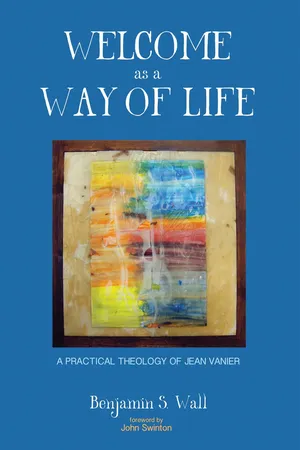
This book is about the theology of Jean Vanier. Drawing from Vanier's writings, it situates Vanier's theological thinking on community, care, and what it means to be and become human in the context of "welcome." This book draws attention to how welcome, for Vanier, is a visible expression of genuine hospitality, friendship, and human growth, offering an alternative way of conceiving and naming the social forming dynamics within Christian community, with special attention given to how welcome occurs within the communities of L'Arche. At a deeper level, this book assesses Vanier's thinking on the place and role both the self and community play in welcoming the truth of reality as it is revealed and given within community in order to prepare the way for exploring how welcome is a sign of community life, the visible expression of individual and communal trust in God's providence, and a conduit of God's presence in the world.
Information
Topic
Theology & ReligionSubtopic
Christian Theology1
A Call to Welcome
This chapter provides a brief overview of the beginnings of L’Arche, reads L’Arche as the visible expression of Jean Vanier’s faithful response to and exploration of God’s will, and outlines significant stages in Vanier’s life that have been instrumental in the shaping of his spiritual and intellectual development. Along the way, this chapter analyzes the ways in which Aristotelian philosophy and ethics not only underlie the development of Vanier’s conceptual framework but also influences and accompanies the concrete theological realism inherent in the lived contexts of community, care, and faith within L’Arche. Finally, this chapter draws attention to the inception, ethos, development, and organization of L’Arche in order to highlight the ways in which L’Arche epitomizes a radical vision of peace for humanity.
Jean Vanier and L’Arche
In the midst of an era marked by global anxiety and international tensions forcing many societies, countries, and nation-states into competing modes of existence, Jean Vanier chose a course of action that would begin and continue to call into question the prevailing powers, principalities, and cultural undercurrents profoundly affecting the characteristic spirit of his time and future generations.1 With determined efforts to reign in freedom, establish a just society, and nonviolently stand up to prevailing oppression, cruelty, and unreasonable repression of marginalized people groups, namely, “persons with intellectual disabilities,” Vanier invited three men with intellectual disabilities (Raphaël, Philippe, and Dany) who had been living in a neighboring institution to live with him in a small house in Trosly, an old village in France (August 1964).2 This was the beginning of the first L’Arche community.3 Yet, L’Arche was no ordinary, sudden, or serendipitous undertaking. Instead, it was and is the embodiment of Vanier and others’ faithful exploration of God’s will involving a life of learning how to listen and remain responsive to God’s activity in the story of human existence. Though originating out of a personal response to God’s call upon Vanier’s life, L’Arche, from the beginning, included encountering others. Encounter is an important theme throughout Vanier’s writings and reflections on community. Reflecting on the entailments pertaining to and flowing from encountering others in community, Vanier explains that the cultivation and growth of trust stems from living together, especially when we live with others in ways that affirm the fulfillment of others’ lives; gestures that occur in and through listening to who they are.4 On this account, listening cultivates trust and genuine meeting, encounters that give way to the lowering and breaking down of defense mechanisms related to who we are. By way of a gradual relationship in the encounter, the meeting, and through listening, others become conscious of their importance and value; they discover who they actually are. Living with people who are broken, according to Vanier, helps them to perceive exactly their value and that they have something to give.5 Correspondingly, “to talk about the encounter one should speak about the encounter between mother and child, which is essentially a celebration. Here, trust is born. The child knows she is loved and that she is seen as precious. She is not just listened to through the ears, but listened to through the body. True encounter gives way to true hospitality. Since the word hospitality entails taking people into oneself, the encounter is a way toward communion.”6 For Vanier, “mutuality,” “trust,” “listening,” “celebrating,” and “meeting” reveal what occurs in the linking between listening and encounter; “meeting,” “encounter,” and “trust” all relate to and deal with listening.7
Living and being with others are integral to the commonly held vision in which belonging and communion with others is visibly expressed in being present-for the other within L’Arche, particularly in and through the economy of caring, a way of life therein. Vanier’s emphasis on belonging and communion is often expressed in terms of “being with” others as a way to articulate the ways in which love is concretized within L’Arche. Love requires more than doing things for others. It involves being with others and takes shape in and through the process of becoming friends, a process that demands dynamic relational gestures such as presence, welcome, listening, and mutual willingness to be vulnerable, to name a few.8 Correspondingly, being with others characterizes the nature, scope, and aim of the type of care provision within L’Arche exchanged between carers and those to/for whom care is rendered. At this point it is important to note that being present-for others in need of care is not the same as doing things for persons in need of care. Rather, being present-for the other involves attitudes and expressions analogous to the relational characteristics Vanier highlights above. John O’Regan writes:
It is so easy to be present with another; this is simply a matter of physical nearness and connotes nothing whatever of friendship. Indeed one can have this sort of closeness with an enemy! It takes little besides ingenuity to be present to another in the sense of wanting to get all I can from him . . . There is no percentage in the present-for partnership; it is that benevolent friendship of Aquinas that seeks the good of the other as its primary purpose. It is real agape, a covenant-like love that has its eye on nothing, but its heart and whole energy devoted to the good and growth of the other.9
Commenting on relational dynamics of presence, Vanier writes, “To be present to the despised, the poor, and the rejected, L’Arche needs to move from a vision of power, even the power to do good, to receiving the Paraclete, the Spirit of Truth promised by Jesus so that we all grow in love for each person and particularly the most despised.”10 On this account, being present-for the other entails more than a mere presence and/or nearness with and/or to others; it involves a real covenant-like love, friendship, and devotion, which holds the capacity to guard against artificial and pretentious relationships.
In the contexts of community, caring, and being with others, being present-for the other is not a mean toward an end—virtue and character development and/or moral formation—as if those persons who seek to be present-for others are seeking to fulfill an ethical imperative in an attempt to be morally formed. As we will see, the self, according to Vanier, receives its ethical form in relation to the other via being present-for others in faithful listening and remaining responsive to the presence of God within the story of human existence. Moreover, being present-for the other is not read from the perspective of a unilateral dynamic of human agency—self-determined efforts of exclusively doing things for others. Though doing things for others is a necessary part of caring practice that occurs within L’Arche, gestures of doing are carried out in light of a commonly held vision of the good of the other that underlies, informs, and shapes gesture...
Table of contents
- Foreword
- Preface
- Acknowledgements
- Introduction
- Chapter 1: A Call to Welcome
- Chapter 2: Welcoming Reality
- Chapter 3: Welcoming Otherness
- Chapter 4: Welcome as a Way of Life within Community
- Chapter 5: Conclusion
- Bibliography
Trusted by 375,005 students
Access to over 1.5 million titles for a fair monthly price.
Study more efficiently using our study tools.
Frequently asked questions
Yes, you can cancel anytime from the Subscription tab in your account settings on the Perlego website. Your subscription will stay active until the end of your current billing period. Learn how to cancel your subscription
No, books cannot be downloaded as external files, such as PDFs, for use outside of Perlego. However, you can download books within the Perlego app for offline reading on mobile or tablet. Learn how to download books offline
Perlego offers two plans: Essential and Complete
- Essential is ideal for learners and professionals who enjoy exploring a wide range of subjects. Access the Essential Library with 800,000+ trusted titles and best-sellers across business, personal growth, and the humanities. Includes unlimited reading time and Standard Read Aloud voice.
- Complete: Perfect for advanced learners and researchers needing full, unrestricted access. Unlock 1.5M+ books across hundreds of subjects, including academic and specialized titles. The Complete Plan also includes advanced features like Premium Read Aloud and Research Assistant.
We are an online textbook subscription service, where you can get access to an entire online library for less than the price of a single book per month. With over 1.5 million books across 990+ topics, we’ve got you covered! Learn about our mission
Look out for the read-aloud symbol on your next book to see if you can listen to it. The read-aloud tool reads text aloud for you, highlighting the text as it is being read. You can pause it, speed it up and slow it down. Learn more about Read Aloud
Yes! You can use the Perlego app on both iOS and Android devices to read anytime, anywhere — even offline. Perfect for commutes or when you’re on the go.
Please note we cannot support devices running on iOS 13 and Android 7 or earlier. Learn more about using the app
Please note we cannot support devices running on iOS 13 and Android 7 or earlier. Learn more about using the app
Yes, you can access Welcome as a Way of Life by Benjamin S. Wall in PDF and/or ePUB format, as well as other popular books in Theology & Religion & Christian Theology. We have over 1.5 million books available in our catalogue for you to explore.