- 264 pages
- English
- ePUB (mobile friendly)
- Available on iOS & Android
eBook - ePub
About this book
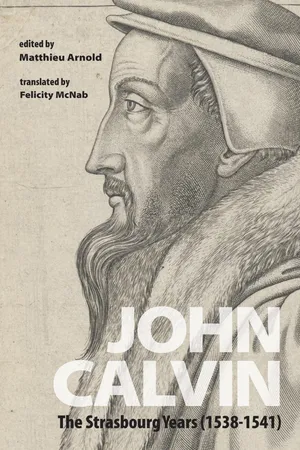
The three years that Calvin spent in Strasbourg are often considered a simple gap between his two periods in Geneva (1536-1538 and 1541-1564). However, this period has been shown to be extremely fertile for Calvin in literary, theological, and pastoral fields, not forgetting his marriage to Idelette de Bure. It was in Strasbourg that Calvin published the second Latin edition, greatly increased, of his "Institution," and where he wrote the first French version of this summary of the reformed religion. There he lectured on "Romans," replied to Cardinal Sadolet, and wrote his "Little Treatise on Holy Communion," intended to reconcile Protestants. There he became familiar with Martin Bucer's catechetical practice and with the songs of the Strasbourg parishes, which inspired his "Some Psalms and Canticles put into Song," and there he gained the friendship of Philippe Melanchthon and the respect of other Reformers.
Information
Topic
Theologie & ReligionSubtopic
Christliche Konfessionen1. Strasbourg
Strasbourg in Calvin’s Time
Various editions of the published sources during the last decades, such as the Anabaptist Deeds2 or even the Works3 and the Correspondence4 of Bucer, but also several synthetic works on worship5 printing6 or political staff7 on Bucer8 or daily life in Strasbourg9 have made it possible to refine our knowledge on all these aspects of the town toward 1540.
Society and Culture
It is thought that Strasbourg at that time had between 20,000 and 25,000 inhabitants10 to which one must add those of the twenty-five villages which depended on the town; it is impossible to give a more precise figure, seeing the fluctuations caused by the arrival of refugees, who stayed more or less permanently, or to loss of life such as that caused by the plague of 1541, a year when 3,208 people died as against 800 or 900 in a normal year. Strasbourg was a large city of the Empire. By comparison, Wittenberg, this “hole in the world,” as Luther said, had 3,000. Geneva, which Calvin had just left, had 9,000 inhabitants, a number which later rose to 16,000.
The inhabitants of Strasbourg were divided into three categories:11 the so-called middle class, the Schultheissenburger (admitted by the listener, a bishop’s official) and the other inhabitants. The first ones, either rich or poor, nobility or commoners, had the right to vote in corporations and could fulfill civil offices within the town. They were middle class by birth, by marriage or, as in Calvin’s case, by purchase, which also meant integration into one of the twenty corporations (for Calvin, the tailors’ one). Woman could avail of the same law, but they were excluded from public life.
As regards the second category, the Schultheissenburger, they were in a modest position, admitted, under the control of an Episcopal administrator, to live and work in the town, on payment of a small fee, on condition of taking the oath of obedience to the established authorities and not to be at the expense of the town. They had no civic right in itself.
Finally, the last category included, for a temporary residence in the town, as many rich representatives of the nobility as deprived refugees, or even domestic servants who came from the surrounding countryside. To these one must add the monks, contemplatives or even canons who had survived and resisted the Protestant Reformation and whom the magistrate of the town tolerated, even protected, without however granting them civic rights.
Let us take a look at the refugees.12 A great many of them poured in during the first half of the sixteenth century. The religious reasons for this refuge have often been favored, and also the welcome granted to the refugees by the authorities of the city and their housing by individuals such as Catherine Zell, Capiton and Bucer. Some of the nobility, such as Hartmut von Kronberg, reached Strasbourg after the failure of the knights’ uprising. From the years 1524–1525 evangelical refugees from the Kingdom of France arrived, especially members of the Group of Meaux, of whom the best known, such as Lefèvre d’Etaples, went back later. Between 1525 and 1533 dissidents from all spheres of influence arrived: there were Anabaptists, illuminist disciples of Melchior Hofman or even spiritualists. A maximum of 2,000 dissidents seems to have been reached in 1530, a figure which is doubtless exaggerated as it relied on simple hearsay.13 During the 1530s a great many more refugees from the Kingdom of France arrived, such as Nicolas Cop, just coming through, or for a longer stay for some of the nobility. The Netherlands also provided their share, one of which was Calvin’s wife, Idelette de Bure.
Beside the religious reasons for immigration, socio-economic factors played a role: after the Peasants’ War, one or other middle-class person, who was compromised in the rising, settled in Strasbourg; that is the case of Wolfgang Schutterlin, who set up his wood business there. Between 1528 and 1534, several famines due to bad harvests push a great many country people to settle in Strasbourg, a town which was prepared for periods of food shortage.
As to the French-speaking parish created in 1538, of which several of the faithful were also of German-speaking origin, it had about four hundred members, that is thirty-five family heads of which two hundred were middle-class people of the town.
The introduction of the Protestant Reformation had not changed the civil institutions of the town which were settled by the Constitution of 1482.14 Let us content ourselves to recall them briefly. The middle-class people of the town were gathered into twenty corporations to which the constofler were added, of which the town’s nobility were a part, country nobility and members of rich business families. For a year the town was governed by an Ammeister who came from the corporations and by a noble Stettmeister who changed every three months, and whose role was especially representative. The collective instance was the Senate, made up of ten noble members and of representatives of the twenty corporations. Elected for two years, half-renewed every year, the Senate sat most often with the XV and the XIII, two commissions whose members were co-opted for life. In charge of the internal politics for the XV and the external politics for the XIII, these two commissions operated most of the power. In exceptional circumstances, as when it was a question of abolishing the mass in 1529 or not, or to introduce the Interim in 1549, all of the magistrates were consulted.
In fact, it was an oligarchy which governed the town. In fact it had at the same ...
Table of contents
- Foreword
- Introduction
- 1. Strasbourg: Strasbourg in Calvin’s Time
- 2. Correspondence: Calvin’s Correspondence during His Stay in Strasbourg
- 3. Calvin the Poet: The Strasbourg Psalter of 1539
- 4. Church Music: Calvin and the Church Music in Strasbourg
- 5. School of Jean Sturm: Jean Calvin and the School of Jean Sturm
- 6. Calvin's Commentary: Calvin’s Commentary on the Epistle to the Romans
- 7. The Institutio: Possible Influences of Martin Bucer on the Institutio of 1539
- 8. Warnings to the Reader: The “Warnings to the Reader” of the 1539 Institutio and the 1541 French Edition
- 9. Patristics: The Patristic Sources in the 1543 Edition of the Institutio Christianae Religionis
- 10. Images of Calvin: Books by the Reformer Printed or Read in Strasbourg
- 11. Sadolet: Jacques Sadolet (1477 to 1547) the Enemy of the Strasbourg Years
- 12. Christ the King: Calvin and the Religious Colloquia of 1539–1541
- 13. Consensus and Disagreement: Consensus and Disagreement in the Little Treatize on Holy Communion (1541)
- 14. Conclusion: The Objectivization of History, between Linguistics and Socio-Psychology
Trusted by 375,005 students
Access to over 1.5 million titles for a fair monthly price.
Study more efficiently using our study tools.
Frequently asked questions
Yes, you can cancel anytime from the Subscription tab in your account settings on the Perlego website. Your subscription will stay active until the end of your current billing period. Learn how to cancel your subscription
No, books cannot be downloaded as external files, such as PDFs, for use outside of Perlego. However, you can download books within the Perlego app for offline reading on mobile or tablet. Learn how to download books offline
Perlego offers two plans: Essential and Complete
- Essential is ideal for learners and professionals who enjoy exploring a wide range of subjects. Access the Essential Library with 800,000+ trusted titles and best-sellers across business, personal growth, and the humanities. Includes unlimited reading time and Standard Read Aloud voice.
- Complete: Perfect for advanced learners and researchers needing full, unrestricted access. Unlock 1.5M+ books across hundreds of subjects, including academic and specialized titles. The Complete Plan also includes advanced features like Premium Read Aloud and Research Assistant.
We are an online textbook subscription service, where you can get access to an entire online library for less than the price of a single book per month. With over 1.5 million books across 990+ topics, we’ve got you covered! Learn about our mission
Look out for the read-aloud symbol on your next book to see if you can listen to it. The read-aloud tool reads text aloud for you, highlighting the text as it is being read. You can pause it, speed it up and slow it down. Learn more about Read Aloud
Yes! You can use the Perlego app on both iOS and Android devices to read anytime, anywhere — even offline. Perfect for commutes or when you’re on the go.
Please note we cannot support devices running on iOS 13 and Android 7 or earlier. Learn more about using the app
Please note we cannot support devices running on iOS 13 and Android 7 or earlier. Learn more about using the app
Yes, you can access John Calvin by Matthieu Arnold, Felicity McNab in PDF and/or ePUB format, as well as other popular books in Theologie & Religion & Christliche Konfessionen. We have over 1.5 million books available in our catalogue for you to explore.