eBook - ePub
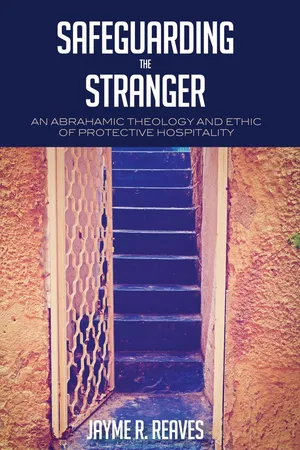
Safeguarding the Stranger
An Abrahamic Theology and Ethic of Protective Hospitality
- 318 pages
- English
- ePUB (mobile friendly)
- Available on iOS & Android
eBook - ePub
About this book
What are the resources and teachings in Judaism, Christianity, and Islam that take hospitality--and its call to provide protective hospitality--seriously enough to inform shared action and belief on behalf of the threatened other?
This book argues that protective hospitality and its faith-based foundations as seen in the Abrahamic traditions of Judaism, Christianity, and Islam merit greater theological attention and that the practice of protective hospitality in Christianity can be enhanced by better understandings of Judaism's and Islam's practices of hospitality, namely their codes and etiquettes related to honor.
Safeguarding the Stranger draws especially on two currents in contemporary Christian theologies: (1) a contextual and political theological approach informed by liberation and feminist theologies, and (2) a cooperative and complementary theological approach informed by interreligious, Abrahamic, and hospitable approaches to dialogue.
This book is unique in that it seeks to contribute to academic debates within theology and religious dialogue as well as to discussions within the fields of peace studies and conflict resolution on the positive role that religions might play in contexts of conflict.
Information
PART One
Hospitality, Ethics, and Theology
1
Locating the Theological Approach
Theology begins with my life, but my life is inter-related with the lives of others.
Thus, “I am” is always also “we are.”
—Jung Young Lee1
Introduction
This book is primarily a Christian exploration of protective hospitality informed by the Jewish and Islamic traditions. As such, it draws upon the hermeneutical principles and methodology of political theology as seen through the more specific lenses of liberation and feminist theologies in an inter-religious ethical context, and explores how the insights of political theology can be extended beyond the Christian tradition to explore the social issue of protective hospitality from an inter-religious perspective in an increasingly pluralist world.
What I seek to do here is to provide an analysis of Abrahamic protective hospitality in a way that is critical, creative, and constructive. I aim to accomplish this through the use of two currents in contemporary Christian theologies: a contextual and political theological approach and a cooperative and complementary theological approach. The first approach emphasizes the situating of this work upon context and lived experience and the methodologies of Christian political, liberation, and feminist theologies. The second approach emphasizes cooperative and complementary theological aspects that are informed by inter-religious, Abrahamic, and hospitable hermeneutics.
A Contextual and Political Theological Approach
A contextual and political theological approach is useful as it enables one to analyze and reflect on hospitality on three different levels—social, cultural and theological—taking into account both orthodoxy (doctrinal belief where it exists) and orthopraxy (practice and context). Starting with practical, contextual examples to set the stage, there will then follow an exploration of the political, liberationist and feminist theological foundations of these examples.
Arising from a Context: Contemporary Examples of Protective Hospitality
The highest virtue is always against the law.
—Ralph Waldo Emerson2
This section presents two brief case studies as initial anchors to contextualize the practice of protective hospitality. There are many examples which could be used, but for the sake of brevity and for the role of theological development, the case studies of Le Chambon-sur-Lignon and the Sanctuary Movement have been chosen.
The Village of Le Chambon-sur-Lignon
One of the best-known examples of protective hospitality of the twentieth century are the relatively widespread actions of Christian, Muslim and other non-Jew rescuers3 who provided sanctuary and assistance to Jews and other threatened individuals and communities in Nazi-occupied Europe, North Africa and Palestine in the late 1930s and early-mid 1940s. The motivations for rescue and refuge given were varied, but the common narrative is that during this time, over twenty thousand people from forty-five countries4 took in strangers, those who were different either religiously, politically, or ethnically, risking their lives for the sake of the other’s well-being.5
Throughout the literature, however, the actions of the village Le Chambon-sur-Lignon (shortened to Le Chambon) in France are cited as a prime example of hospitality in the context of rescuers during the Holocaust. Under the primary leadership of Protestant pastors André Trocmé and Edouard Theis, the village rescued between three and five thousand Jews by providing sanctuary within the community, either by helping them get to safer locations (such as Switzerland) or by harboring them more long-term in private homes, local farms or public buildings in the village. Putting themselves in harm’s way and giving up much of their own freedom while under the Vichy regime of World War II France, the villagers of Le Chambon, also referred to as Chambonnais, practiced hospitality in some of the most costly ways.
The understanding of protection for the Chambonnais was rooted in their own tradition as descendents of the Calvinist French Huguenots who had been severely persecuted during the European Reformation as a result of their criticism of the use of power by the kings of France and the Roman Catholic Church.6 This use of historical memory informs what theologian Letty Russell refers to as their “heritage of resistance.”7
Russell’s term “heritage of resistance” encourages a discussion of the term coined by Christian political theologian Johann Baptist Metz—“dangerous memory”—which, for Metz, stems from Christian Eucharistic theology and the concept of anamesis, wherein adherents remember God’s saving deeds as an act of worship.8 From meaningful, healthy remembrance of past events and the communal narrative comes action, and it is action that can be described as “dangerous” as it often challenges the status quo, highlights injustice and will, on many occasions, inform and motivate acts of resistance. It must be said, however, that this reliance upon memory as fuel for tradition of resistance as seen in the actions of Le Chambon is not unique to the Christian tradition in its practice of hospitality. There there are accounts of Muslims in South Europe, North Africa and Palestine conducting similar activities with similar motivations. Moreover, all three of the Abrahamic traditions have this “heritage of resistance” at its core and all subsequently advocate welcome and hospitality as a result, which will be explored later.
In the case of Le Chambon and their own dangerous memory, ethicist Philip Hallie notes that even the routes the Chambonnais used to take Jewish children and families thro...
Table of contents
- Acknowledgments
- Introduction
- PART ONE: Hospitality, Ethics, and Theology
- PART TWO: Protective Hospitality
- Conclusion
Trusted by 375,005 students
Access to over 1.5 million titles for a fair monthly price.
Study more efficiently using our study tools.
Frequently asked questions
Yes, you can cancel anytime from the Subscription tab in your account settings on the Perlego website. Your subscription will stay active until the end of your current billing period. Learn how to cancel your subscription
No, books cannot be downloaded as external files, such as PDFs, for use outside of Perlego. However, you can download books within the Perlego app for offline reading on mobile or tablet. Learn how to download books offline
Perlego offers two plans: Essential and Complete
- Essential is ideal for learners and professionals who enjoy exploring a wide range of subjects. Access the Essential Library with 800,000+ trusted titles and best-sellers across business, personal growth, and the humanities. Includes unlimited reading time and Standard Read Aloud voice.
- Complete: Perfect for advanced learners and researchers needing full, unrestricted access. Unlock 1.5M+ books across hundreds of subjects, including academic and specialized titles. The Complete Plan also includes advanced features like Premium Read Aloud and Research Assistant.
We are an online textbook subscription service, where you can get access to an entire online library for less than the price of a single book per month. With over 1.5 million books across 990+ topics, we’ve got you covered! Learn about our mission
Look out for the read-aloud symbol on your next book to see if you can listen to it. The read-aloud tool reads text aloud for you, highlighting the text as it is being read. You can pause it, speed it up and slow it down. Learn more about Read Aloud
Yes! You can use the Perlego app on both iOS and Android devices to read anytime, anywhere — even offline. Perfect for commutes or when you’re on the go.
Please note we cannot support devices running on iOS 13 and Android 7 or earlier. Learn more about using the app
Please note we cannot support devices running on iOS 13 and Android 7 or earlier. Learn more about using the app
Yes, you can access Safeguarding the Stranger by Jayme R. Reaves in PDF and/or ePUB format, as well as other popular books in Social Sciences & Christian Theology. We have over 1.5 million books available in our catalogue for you to explore.