eBook - ePub
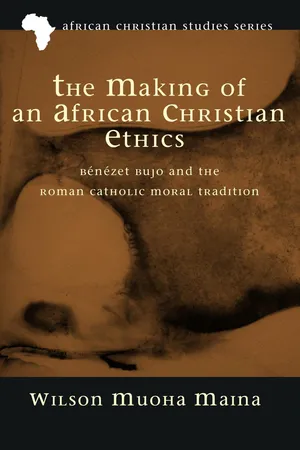
The Making of an African Christian Ethics
Bénézet Bujo and the Roman Catholic Moral Tradition
- 210 pages
- English
- ePUB (mobile friendly)
- Available on iOS & Android
eBook - ePub
The Making of an African Christian Ethics
Bénézet Bujo and the Roman Catholic Moral Tradition
About this book
An exploration of the development of a contextualized Roman Catholic moral theology in an African context is warranted in our day. This book is a study of the work of Benezet Bujo, an African moral theologian. An analysis of Bujo's work shows the various aspects of an African Catholic moral theology. Bujo's work is viewed here as critically bridging African moral theology and the development of moral theology in the Catholic Church, especially in the West. An African moral theology in this work builds on the elements of the renewal of moral theology after the Second Vatican Council. The renewal elements reflected in Bujo's work and other African Catholic theologians include, among others, the use of Scripture, the relevance of history, the debate on moral norms, the relevance of social sciences to moral discourse, the theory of natural moral law, and the relation between the theologian and the magisterium. This work, therefore, locates the theology of Bujo in the development of moral theology after the Second Vatican Council. The author establishes a relation between African traditional religions, African history, Christology, natural moral law, moral autonomy debate, the encyclical Veritatis Splendor, and political-liberation theological ethics.
Information
Topic
Theology & ReligionSubtopic
Christian Church1
The Foundations of African Christian Theologies: African Traditional Religion(s) and the African Historical and Cultural Contexts
The historical development of African Christian theology requires a critical analysis. In this work, I view an attempt to generalize African people as sharing the same traditional religions and way of life as creating an overly homogenized African people and African Christian theology. The basic premise here is that an African Christian theology appropriates African traditional religions and Christian teachings, and therefore any generalization of African traditional religions constitutes an untenable generalization in African Christian theology. I argue there are many African traditional religions. There is evidence of diversity in language and culture among African people which therefore calls for many African Christian theologies. This chapter avers in a radical way that African history and culture informs theological developments in the continent, and especially theological ethics.
Contemporary Africa has witnessed the birth and development of an African Christian theology. Unfortunately, African theology has remained in its preliminary stages for decades. From a critical-analytical and comparative approach, this work raises questions on the various perspectives taken by some African theologians as the starting point in their work. Theological responses are dialectically analyzed from the perspective of cultural diversity in Africa. Diversity is especially evident through an observation of multiplicity of African languages, and how these leads to many theologies within African Christianity.
An African Christian theology is based on an understanding of the African traditional religion(s) and varied responses to Christian faith and teachings. The (s) in African Traditional Religion(s) caters for two views in the understanding of religion in Africa. One view refers to African religion in the singular and the other view, which I view as more accurate, holds there are many traditional religions in Africa. It is for this reason I deal with the problem of generalization in African traditional religions and the ensuing theological perspective that African theology is one as opposed to many theologies.
This chapter is divided into two parts. Part one explores the meaning of African Christian theology, its diversity, and foundations in African traditional religion(s). African continent is presented as comprised of diverse traditional religions, cultures, and languages, and this is thought to presuppose the development of many theologies and not just one theology. Part two explores an African theology and ethics as informed and shaped by an African historical and cultural setting. The work of Bénézet Bujo is used in part two to show the historical and cultural perspective in African Christian theology.
Part One: African Christian Theology, African Traditional Religion(s), and Cultural Diversity
African Christian theology is informed by a critical analysis of an African cultural context. It bases the Christian teachings, through critical reflection, on African reality that shapes human living in society. Hence, a proper understanding of African traditional religion(s) is necessary in the understanding of the relationship between religion and ethics in Africa.
1. What is African Christian Theology?
African Christian theology is a science or discipline that is responsible for understanding the Christian message in an African social context. The purpose of African Christian theology is to see to it that the message of Christ is expressed in African categories and thought patterns. Bujo expresses the role of African theology as follows: “the inculturation of Christianity, however, should not hide the social relevance of African tradition, but rather challenge the African person to transform his/her world into a better place.”1 African Christian theology is concerned with making Christian doctrine relevant in an African context. To do this, African traditions and customs have to be given their rightful place for it is only in this way that an African can hear the call by Jesus Christ to faith. It is also in this context that Charles Nyamiti wrote:
Indeed, if African theology is the understanding and presentation of the Christ-event in accordance with African needs and mentality, then African Christologies must have existed since the beginning of evangelization on the Black continent (although mainly in latent, oral, and unsystematic form). Despite their predominantly Western way of theologizing, missionaries were often induced to present Christ’s mystery to answer to the problems and ways of thinking of the African people. The people received that message in its Western form according to which it was delivered and also in accordance with their African experience.2
To understand how African Christian theology evolved an article by A. Ngindu Mushete is helpful. He distinguishes three currents that typify theology in Africa: missionary theology, so-called African theology, and “black theology” as exemplified in South Africa.3 He presents the three distinctions as stages in the development of theology concerning Africa. He states; “For one school, the aim of mission work is the conversion of the infidel. For a second school it is the establishing or implanting of the church. For a third school it is giving birth to a native church and helping it to grow properly; this means helping it to assume its proper role and responsibility in communion with Christ and all other local churches.”4 Mushete presents missionary theology as centered around the salvation of souls or the conversion of the infidel. It was developed and defended in particular by the missiological school of Münster. It polarized missionary reflection for several centuries right up to the start of the twentieth century. Mushete holds that missionary theology was “solidly grounded on the adage, extra ecclesiam (romanam) nulla salus. The theology centered on the salvation of infidels logically led its partisans to wholly disqualify the cultural and religious traditions of African peoples.”5
The missionary theology of church implantation, according to Mushete, “was solidly ecclesiastical and even ecclesiocentric in its orientation. On the clean slate, or the slate wiped clean, of people without culture or civilization, missionaries were to establish the church as it had been known historically in the West.”6 The goal of mission work was to establish the church where it does not yet exist visibly. It must give stable and perduring organization to the various means of salvation: i.e., the clergy, the laity, religious communities, and Christian forms in general.7
Contemporary African Christian theology should not be viewed at the level of missionary theology. It is at the level of critical African theology. This theology should be seen in what Mushete says, that “African” theology attempts to take due account of the Africans to whom the faith is addressed. It takes note of Africa’s culture, religion, and civilization. It advocates the right of African Christians to ponder Christianity and its truth in their own terms.8
2. African Christian Theology and African Traditional Religion(s)
The correlation of African Christian theology with the African traditional religion(s) leads to a further dimension of the foundation of African ethics and Christian ethics. The focus here is on the inseparable relation between religion and ethics in an African context. Further, I analyze the African world-view that informs the making of an African Christian theology and ethics.
(a) The relation between Religion and Ethics in an African Context
Ethical behavior is very much influenced by people’s beliefs as established in their religion. African morality does not escape the fact that it is shaped by the African traditional religion(s). For example, Ukachukwu Manus holds that “the truism that religious outlook and worldviews are symbiotic is very sure in Africa where, more than elsewhere, both realities are interdependent and influence each other.”9 The same symbiotic relationship can be said of religion and morality.10
Religion and ethics are inseparable in Africa.11 This is true not only in Africa but also in other places where religious beliefs can be said to inform the ethical life of its adherents. Laurenti Magesa notes that “morality or ethics is of the ver...
Table of contents
- Preface
- Acknowledgments
- Chapter 1: The Foundations of African Christian Theologies: African Traditional Religion(s) and the African Historical and Cultural Contexts
- Chapter 2: The Call for Renewal of Moral Theology by the Second Vatican Council and the Development of African Moral Theology
- Chapter 3: African Communitarian Ethics in the Theological Work of Bénézet Bujo
- Chapter 4: An African Christian Ethics is a Liberation Ethic in the Theology of Bénézet Bujo
- Chapter 5: Human Ethics and/or Christian Ethics? Is There a Specifically Christian Ethics?
- Chapter 6: Veritatis Splendor as a Response to Renewal in Moral Theology
- Bibliography
Trusted by 375,005 students
Access to over 1.5 million titles for a fair monthly price.
Study more efficiently using our study tools.
Frequently asked questions
Yes, you can cancel anytime from the Subscription tab in your account settings on the Perlego website. Your subscription will stay active until the end of your current billing period. Learn how to cancel your subscription
No, books cannot be downloaded as external files, such as PDFs, for use outside of Perlego. However, you can download books within the Perlego app for offline reading on mobile or tablet. Learn how to download books offline
Perlego offers two plans: Essential and Complete
- Essential is ideal for learners and professionals who enjoy exploring a wide range of subjects. Access the Essential Library with 800,000+ trusted titles and best-sellers across business, personal growth, and the humanities. Includes unlimited reading time and Standard Read Aloud voice.
- Complete: Perfect for advanced learners and researchers needing full, unrestricted access. Unlock 1.5M+ books across hundreds of subjects, including academic and specialized titles. The Complete Plan also includes advanced features like Premium Read Aloud and Research Assistant.
We are an online textbook subscription service, where you can get access to an entire online library for less than the price of a single book per month. With over 1.5 million books across 990+ topics, we’ve got you covered! Learn about our mission
Look out for the read-aloud symbol on your next book to see if you can listen to it. The read-aloud tool reads text aloud for you, highlighting the text as it is being read. You can pause it, speed it up and slow it down. Learn more about Read Aloud
Yes! You can use the Perlego app on both iOS and Android devices to read anytime, anywhere — even offline. Perfect for commutes or when you’re on the go.
Please note we cannot support devices running on iOS 13 and Android 7 or earlier. Learn more about using the app
Please note we cannot support devices running on iOS 13 and Android 7 or earlier. Learn more about using the app
Yes, you can access The Making of an African Christian Ethics by Wilson Muoha Maina in PDF and/or ePUB format, as well as other popular books in Theology & Religion & Christian Church. We have over 1.5 million books available in our catalogue for you to explore.