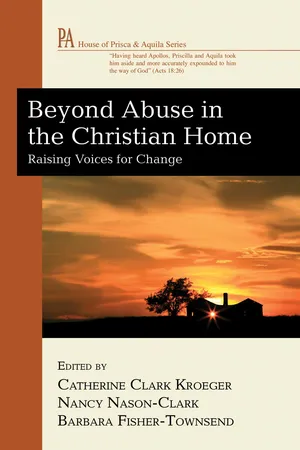
eBook - ePub
Beyond Abuse in the Christian Home
Raising Voices for Change
- 254 pages
- English
- ePUB (mobile friendly)
- Available on iOS & Android
eBook - ePub
Beyond Abuse in the Christian Home
Raising Voices for Change
About this book
In January 2004 a newly founded evangelical organization called PASCH was formed. The word denotes the Passover or time of new beginnings--when God kept people safe in their own homes before leading them into freedom from abuse and oppression. Yet the word PASCH also stands for Peace and Safety in the Christian Home. PASCH began as a small group of therapists, sociologists, domestic-violence experts, clergy, biblical scholars, survivors--and dedicated Christians.
In essence, PASCH was born out of the cries, confusion, and frustration of the people of God. As we encountered many horrifying situations of domestic abuse in Christian homes, those of us who seek to address various aspects of the issue concluded that we needed a fellowship of concerted study, prayer, and action.
It was the dream of Catherine Clark Kroeger that an edited book might emerge from the 2005 and 2006 PASCH conferences in order that the papers, presentations, and discussions might be widely available. We found that to make that happen, we needed to work together: that each of us possessed one piece of the puzzle, and that by God's grace we could collectively begin to put the pieces together. The topic of abuse is ugly, which is why so many Christians shy away from discussing it. But in this volume we have tried to present an accurate, faith-based analysis of abuse in the Christian family context. We hope that various chapters stimulate discussion--sometimes debate--and in so doing prompt pastor and people to action.
We call on you the reader to consider the various ideas and perspectives offered throughout the book. Hopefully each chapter will prompt you to consider afresh how you conceptualize violence among families of faith. Like you, the reader, the contributors to our collection come from various faith traditions, work in different contexts, and see the issue in part based on their own narrative and training. Yet, despite our differences--and our ongoing debates--we are unanimous that violence has no place in the home. Every home should be a safe place; every home a shelter. When abuse occurs in families of faith, it is the responsibility of the church to offer compassion and support to victims and to call those who act abusively to accountability and justice.
Our edited collection includes
? Dan Allender speaking from the heart about the impact of the fall on relationships between men and women;
? Al Miles reflecting on his pastoral experience of the difficulties and opportunities of speaking out against violence in Christian families;
? Bruce and Karen McAndless-Davis offering one couple's story of the long journey toward accountability and dramatic change;
? Julie Owens retelling her own dramatic story of abuse, the life imprisonment of her ex-partner and what she wished every pastor knew about domestic violence.
Information
Topic
Theology & ReligionSubtopic
Christian ChurchPart One
Raising Our Voices
Looking Back
1
A Survivor Looks Back
What I Wish Pastors had Known When I was Looking for Help
Julie Owens
The home in which I grew up is a Christian one. My father is a well respected Presbyterian minister who, many years beyond retirement, still preaches every Sunday. My mother is a classically trained soloist and former church choir director who is so well known for her hospitality that a Christian women’s shelter is named in her honor. I was one of five children who practically grew up in churches. It’s no surprise that we are now involved in ministries as diverse as domestic violence, music therapy, inner-city community organizing and children’s performing arts. We are a very close family and my parents are role models for a mutually respectful, affectionate, caring marriage partnership that is rooted in Biblical equality.
I neither knew nor understood anything about domestic violence while growing up. Even later, when I was in the midst of experiencing it myself, I had no name for the chaos and misery in my marriage. No one from whom I sought support—from the numerous ministers to professional marriage counselors, from mental health professionals to concerned church friends—ever actually named it as ‘domestic violence,’ so of course I never considered myself a battered woman. While my supporters were very kind and caring, they were untrained and fundamentally unacquainted with the issue of partner violence. The focus of their attention while intervening, therefore, was either on repairing my fractured marriage or addressing my husband’s personal problems. Neither the impact that his extreme behavior was having on me nor his potential for physical violence was ever discussed. As a result, I was completely unaware of the dynamics of domestic violence and the escalation of violence that typically occurs at the point of separation or divorce.
It was not until several months after a dramatic post-separation attack on my father and me that I called a secular community agency for help. I had been plagued by terrifying nightmares and other symptoms of posttraumatic stress. I asked them if I could come to their support group for abused women, saying somewhat apologetically, “Look, I know I’m not really a battered woman, but my husband stabbed me when I filed for divorce, so could I please come anyway?” Although our church had rallied around us and supported us every step of the way, it was in that secular domestic violence support group that my healing journey began in earnest. As a result, I have spent considerable time in the intervening years trying to prepare church leaders and communities of faith to help other families who find themselves in similar situations.
Often I am asked what I wish pastors had known when I was seeking help during my abusive marriage. I have had many years to consider that question. While the complete lack of knowledge of those who intervened probably increased the danger of my situation, I feel great compassion for them. They were sincere and they did try to help. Through no fault of their own they were simply unequipped for the job. The sad truth is that the places where they were educated did nothing to help the students understand or deal with abuse in Christian families. They were never taught what domestic violence is and isn’t, the many myths and misconceptions surrounding it, what the scripture says about it, or how best to counsel those whose lives have been impacted by violence.
Thankfully, in the years since my experience, more and more seminaries and Christian schools have begun offering classes on family violence or incorporating curriculum addressing abuse issues into their counseling courses. Based on the stories I continue to hear on an almost daily basis, however, it is clear that there is still much more to be done. I hope that by sharing my experiences and the lessons I have learned, pastors and Christian counselors who are not yet trained about the issue of domestic violence will understand the importance and value of enhancing their knowledge base.
My story, like that of so many other survivors of abuse, started in a seemingly ordinary way. I was thirty-two when I married David, a man who adored me, who professed to love my God, and who appeared to have so many of the qualities I was looking for in a husband. He doted on me, laughed easily, got along well with my friends, and loved spending time together. There was no hint of abuse or controlling behavior during our courtship, just sweetness and sharing, fun and togetherness. My friends loved David and thought we made a wonderful couple. We were both ready to settle down and shared the dream of living a simple life in the Texas countryside. Since we were older and convinced that in each other we had found “the one,” a prolonged engagement seemed unnecessary. We were eager to begin our life together. After discussing the many options, we decided to marry in a sweet, simple ceremony. We exchanged vows at sunset in a lovely little Presbyterian chapel on a river, surrounded by friends. At my request, a friend read aloud from my favorite chapter of the New Testament, First Corinthians 13 “Love is patient, love is kind, love isn’t jealous or boastful or proud . . . .” We immediately started planning for a more traditional ceremony and honeymoon back home in Hawaii that would include my large family and my many friends. I could not wait to introduce David to my family and to the islands. I knew that he would love them both.
We were surprised but overjoyed when we learned very soon after our wedding that we were expecting our first baby. We immediately called our loved ones to share the wonderful news and then went to work shopping for baby items. We had spent many hours dreaming and talking of how wonderful it would be to have children together, and we were thrilled that our dream was coming true. I couldn’t wait for a baby to snuggle and love, and David wanted nothing more than to raise a child in a close, loving family that would be different from the abusive home in which he had grown up.
I could not have been happier. But that was soon to change. It was not long before David seemed to begin to transform right before my eyes. Instead of being the playful and sweet man I had fallen in love with, he became more and more moody and critical everyday. Before we married he had seemed to love my independent, out-going personality. Now he made cruel, hurtful remarks about me and accused me of flirting if I innocently made eye contact with any other man. He wanted the two of us to be together at all times and seemed threatened by anyone else with whom I spent time, co-workers and friends alike.
David insisted on driving me each morning to the school where I worked, then picking me up each afternoon. He popped in to my classroom to bring me gifts, showed up to take me out to lunch, and called frequently during the day to check on me. Soon he was even volunteering part-time in my classroom, where the students and teachers loved him. He seemed unwilling to leave my side for fear I would betray him somehow. These things that seemed like acts of sweetness initially later were revealed as merely a means to monitor and control me.
At home when we were alone, periods of increasing darkness began to creep in and overtake the good times, eroding my newlywed happiness. At first I wrote it off as marriage adjustment issues that would take care of themselves as we spent more time together and adapted to life as a couple. I wanted nothing to spoil my happiness. Daily I would tell myself that I was married to a man I loved and I was having his baby. I had a job I loved and I was content with my life.
Before long, though, our relationship began to deteriorate to such a degree that I could no longer pretend it would somehow magically improve. I had to consider for the first time that perhaps the man I had married had hidden a great deal from me about his true nature. His affectionate ways and loving attentions had given way to ever-increasing displays of unfounded jealousy and insecurity. Although I was faithful and fully committed to David, for some reason that I could not fathom, he was not able to trust me. As a result, he insisted on knowing every single detail of my comings and goings, and became very agitated when he was not included in every minute of my daily plans. I could not comprehend why the man to whom I was so completely devoted would behave in such a way. He had begun to routinely berate me and call me names, swear at me and disrespect me in ways that were unthinkable. I was dejected and confused.
I was thrilled to be carrying the precious baby that we so wanted, but I began to fear that perhaps I had made some terrible mistake. While David’s devoted attention had been wonderful before we married, it had become increasingly oppressive. Before long I was feeling like a prisoner, under siege in my own home. We lived far out in the country, away from other houses. This was in the days before cell phones, and the home phone soon was being ripped out of the wall and thrown across the room whenever I received or made calls. The car keys were even hidden from me in an effort to keep me home.
At one point David started to routinely wake me in the middle of the night to interrogate me or accuse me of crazy things. I was exhausted from the pregnancy and from working full time in a stressful position, but he would refuse to let me go to sleep or stay asleep. Instead, he would follow me from room to room harassing me, even insisting that the baby I was carrying was not his. Nothing I could say would calm or appease him. I would sob in frustration and beg him to let me sleep. My heart was breaking. When he started going through my many old boxes of mementos, tearing up photos he found of me with any other male, friends and relatives alike, I was dumbfounded. Even my favorite picture of my grandfather and me was ripped in half. When things were at their worst and I told him that I could not take it any longer, I would attempt to leave the house. But he would body-block or restrain me, refusing to let me out the door. Once he even took the spark plugs out of the car so that I could not leave the property. I tried to remain calm during these turbulent times, but I had never felt so helpless, dejected or alone.
When things were calmer, I would try to comprehend the downward spiral that my marriage had taken. It simply made no sense. I could only think that David must be sick. Since David was in recovery from a drinking problem and attended AA meetings, I called an addictions counselor. I was urged to attend an Al-Anon group. I did so, and the members were kind, but they did not seem to understand what I was experiencing any better than I did. They told me that when he acted irrationally, I should, “Just see the word sick flashing on his forehead.” When I described the horrible things he called me, I was told to ignore it. “If he called you a chair, would that make you a chair?” someone asked. I was told to remember that addiction is a disease. I had pledged to love my husband “in sickness and in health” and now he did indeed seem to be sick. In fact, he seemed to have morphed into someone I no longer even knew.
I was exhausted. I tried to reason with David. I prayed for wisdom. I talked with doctors and with pastors. I wanted nothing more than to get away...
Table of contents
- Title Page
- Tributes to Dr. Catherine Clark Kroeger
- Contributors
- Introduction
- Part One: Raising Our Voices: Looking Back
- Part Two: Raising Our Voices: Assessing the Contemporary Scene
- Part Three: Raising Our Voices: The Prophetic Call for Future Action
Trusted by 375,005 students
Access to over 1.5 million titles for a fair monthly price.
Study more efficiently using our study tools.
Frequently asked questions
Yes, you can cancel anytime from the Subscription tab in your account settings on the Perlego website. Your subscription will stay active until the end of your current billing period. Learn how to cancel your subscription
No, books cannot be downloaded as external files, such as PDFs, for use outside of Perlego. However, you can download books within the Perlego app for offline reading on mobile or tablet. Learn how to download books offline
Perlego offers two plans: Essential and Complete
- Essential is ideal for learners and professionals who enjoy exploring a wide range of subjects. Access the Essential Library with 800,000+ trusted titles and best-sellers across business, personal growth, and the humanities. Includes unlimited reading time and Standard Read Aloud voice.
- Complete: Perfect for advanced learners and researchers needing full, unrestricted access. Unlock 1.5M+ books across hundreds of subjects, including academic and specialized titles. The Complete Plan also includes advanced features like Premium Read Aloud and Research Assistant.
We are an online textbook subscription service, where you can get access to an entire online library for less than the price of a single book per month. With over 1.5 million books across 990+ topics, we’ve got you covered! Learn about our mission
Look out for the read-aloud symbol on your next book to see if you can listen to it. The read-aloud tool reads text aloud for you, highlighting the text as it is being read. You can pause it, speed it up and slow it down. Learn more about Read Aloud
Yes! You can use the Perlego app on both iOS and Android devices to read anytime, anywhere — even offline. Perfect for commutes or when you’re on the go.
Please note we cannot support devices running on iOS 13 and Android 7 or earlier. Learn more about using the app
Please note we cannot support devices running on iOS 13 and Android 7 or earlier. Learn more about using the app
Yes, you can access Beyond Abuse in the Christian Home by Catherine Clark Kroeger,Nancy Nason-Clark,Barbara Fisher-Townsend, Kroeger, Nason-Clark in PDF and/or ePUB format, as well as other popular books in Theology & Religion & Christian Church. We have over 1.5 million books available in our catalogue for you to explore.