- 178 pages
- English
- ePUB (mobile friendly)
- Available on iOS & Android
eBook - ePub
About this book
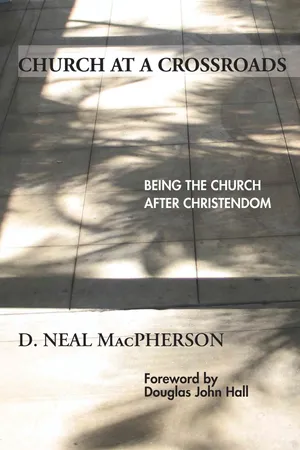
Facing the uncertainty of their present life and ministry, the American and Canadian churches of mainline Protestantism are, for the most part, responding in one of two ways. Some are simply choosing to ignore the process of their disestablishment. They continue to carry on with their church life as though nothing were happening, as though they were still occupying a place at the center of society. Others, knowing that they are being moved to the periphery of social and political life, are seeking to regain their past power and influence by adopting one or another program of church growth, many of which are being promoted by the newly emerging megachurches of the Christian right.
Based upon the history and experience of a particular congregation, Church of the Crossroads in Honolulu, Hawaii, this book suggests a third option for the churches of mainline Protestantism: to embrace their ongoing disestablishment and to see it not as a burden or as something to be either ignored or reversed, but as an opportunity to envision a new way of being in the world.
Information
Topic
Theology & ReligionSubtopic
Christian Church1
The Church in Context
Most of the world is now following a kind of right-wing fundamentalism. That is true in the South of the United States, and not only in the South, but it is also true, it seems, for Africa and Latin America, and, as far as Protestantism is concerned, also in Asia. In the Philippines, mainly Catholic, it is Opus Dei who brings the fundamentalist message; it is particularly active in Manila. This for me is kind of frightening, that this is the only evangelism we have. What do we have to offer in terms of evangelism?
—Renate Rose
It’s the end of Christendom as we have known it. Today’s world is a world of religious pluralism and diversity where major religions find it necessary to encounter the truth of other faiths, and this raises a whole new question. What is it that salvation means in universal terms? What does salvation really mean in a world of pluralism? And a final comment is that churches as institutions are no longer vehicles for the gospel they profess to embrace. In place of religion and churches as institutions, there is a movement embodied in “Christian entities” or “Christian communities.” These manifest themselves not as much as institutions but as processes moving hopefully toward transformation.
—Mitsuo Aoki
I believe we are really seeing a new kind of Christendom. Political leaders are leaning on religion and using it for what they want, and so I think that although we are finding ourselves in the midst of a post-fourth-century Christendom, the effort to create a new Christendom is alive and well.
—Judy Rantala
The preceding are comments from members participating in adult education classes at Church of the Crossroads, June 2004. Additional comments from the same classes as well as other reflections from members of Church of the Crossroads will be found at the beginning of each subsequent chapter.
He called the crowd with his disciples, and said to them, “If any want to become my followers, let them deny themselves and take up their cross and follow me. For those who want to save their life will lose it and those who lose their life for my sake, and for the sake of the gospel, will save it. For what will it profit them to gain the whole world and forfeit their life?” (Mark 8:34–36)
A Remarkable Event
I will begin this book by describing a remarkable event in my life, and by implication, in the life of Church of the Crossroads. On a Sunday morning in August 2005, I was asked to address the John A. Burns Grassroots Democracy Luncheon, an annual gathering of the Democratic Party in Hawai‘i. John A. Burns served as Hawai‘i’s first governor, from 1962 to 1974. The fact that the event took place at 10:30 on a Sunday morning speaks volumes. It was a clear indication that our society is, for the most part, a secular society. In years past, it would have been unheard of to schedule a public gathering on a Sunday morning. The title of my address was “The Intersection of Religion and Politics: Rediscovering the Common Good.” I began my address with these words:
It is an honor for me to have been asked to be here today and to share my thoughts on the way religion and politics might intersect in our time. The honor is not mine alone, but belongs even more so to the congregation I have served for the past seventeen years. Church of the Crossroads is a community of faith that throughout its eighty-two-year history has often acted out a deep commitment to justice and peace in our world, and on behalf of those who have been left out of the political process and those whose lives have been marked by poverty and powerlessness.
I went on to say that in my thirty-three years in the ordained ministry, I had never been asked to do anything like this. I noted that clergy who represent the churches of mainline Protestantism are rarely asked to speak to anyone other than the members of the congregations they serve or perhaps other religious groups. Occasionally, they are asked to give a blessing at a public gathering. Furthermore, clergy who are willing to speak out on issues of peace and justice have found themselves out of favor with many who currently hold political power in our society.
I continued:
Political leaders find it more to their advantage these days to pay attention to those who belong to the Christian Right rather than people like me. Indeed, the Christian Right has succeeded not only in commanding the attention of political leaders but has also succeeded in shaping the moral values agenda that had such a tremendous influence on the outcome of the 2004 Presidential Election and which continues to define, unfortunately, I believe, the intersection of religion and politics in our time.
I assured the audience that I was not complaining, however, and continued,
It’s not a terrible thing to be out of favor. Being on the periphery of religious and cultural life gives one a tremendous freedom to articulate a larger moral vision than the narrow moral agenda that is in vogue these days.
In the course of the speech itself, I reintroduced the old democratic idea of the common good, which, when taken seriously, transcends special interest and goes beyond a narrow conception of what constitutes moral values. Governor Burns himself exemplified decision making based upon this principle of the common good when he, a good and devout Roman Catholic, allowed a bill to pass that overturned the abortion law in Hawai‘i, thereby guaranteeing a woman’s right to choose. Hawai‘i was the first state in the union to do this, and it did so a number of years before Roe vs. Wade was heard by the Supreme Court of the United States.
In articulating a vision of the common good, I spoke out of my own Judeo-Christian heritage and said that this tradition points to God’s concern for the whole of the human community, especially the poor, the hungry, and the destitute, and also for the well-being of the creation itself. I quoted from the psalms, the prophets, and Jesus. I then invited the members of the audience to explore their own religious and humanist traditions in order to explore their own vision of the common good.
At the close of the speech, I summarized my main points:
1. Our society is a religiously pluralistic society and largely a secular society. No one religious viewpoint should be allowed to shape public discourse and policy.
2. Christians who are currently out of favor ought to, on the basis of scriptural evidence, challenge openly and boldly those Christians who are controlled by a right wing ideology and a narrow conception of what constitutes moral values.
3. These same Christians ought to set themselves about the task of discerning what God wills for the common good of all, relying on those parts of the scriptural heritage that point to God’s concern for all people, and the emphasis of the prophets and Jesus on distributive justice and the need to care for the neighbor, defined as every man, woman, and child who shares the common life of our society and world.
4. Those in political life ought to engage themselves in their own discernment of the common good, and then be willing to enter into dialogue with all who approach the question from their own religious, ethical, or humanist traditions.
5. We must not be silent and allow ideology, either political or religious, to dominate and control our political life and our public discourse surrounding moral values.
6. We must all seek to act out of a disinterest that enables us to move beyond our own self-interest and our own beliefs in order to consider that which will be good for all.
7. We must always understand that the government is the only thing we own in common. We are the government. Government belongs not to a religious group or to those who hold political power or to those who hold economic power in our society. It belongs to everyone, and everyone must have a voice in shaping a society that benefits all.
8. Finally, religious and political leaders must always be open to one another and respectful of one another as together they seek the common good of all.
A Church on the Periphery
I must say that I was somewhat anxious about giving this speech. Would people understand what I was trying to say? Would the response be affirmative or negative? Well, about a dozen of the three hundred people who were present did walk out as I was speaking about a woman’s right to choose. Some ran after them, urging them to remain for the rest of the speech, but they continued to head toward the elevators. Those who remained enthusiastically affirmed what I had to say.
Since then, the speech has been disseminated far and wide through the Internet. Groups on the islands other than O‘ahu have gathered to read and discuss it. I must say that the response has amazed me. I have come to realize that churches like Church of the Crossroads can indeed engage the world, and that there are many people who want the mainline Protestant churches to address issues of peace and social justice openly with passion and conviction. These same people, most of whom would never enter the doors of a church, are looking for a language they can use to address those on the right who have dominated the discourse around moral values.
When I spoke that Sunday morning, it was really Church of the Crossroads speaking. Every member of this two-hundred-person congregation agreed with the main ideas of the speech. They were aware of the event before it took place and were anxious to hear how everything went. Unlike so many pastors who engage in public witness, I felt that when I spoke that Sunday morning, I was really representing the congregation I serve. My speech, then, was both an individual and a corporate expression. Since the event, I have come to appreciate that throughout the eighty-four years of its existence, this congregation has been intentional in enabling its members to engage in theological education and reflection. I believe that the members of a congregation do not arrive at this kind of shared understanding by accident. It takes intentionality. It takes years of devoted study, discussion, and discernment by everyone involved.
In giving the speech, I also sensed a tremendous freedom to speak openly and honestly to a gathering of people that included a number of elected officials. Often, the church has not enjoyed this kind of freedom. The church has been so linked to the centers of political and social power that it has been less than free to speak truth to power.
Church of the Crossroads has never occupied a position of prestige and power in the political and social life of Hawai‘i. In recent years, it has found itself even more so on the periphery. Being on the periphery brings a measure of uncertainty. The old assumptions about what it means to be a “church” no longer suffice. Everything becomes fluid and tentative. At the same time, being on the periphery of social and political life brings new possibilities. When a church is set free from the constraints that in the past resulted from a grasping for position, power, and prestige, it is able to get in touch with the original spirit and message of the Gospel, which has always been, when honestly proclaimed, bold, new, and unconventional.
The Theme of This Book
In this book, I will draw upon the life and experience of Church of the Crossroads in order to describe both the uncertainties and possibilities that exist when a church not only recognizes but also affirms its changing status in the world. I trust that what I write will provide a measure of encouragement to mainline Protestant churches, which are presently experiencing an uncertain existence in the North American context and are consequently seeking to be “church” in a new and faithful way.
In a very real sense, these churches exist between a Constantinian Christianity and a Christianity that is to be. I believe that the uncertainty the mainline Protestant chu...
Table of contents
- Title Page
- Foreword
- Preface
- Chapter 1: The Church in Context
- Chapter 2: The Shaping of a Church
- Chapter 3: Engaging the World
- Chapter 4: Our Stories at the Foot of the Cross
- Chapter 5: Gathered for Worship
- Chapter 6: The Spirit of Crossroads
- Bibliography
Trusted by 375,005 students
Access to over 1.5 million titles for a fair monthly price.
Study more efficiently using our study tools.
Frequently asked questions
Yes, you can cancel anytime from the Subscription tab in your account settings on the Perlego website. Your subscription will stay active until the end of your current billing period. Learn how to cancel your subscription
No, books cannot be downloaded as external files, such as PDFs, for use outside of Perlego. However, you can download books within the Perlego app for offline reading on mobile or tablet. Learn how to download books offline
Perlego offers two plans: Essential and Complete
- Essential is ideal for learners and professionals who enjoy exploring a wide range of subjects. Access the Essential Library with 800,000+ trusted titles and best-sellers across business, personal growth, and the humanities. Includes unlimited reading time and Standard Read Aloud voice.
- Complete: Perfect for advanced learners and researchers needing full, unrestricted access. Unlock 1.5M+ books across hundreds of subjects, including academic and specialized titles. The Complete Plan also includes advanced features like Premium Read Aloud and Research Assistant.
We are an online textbook subscription service, where you can get access to an entire online library for less than the price of a single book per month. With over 1.5 million books across 990+ topics, we’ve got you covered! Learn about our mission
Look out for the read-aloud symbol on your next book to see if you can listen to it. The read-aloud tool reads text aloud for you, highlighting the text as it is being read. You can pause it, speed it up and slow it down. Learn more about Read Aloud
Yes! You can use the Perlego app on both iOS and Android devices to read anytime, anywhere — even offline. Perfect for commutes or when you’re on the go.
Please note we cannot support devices running on iOS 13 and Android 7 or earlier. Learn more about using the app
Please note we cannot support devices running on iOS 13 and Android 7 or earlier. Learn more about using the app
Yes, you can access Church at a Crossroads by D. Neal MacPherson in PDF and/or ePUB format, as well as other popular books in Theology & Religion & Christian Church. We have over 1.5 million books available in our catalogue for you to explore.