- 318 pages
- English
- ePUB (mobile friendly)
- Available on iOS & Android
eBook - ePub
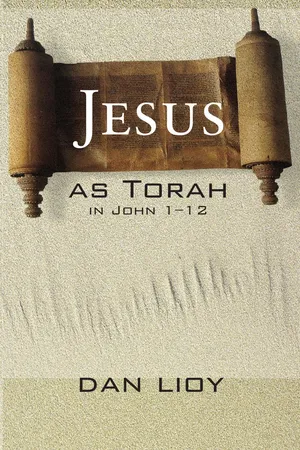
Jesus as Torah in John 1–12
About this book
In this study of John 1-12, the author develops the thesis that Jesus is the divine, incarnate Torah, and that Jesus as Torah is the conceptual center of the Fourth Gospel. An overarching goal of the treatise is to explore the Evangelist's portrait of Jesus as the fulfillment of the Mosaic law. Connected with this aim is the central thesis that the Messiah appears in the Gospel of John as the realization of all the law's redemptive-historical types, prophecies, and expectations. A corresponding major claim is that those who trust in Jesus for eternal life and heed his teaching satisfy fully the requirements of the moral law recorded in Scripture.
An examination of John 1-12 substantiates the truth that Jesus is the perfection of the gift of the Tanakh. He existed in the beginning with the Father and Spirit as God. The eternal Torah is light and life, fulfillment and joy, in fellowship with the triune God for all eternity. The divine Tanakh, by becoming incarnate, revealed the glory of the Father and made the fullness of God's grace and truth available to humankind. The living Word not only provides salvation but in so doing unveils the loving and redeeming heart of the Father for all to see. The Son of God is the one to whom all the Old Testament luminaries--such as Abraham, Jacob, Moses, and Isaiah--pointed, and in whom their eschatological hopes were realized. The Anointed One is greater than and supreme over all the religious institutions once associated with the Jerusalem tabernacle and temple. Even such Jewish festivals as the Feast of Tabernacles, Pentecost, Dedication, and Passover find their fulfillment in the Messiah. This volume is appropriate for personal study and is also suitable as a college and seminary text.
Information
1
The Framework and Intent of This Study
Identifying Two Different Worldly Cultures
Specialists across a variety of disciplines have noted the prevalence in today’s society of two different cultures. Entitlement characterizes the first, while merit is the credo of the second. According to Anderson, a culture of entitlement maintains that people “do not have to earn what they get.”1 Instead, they automatically “deserve what they get” and receive “what they want.”2 The foundation for this claim is the inherent worth of the person(s) or group, not what they have accomplished. There is an obsession with putting one’s own needs first, feeling good about oneself, and being happy.3 People also tend to devalue what they have and demand more things (for instance, possessions, privileges, and so on). Olson notes, “Personal desires and aspirations seem to trump any concern for the greater good.”4
This mindset is exemplified in the contemporary prosperity gospel movement; and Joel Osteen is perhaps its best known spokesperson today within American evangelicalism. Jason Byassee points out that Osteen’s message is a continuation of what others before him have taught (such as Russell Conwell, Norman Vincent Peale, and Bruce Wilkinson): “just improve your attitude, keep your chin up, and God’s blessings will rain down on you.”5 Osteen urges people to “enlarge their vision” about the “good things” God supposedly wants to do for them and “expect people to go out of their way” to offer help. Osteen asserts that when people think “upbeat, self-confident” thoughts about themselves and “speak words of victory” over dire situations, happiness and abundance will result. In short, this message is a “pagan gospel of acquisition,” “self-help,” and “self-improvement.”
A culture of merit takes an entirely different approach to life. Those among the “talented” are “chosen and moved ahead on the basis of their achievement.”6 Expressed differently, social positions of prestige and responsibility have to be earned, and competence is demonstrated against the backdrop of fierce competition. Individuals, in their “relentless pursuit of perfection,” strive “to chart their own courses,” “master their destinies,” and “make themselves over.”7 Anderson notes that in a predominantly merit-based culture, those who are “strongest” are “fully supported,” while those deemed to be the “weakest” are “weeded out.”8 The basis for such a determination is whether people succeed or fail to “meet performance standards.” There is peer pressure to “produce results” and hostility toward “mediocrity.”
This mindset pervades spiritual traditions that consider “rituals, sacraments, and liturgical prayers” as a means of salvation and sanctification.9 One example of this from the past would be the religious elite of the first century AD. They believed that righteousness (or living in conformity to God’s perfect ethical standard)10 was attained by meticulously heeding the Mosaic law (cf. Rom 9:31).11 Despite their enthusiasm for God, their zeal was misdirected, being based on human merit rather than divine grace (cf. 10:2–3). Paul, before his conversion, exemplified this way of life. Like the most admired of his peers, his credentials were laudatory. He was a pure-blooded Hebrew, a member of the Pharisees (undoubtedly, the most pious religious group of the day), an ardent observer of the law, and even a persecutor of Jesus’ followers (Phil 3:5–6). Paul and other members of the religious elite were so smug about their ability to earn God’s favor that they disdained those who failed to achieve their self-imposed benchmarks of piety (cf. Luke 18:9–14). Those entrapped by this arrogant outlook publicly performed such good deeds as charitable giving, praying, and fasting to win the admiration of others (cf. Matt 6:1–18).
Embracing an Attitude of Humility
Both a culture of entitlement (“it’s all about me”) and a culture of merit (“you only get what you earn”) embody a religion of self in which people believe they are the measure of all things. Like other forms of humanism, it is an “attitude or way of life centered on human interests or values.”12 When people insist they are complete within themselves, it leads to a rejection of virtually every truth-claim about God and His existence.13 A God-centered ethical norm is jettisoned for a man-centered, materialistic one. Also, rather than look to Scripture for moral guidance, ethical standards are determined by one’s own feelings and experience.14
Society might regard those who advocate these views as being worldly wise (or “street smart”); but when people make themselves, rather than God, the center of their existence, they remain ignorant of the true nature of the divine kingdom. Their lives propagate such vices as bitterness, envy, and selfish ambition. The trail of deceit and strife they leave behind is nothing to boast about; in fact, their bragging and lying are used to cover up the truth (cf. Jas 3:14). Verse 15 spotlights the real source of worldly wisdom. The jealousy and selfishness it spawns originate from below, not “from heaven.”15 Verse 16 explains that where envy and selfish ambition are present, the natural result is confusion and a variety of immoral behaviors.
The solution is to replace all pagan doctrines of mind and behavior with an attitude of humility. In 1 Corinthians 1:26–30, Paul urged believers to consider the Lord Jesus to be the center of God’s wisdom and power. With respect to the apostle’s original readers, few if any of them were intellectually impressive or touted stellar educational credentials, at least according to the sophisticated society of the day; yet God had entrusted to the “foolish,” the “weak,” the “lowly,” and the “despised” the most valuable message the world has ever known. The presence in the church of those who had no rank or standing completely negated what the world thought was important. In a brief but simple phrase, Paul explained God’s purpose in allowing the foolish to understand and accept His message: “so that no one may boast before him” (v. 29). Through the message of the cross of Calvary, the Father showed conclusively that human beings can do nothing to earn salvation. All forms of entitlement and merit in the world could not result in anyone’s deliverance. Righteousness, holiness, and redemption only come through faith in the Son (v. 30). Thus, no one has any right to boast about how he or she has earned God’s favor (v. 31; cf. Jer 9:24).
Living in Humble Submission to the Lord
Both the Old and New Testaments lift up for consideration the lives of those who humbly made the Lord, not themselves, the sum total of their lives. Abraham is one noteworthy example. According to Isaiah 41:8, God considered the patriarch to be His friend. The discussion that went on between the two concerning the impending judgment of Sodom and Gomorrah confirms the closeness of their relationship (cf. Gen 18:16–33). God told Abraham what He was planning to do; and the patriarch interceded on behalf of the people of the plain. At one point in the exchange, Abraham noted how bold he had been to “speak to the Lord” (v. 27) and humbly referred to himself as being “nothing but dust and ashes” (cf. Job 30:19; 42:6). While such a view might be objectionable to modern sensibilities, it reflects a profound theological truth, namely, that God is the exalted Lord and sovereign Judge, while people exist as a humble part of His creation (cf. Gen 2:7).
Paul is another person of faith who exemplified an attitude of humility toward God. In 2 Corinthians 12:11, Paul claimed to be in no way inferior to a group of so-called “super-apostles.” These individuals were nothing more than false messengers of the Lord Jesus who had infiltrated the church at Corinth. Though Paul defended his rights as an apostle, he also referred to himself as “nothing.” By doing so, he might have been citing one of his rivals’ charges against him. If so, he used it to affirm that his apostolic calling and empowerment came from God. Paul was neither entitled to nor merited such an appointment to ministry. Indeed, compared to the all-glorious Lord, the apostle (along with the rest of humanity) was nothing. Appropriately, then, God’s grace to Paul meant everything.
The statements John the Baptizer made about himself disclose a similar attitude of humility (cf. John 3:22–35). Sometime after Jesus’ conversation with Nicodemus, the Savior continued His ministry in the countryside of Judea. John was still baptizing people at Aenon near Salim, which suggests there was an overlap between the two ministries until Herod the Great imprisoned John. Some of John’s disciples approached him about...
Table of contents
- Title Page
- Preface
- Chapter 1: The Framework and Intent of This Study
- Chapter 2: The Moral Law in Christ-Centered Perspective
- Chapter 3: Jesus as Torah in John 1
- Chapter 4: Jesus as Torah in John 2–4
- Chapter 5: Jesus as Torah in John 5–6
- Chapter 6: Jesus as Torah in John 7–9
- Chapter 7: Jesus as Torah in John 10–12
- Chapter 8: Affirming the Truth of Jesus as Torah
- Appendix
- Bibliography
Trusted by 375,005 students
Access to over 1.5 million titles for a fair monthly price.
Study more efficiently using our study tools.
Frequently asked questions
Yes, you can cancel anytime from the Subscription tab in your account settings on the Perlego website. Your subscription will stay active until the end of your current billing period. Learn how to cancel your subscription
No, books cannot be downloaded as external files, such as PDFs, for use outside of Perlego. However, you can download books within the Perlego app for offline reading on mobile or tablet. Learn how to download books offline
Perlego offers two plans: Essential and Complete
- Essential is ideal for learners and professionals who enjoy exploring a wide range of subjects. Access the Essential Library with 800,000+ trusted titles and best-sellers across business, personal growth, and the humanities. Includes unlimited reading time and Standard Read Aloud voice.
- Complete: Perfect for advanced learners and researchers needing full, unrestricted access. Unlock 1.5M+ books across hundreds of subjects, including academic and specialized titles. The Complete Plan also includes advanced features like Premium Read Aloud and Research Assistant.
We are an online textbook subscription service, where you can get access to an entire online library for less than the price of a single book per month. With over 1.5 million books across 990+ topics, we’ve got you covered! Learn about our mission
Look out for the read-aloud symbol on your next book to see if you can listen to it. The read-aloud tool reads text aloud for you, highlighting the text as it is being read. You can pause it, speed it up and slow it down. Learn more about Read Aloud
Yes! You can use the Perlego app on both iOS and Android devices to read anytime, anywhere — even offline. Perfect for commutes or when you’re on the go.
Please note we cannot support devices running on iOS 13 and Android 7 or earlier. Learn more about using the app
Please note we cannot support devices running on iOS 13 and Android 7 or earlier. Learn more about using the app
Yes, you can access Jesus as Torah in John 1–12 by Dan Lioy in PDF and/or ePUB format, as well as other popular books in Theology & Religion & Biblical Criticism & Interpretation. We have over 1.5 million books available in our catalogue for you to explore.