- 226 pages
- English
- ePUB (mobile friendly)
- Available on iOS & Android
eBook - ePub
About this book
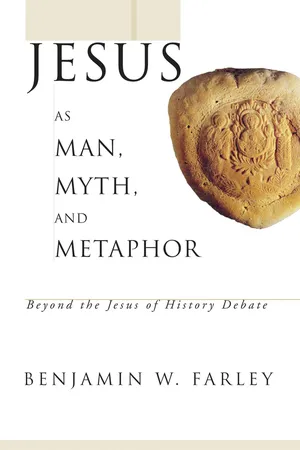
Current New Testament scholarship has done much to advance knowledge of Jesus's authentic words and message. The works of Crossan, Borg, Vermes, Mack, and many others attest to this movement. In this process, however, the Christ of the Gospels, or the so-called Christ of faith, has been caught in the crosshairs, forcing Christianity to reflect anew on the church's interpretation of his life and place in history. Has the church's dogma overreached the "facts" of Jesus's life?
Farley's book addresses these issues and offers a feasible and illuminating context within which to reexamine Jesus's life and significance for modern humankind. His book probes the boundaries of Jesus as a historical person (as a man), as a figure of mythical proportions, and as a metaphor for today's Christian sense of wholeness. Along the way, Farley incorporates the insights of Carl Jung, Joseph Campbell, and Paul Tillich to demonstrate the ways that psychology, mythology, and symbolism contribute to an appreciation of Jesus that moves beyond the debate of Jesus's historical status alone.
Information
Topic
Theology & ReligionSubtopic
Christian Church1
Defining the Jesus of History
The past century and more has witnessed a plethora of quests of the historical Jesus. They range from Schweitzer’s to Bultmann’s, from Bultmann’s to Bornkamm’s, and from the latter to the current sea of works undertaken by such scholars as Marcus Borg, Burton Mack, Geza Vermes, and John Dominic Crossan. Crossan’s monumental The Historical Jesus: The Life of a Mediterranean Jewish Peasant and its sequel, The Birth of Christianity, attest to New Testament research at its best. But much of this has come at a diminution of the so-called Christ of Faith, or problematic for understanding the role of the post-Easter Jesus. Can the Christ of Faith survive in light of the current critical perception that presents Jesus as a social revolutionary, or a peasant Cynic, who became something of a cult figure from both a political and religious perspective?
Certainly, the above studies constitute welcomed resources for exploring the life of Jesus. They provide essential windows into its historicity and Jesus’ authentic sayings, deeds, and identity. Such works also attempt to analysis the tantalizing transition from Jesus the historical person to Jesus the risen Savior and Lord of the world. Nonetheless, the question remains: why study Jesus, if he were merely a Cynic, or a popular peasant revolutionary? Moreover, that the Apostolic and Post-Apostolic Ages found his version of Yahwistic piety and his symbolism as a soter figure superior to Roman imperialism’s gods and goals, does not suffice, necessarily, to render him, or early Christianity’s views, tenable today. This seems especially apparent in view of the intense research to recover the historical Jesus before that transition occurred.
Furthermore, compounding all this is the fact that the modern era no longer believes in the ancient world’s superstitions, theocracies, political philosophies, etc. We admire their art, literature, architecture, and myths. For these provide insight into their concepts of self, politics, religion, philosophy, and universal longings. However, their respective answers and achievements for their day cannot substitute for modern mankind’s efforts, nor can their beliefs be embraced without critical reflection. There has to be a more compelling reason for Jesus studies and adherence to Christian beliefs, beyond the fact that he challenged his Palestinian hearers to rethink their religious and political heritage. In truth, that he might represent the best that one can become, or save one from personal and collective sin, or insure a believer of a life in a world hereafter, strikes the agnostic contemporary world as delusional, at best. The present time frame encourages a person to become only that unique self he or she chooses to become in the process of individuation. Psychiatry has demonstrated the value of this quite successfully for over a century now. Moreover, the current worldview looks unkindly on someone else doing for an individual what an individual must do alone for oneself. The Buddha taught that one is one’s only savior; that it is an illusion to expect redemption to come from without. Jesus said: “The kingdom of God is within you” (Luke 9:35). It is not outside but inside human beings. Nonetheless, having said that, Jesus did not discourage faith in the transcendent God of his forebears. As for a life beyond the grave, Gilbert Ryle’s famous “Ghost in the Machine” made it painfully clear that mankind’s conscious episodes are impossible without brain waves and the latter impossible without physiological underpinnings. There are no two, separate selves, one inner and destined for eternity, the other outer and limited by death and decay. Inner and outer are only two aspects of the same self. To reason otherwise is to create a “category mistake.” His arguments, along with others,’ sought to end that long noetic trail from Plato through Descartes that favored a dualistic, two-substance approach.
The challenge is rightfully to be asked: How are we to assess this historical figure today? Is his value like the Buddha’s, or Lao Tzu’s and his Taoist principles in general? That is at least one question worth pursuing. A second has to do with Jesus’ timeframe and its mythic worldview. Jesus’ Jewish faith repudiated the classical world’s concepts of deity and multiple gods. Yet, within a few years following Jesus’ crucifixion, classical Christianity began utilizing Greco-Roman perceptions of divinity with respect to the life of Jesus, interpreting his appearance as a God-Man, or Son of God, born of a divine spiritual essence that had “overshadowed” (Luke 1:35) his Galilean mother, Mary. This “mythologization” of the historical Jesus as the Sophia of the universe become flesh is preserved in all four Gospels, whether implicitly or explicitly, and cannot be ignored. Also, Plato’s dualistic view of spirit versus flesh dominates Paul’s theology, and many of Paul’s recommended virtues are Stoic in content and form. Is it still possible for one to find his or her spiritual needs fulfilled by this post-Easter figure whose universal purpose and divine status contrasts so sharply with the Jesus of history? If so, how and why? I realize that my interpretations may be viewed, at best, as only tentative, or idiosyncratic, and will represent only one scholar’s viewpoint. Perhaps they will generate more incisive and critical approaches, or more successfully argued positions. In truth, as Schweitzer knew so well, every generation must conclude for itself the significance of Jesus and his lasting value for believers, as well as nonbelievers.
First a brief review of some of history’s more salient appraisals of the historical Jesus is in order. As appropriate, Albert Schweitzer deserves first mention.
Albert Schweitzer (1875–1965)
Albert Schweitzer’s Quest of the Historical Jesus left him both disillusioned and mesmerized. What disillusioned him? German liberal theology’s assessment and reconstruction of Jesus, because it was the product of an unbridled attempt to render Jesus as a perfectly understandable phenomenon of history. Writes Schweitzer:
There is nothing more negative than the result of the critical study of the Life of Jesus. . . .The Jesus of Nazareth who came forward publicly as the Messiah, who preached the ethic of the Kingdom of God, who founded the Kingdom of Heaven upon earth, and died to give His work its final consecration, never had any existence. He is a figure designed by rationalism, endowed with life by liberalism, and clothed by modern theology in an historical garb.1
After much agonizing of his own, Schweitzer ventured that the Jesus of history was a mistaken apocalyptic who, aflame with eschatological fervor, sought to hasten the coming of God’s kingdom by taking matters into his own hand and by dying as a martyr to insure God’s intervention in history. Regrettably, such did not happen.
As for the liberal view of his day, Schweitzer rejected its Jesus altogether. Such a modern Jesus as they perceived him was too small to serve mankind, and his portrayal as such missed the whole mark. In Schweitzer’s view, Jesus, “as a man like ourselves,” never existed. Moreover, such a Jesus “cannot call spiritual life into existence.” For Schweitzer, it is far wiser “to leave the individual man alone with the sayings of Jesus . . .” Furthermore, “it is not Jesus as historically known, but Jesus as spiritually arisen within men, who is significant for our time and can help it.” It is his spirit that “goes forth from Him and in the spirits of men strives for new influence and rule, is that which overcomes the world.”2 Sounding Platonic and Gnostic to the core, he adds:
The abiding and eternal in Jesus is absolutely independent of historical knowledge and can only be understood by contact with His spirit which is still at work in the world. In proportion as we have the Spirit of Jesus we have the true knowledge of Jesus.3
The historical Jesus “influenced individuals by the individual word,” one on one. Identifying him with the Messiah, or Son of God, complete with a rationalistic system of doctrine and dogma, only obscures his appeal and value. Finally, Schweitzer found the words within himself that best summed up the historical Jesus for him. His summary has never been superceded.
He comes to us as One unknown, without a name, as of old, by the lake-side. He came to those men who knew Him not. He speaks to us the same word: “Follow thou me!” and sets us to the tasks which He has to fulfil for our time. He commands. And to those who obey Him, whether they be wise or simple, He will reveal Himself in the toils, the conflicts, the sufferings which they shall pass through in His fellowship, and, as an ineffable mystery, they shall learn in their own experience Who He is.4
Such a Jesus inspirited Schweitzer to re-equip himself as a medical missionary and to lose himself in the great Unknown of Africa’s jungles as one whose soul had come to know Who He was, in the ineffable mystery of obedience and suffering. Only Gandhi, Mother Teresa, and the Dalai Lama have followed in Schweitzer’s footsteps in similar paths of obedience, conflict, and suffering.
Rudolf Bultmann (1884–1976)
Rudolf Bultmann is best remembered for his demythologization program and form critical analysis, which he shared with Martin Dibelius. By recognizing the three-storied universe into which Jesus and his disciples were born, and its mythological structures (heaven, God, and angels above, earth in the middle, and the devil, disease, and evil spirits below), Bultmann hoped to capture a more historically accurate portrait of Jesus. His methodology sought to discover the Sitz im Leben (setting in life) of Jesus’ sayings, along with each unit’s literary form and usage in the early Christian community. This led Bultmann and Dibelius to identify five primary types of literary forms that, hopefully, would shed light on Jesus’ mission and message. The five are: pronouncement stories, legends, sayings, miracles, and the passion narrative. Once a reader dismisses the early Church’s Hellenization of Jesus, in which it turned the historical Jesus into a divine figure sent from God to save the world, a closer view of Jesus as a radical Jewish interpreter of God’s will emerges. Since, however, this wisdom of old no longer grasps a modern humanity, Bultmann sought to render Jesus’ message and life meaningful by interpreting both along existentialist lines. The cross and resurrection remain paramount for Bultmann, but for existentialist reasons.
The historical event of the cross acquires cosmic dimensions. . . . For if we see in the cross the judgment of the world and the defeat of the rulers of this world . . . , the cross becomes the judgment of ourselves as fallen creatures enslaved to the powers of the “world.” By giving up Jesus to be crucified, God has set up the cross for us. To believe in the cross of Christ does not mean to concern ourselves with a mythical event...
Table of contents
- Title Page
- Acknowledgements
- Chapter 1: Defining the Jesus of History
- Chapter 2: Other Historical Figures and Movements and Their Impact on Mankind
- Chapter 3: The Elements of Myth
- Chapter 4: Mythical Dimensions in the Life of the Pre-Easter Jesus
- Chapter 5: Parable, Metaphor, and Myth
- Chapter 6: Children, Women, Prostitutes, Publicans, and Beggars
- Chapter 7: The Hero as Universal Archetype
- Chapter 8: Archetypes of the East
- Chapter 9: Nativity, Transfiguration, and the Cross
- Chapter 10: The Resurrection
- Chapter 11: Jesus as Metaphor
- Chapter 12: Jesus as Shaman, Magician, and Healer
- Chapter 13: The Pre-Easter Jesus as Wonderful Counselor and Prince of Peace
- Chapter 14: The Chief Priests, Scribes, Elders, Pharisees, and Essenes
- Chapter 15: Jesus and the Sabbath
- Chapter 16: The Historical Jesus and the Apostle Paul
- Chapter 17: The Pre-Easter Jesus and the Creeds of the Church
- Chapter 18: The Historical Jesus and the Reformed Tradition
- Chapter 19: Intrigue, Conspiracies, and Plots
- Chapter 20: Conclusion: The Five Trees of Paradise
- Bibliography
Trusted by 375,005 students
Access to over 1.5 million titles for a fair monthly price.
Study more efficiently using our study tools.
Frequently asked questions
Yes, you can cancel anytime from the Subscription tab in your account settings on the Perlego website. Your subscription will stay active until the end of your current billing period. Learn how to cancel your subscription
No, books cannot be downloaded as external files, such as PDFs, for use outside of Perlego. However, you can download books within the Perlego app for offline reading on mobile or tablet. Learn how to download books offline
Perlego offers two plans: Essential and Complete
- Essential is ideal for learners and professionals who enjoy exploring a wide range of subjects. Access the Essential Library with 800,000+ trusted titles and best-sellers across business, personal growth, and the humanities. Includes unlimited reading time and Standard Read Aloud voice.
- Complete: Perfect for advanced learners and researchers needing full, unrestricted access. Unlock 1.5M+ books across hundreds of subjects, including academic and specialized titles. The Complete Plan also includes advanced features like Premium Read Aloud and Research Assistant.
We are an online textbook subscription service, where you can get access to an entire online library for less than the price of a single book per month. With over 1.5 million books across 990+ topics, we’ve got you covered! Learn about our mission
Look out for the read-aloud symbol on your next book to see if you can listen to it. The read-aloud tool reads text aloud for you, highlighting the text as it is being read. You can pause it, speed it up and slow it down. Learn more about Read Aloud
Yes! You can use the Perlego app on both iOS and Android devices to read anytime, anywhere — even offline. Perfect for commutes or when you’re on the go.
Please note we cannot support devices running on iOS 13 and Android 7 or earlier. Learn more about using the app
Please note we cannot support devices running on iOS 13 and Android 7 or earlier. Learn more about using the app
Yes, you can access Jesus as Man, Myth, and Metaphor by Benjamin W. Farley in PDF and/or ePUB format, as well as other popular books in Theology & Religion & Christian Church. We have over 1.5 million books available in our catalogue for you to explore.