eBook - ePub
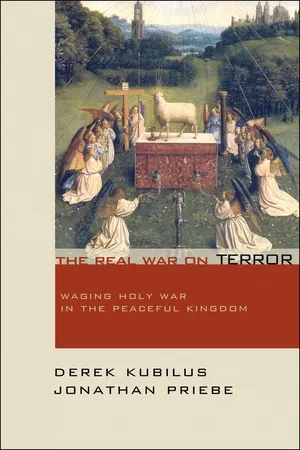
The Real War on Terror
Waging Holy War in the Peaceful Kingdom
- 126 pages
- English
- ePUB (mobile friendly)
- Available on iOS & Android
eBook - ePub
About this book
Do you ever find yourself confused about the war and violence that pervade our post-9/11 world? On the one hand, the Bible and Christ speak of loving enemies and self-sacrifice. On the other hand, the world around us teaches, and most Christians seem to simply accept, that violence is necessary in a world wrecked with sin.
Are Christians a people of peace? Does that peace have to be won through war? Should we fight for our convictions? Or die for them?
Jonathan and Derek invite you to come along with them as they explore the biblical teachings on war and violence and attempt to construct a solidly biblical and uniquely Christian view of war and violence.
Information
Topic
Theology & ReligionSubtopic
Christian Theology1
The Day Fear Invaded
“I hereby command you: Be strong and courageous; do not be frightened or dismayed, for the Lord your God is with you wherever you go.” Joshua 1:9
The world honorably wages war in search of peace. Throughout all of history, humankind has fought in vain against itself, hoping that peace would somehow come from the blood sacrificed by millions of women, children, and men. Theologians, philosophers, and soldiers have long theorized and speculated on how to make war to achieve peace. They think that if only they can wrest control from this last dictator, if only they can win this last war, there will be peace. They think. They hope. But then, as always, another iron-fisted tyrant springs up in some other nation or a band of religious extremists decides to fly planes into crowded buildings, and once again, it appears necessary to strike down evildoers who threaten the safety of the innocent.
Despite thousands of years of war-making “for peace,” true and lasting peace still eludes us. Humanity has not yet learned this inescapable lesson: war only begets more war, and violence only begets more violence. Those eleven words fully summarize the teachings of the entire history of warfare. The cycle of fear and retaliation cannot be broken with bloodshed. No, the only remedy for this disease of never-ending violence that has plagued humanity since Cain killed Abel is for us to rise above the violence itself, to transcend the fear that compels us to take up arms against one another, and to overcome evil with good.1
We, Jon and Derek, have come to the realization that all this war and violence is completely and utterly incompatible with Christ’s teaching. We have discovered that God, through his eternal Word, has shown his children a better way, a higher path. We believe that through Christ, God has taught us that violence is not the answer to overcoming the world’s problems and that his children should abstain from all violence and, instead, lead lives of peace and self-sacrifice.
We humbly ask for your time. On paper, two twenty-somethings from the Midwest have very little credibility on this theological issue. But we realize that God often works through those with very little or no credibility. Moses, David, Jesus . . . all were nothing in the eyes of man. We surely don’t place ourselves in their company, but we pray that God would use us, like he used them, to convey a small portion of his Word . . . that through this book, we could play a minor role in the building of Christ’s peaceable Kingdom. We only ask that you approach this work with a humble heart and a discerning mind. As you read our discussion of nonviolence, we urge you to search the Scriptures to test what we say. Don’t take what we say for granted. Think for yourself; push into God; fearlessly search out the truth.
We are not the first folks to have come to the conclusion that evil cannot overcome evil and that violence cannot create an enduring peace. Ancient Greek playwrights, Indian mystics, American Civil Rights pioneers, and yes, even Evangelical Christians have proposed this same view over the years. It’s just that we’ve noticed that this perspective often gets dismissed and ridiculed as cowardice. Therefore, it is often confined to college philosophy texts, seminary libraries, and Phish concerts. We want to bring this position back to where it belongs: in the mainstream of Christianity. We want nonviolence to be taught in our Sunday schools and preached about from our pulpits. This book is intended to be a stepping stone for bringing the issue of nonviolence back to the front lines of Christian ethics.
Given the political climate that our nation finds itself in, as well as the violence that plagues our streets, Christians in America cannot afford to ignore the issue of violence. As elected officials wage war on our behalf, spending our tax dollars on weapons to kill enemies who could be called to repentance, our spiritual shepherds remain silent. According to a Pew Forum study from March 2003, only fifty-seven percent of American pastors had recently spoken on the issue of war with Iraq. Unbelievably, only a third of those who had discussed the topic were concerned enough for their flock to take a position on war (for or against).2 How can Christians remain silent while terrorists hurl threats against us, our money is used to finance a war against those terrorists, and our sons and daughters are being sent into harms way, all in the name of national defense? War is a reality. We Christians must acknowledge this and search for a Christian response to it.
General William Tecumseh Sherman once wrote, “War is hell.”3 Americans now know this all too well. Only six short years ago, America was shocked out of her complacency to find that she still lives in a world where war and violence are grim realities. In September of 2001, it became apparent that although this “hell” that Sherman mentioned had long been relegated to history books and international news broadcasts, war can still reach our seemingly secure back yards and change our ways of life forever.
Most Americans would agree that the attacks of September 11th have had a profound impact on their lives. The vast majority of Americans are still able to tell you where they were and what they were doing on that bright Tuesday morning. Not since the assassination of John F. Kennedy or the Challenger explosion has the nation felt such a connection to a particular day. Millions of opinions about war and violence have been forged from the smoldering ruins of the Twin Towers. This invasion left many feeling scared, some angry, but it left almost all, including us, feeling very confused.
Derek’s September 11 Experience
That morning was like any other. Coffee in hand, I showed up at the office, but for some reason, no one was at their desks. I just figured our Wednesday team meeting had been bumped up to Tuesday and that I had not gotten the memo. So I went to the conference room, where I found the entire office crowded around a television set, watching the towers burning.
“When the first one hit, everyone thought it was just an accident, but then a second plane took out the other tower!” exclaimed a coworker with a bewildered look on her face. It was apparent that this was no accident. This was an act of aggression the likes of which no one in Generation X had ever seen before.
The following week was almost surreal. Government officials were making constant statements, crews were working around the clock to find survivors, and images of sobbing families were plastered all over the news. There were people missing work all over the place and coworkers were found crying at their desks. For the very first time in my life, I found myself mourning for people I didn’t even know. Something had shaken us up and jarred us from our comfortable lives in Western society.
For the first time in several decades, we felt vulnerable as a nation. We all felt like victims. We were all faced with the horrific reality that we could die an untimely death at the hands of another at any moment.
I suppose that’s why we all flocked to church that Sunday. Many in our nation had never seriously dealt with the issue of death before. Many never considered that the chaotic violence that was so prevalent on television broadcasts from other countries could actually be real! No one believed it could ever come to into our nation and touch our lives. We all found ourselves playing a role we were not accustomed to. Americans were faced with their own mortality, and they wanted to see what God had to say. In this grand play called human existence, Americans found themselves playing the part of the helpless victim for the first time, and we needed to know why.
I guess we could all identify with Jesus at that moment. He was a man of supreme power, capable of creating and destroying worlds with a single word. He drove out demons, healed the blind and walked on water. Yet, even in his power, he found himself playing the role of the victim, being crucified on a cross. So it was with the United States. We are a nation of supreme power. America basically controls the world’s economy, protects smaller nations with its nuclear arsenal, and topples oppressive governments, all in our spare time. How could America, like Jesus, fall at the hands of those who were so weak in comparison?
The absurdity of the situation was too much for most to handle. Starting with church services on September 16th, the people of this great, yet vulnerable nation called for war. This injustice could not be allowed to stand. America must save face.
I was surprised when I heard this message preached at church that Sunday. It wasn’t that I disagreed with that message. It’s just that I had grown accustomed to pastors talking about compassion, loving your enemies, and all that. It was unsettling to hear sentiments of war and vengeance being preached in front of the altar of God.
At that moment I first recognized that there was some tension between the concept of war and the teachings of Jesus Christ. I already knew it was there in the back of my mind, but I had never really focused on it before. Just as quickly as I came to that realization I decided to table that thought, putting it back on the rear burner for another day. I needed to focus on freedom, loyalty and the flag that represented those things. I had no time or energy to devote to complex ethical deliberation.
But as time went on and we began attacking the Taliban in Afghanistan, I found it more and more difficult to stop thinking about resolving the conflict between Christ’s Sermon on the Mount and the practice of war. Part of me was calmed by seeing war taking place where it belonged: on television in a foreign land. But, another part of me was just starting to stir. It was as if a different side of me was just now waking up for the first time, and that it was rubbing its eyes, asking, “What’s going on?”
Over the next year or two, as the war waged on in Afghanistan and a new war “to defend freedom” was being spo...
Table of contents
- Title Page
- Acknowledgements
- Chapter 1: The Day Fear Invaded
- Chapter 2: The Lord Is a Warrior
- Chapter 3: The Ironic Messiah
- Chapter 4: A Tradition of Peace
- Chapter 5: The Inner Struggle
- Chapter 6: The Outer Struggle
- Chapter 7: God and Country
- Chapter 8: Fighting the Good Fight
- Bibliography
Trusted by 375,005 students
Access to over 1.5 million titles for a fair monthly price.
Study more efficiently using our study tools.
Frequently asked questions
Yes, you can cancel anytime from the Subscription tab in your account settings on the Perlego website. Your subscription will stay active until the end of your current billing period. Learn how to cancel your subscription
No, books cannot be downloaded as external files, such as PDFs, for use outside of Perlego. However, you can download books within the Perlego app for offline reading on mobile or tablet. Learn how to download books offline
Perlego offers two plans: Essential and Complete
- Essential is ideal for learners and professionals who enjoy exploring a wide range of subjects. Access the Essential Library with 800,000+ trusted titles and best-sellers across business, personal growth, and the humanities. Includes unlimited reading time and Standard Read Aloud voice.
- Complete: Perfect for advanced learners and researchers needing full, unrestricted access. Unlock 1.5M+ books across hundreds of subjects, including academic and specialized titles. The Complete Plan also includes advanced features like Premium Read Aloud and Research Assistant.
We are an online textbook subscription service, where you can get access to an entire online library for less than the price of a single book per month. With over 1.5 million books across 990+ topics, we’ve got you covered! Learn about our mission
Look out for the read-aloud symbol on your next book to see if you can listen to it. The read-aloud tool reads text aloud for you, highlighting the text as it is being read. You can pause it, speed it up and slow it down. Learn more about Read Aloud
Yes! You can use the Perlego app on both iOS and Android devices to read anytime, anywhere — even offline. Perfect for commutes or when you’re on the go.
Please note we cannot support devices running on iOS 13 and Android 7 or earlier. Learn more about using the app
Please note we cannot support devices running on iOS 13 and Android 7 or earlier. Learn more about using the app
Yes, you can access The Real War on Terror by Derek Kubilus,Jonathan Priebe in PDF and/or ePUB format, as well as other popular books in Theology & Religion & Christian Theology. We have over 1.5 million books available in our catalogue for you to explore.