- 272 pages
- English
- ePUB (mobile friendly)
- Available on iOS & Android
eBook - ePub
About this book
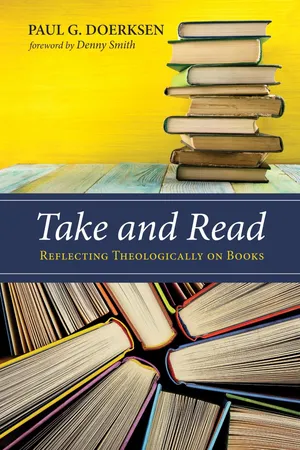
Take and Read is a collection of essays first presented as oral theological reflections on books, written to stimulate conversations among diverse groups of readers, which included farmers, physicians, teachers, poets, novelists, scientists, people involved in business, finance, relief work, and many other walks of life, ranging in age from twenty-something to eighty. These reflections introduce and offer samples of theological readings of a variety of books. The result is a collection of essays addressing a wide range of topics from food security to violence, from dementia to indigenous issues. Perhaps this book is best described as an invitation to joining a conversation about books, and more importantly, about God.
Information
Topic
Theology & ReligionSubtopic
Christian Church1
In the Ruins of the Church
Russell R. Reno. In the Ruins of the Church: Sustaining Faith in an Age of Diminished Christianity. Grand Rapids: Brazos Press, 2002.
If you find the church frustrating, then Reno’s book will (at first glance) confirm that frustration, since he agrees that the church can be seen as a failure, as hypocritical and faithless, and something from which we may want to distance ourselves. In fact, this “aloof ecclesiology” is something we come by honestly in our current situation, where ironic distance is often celebrated. The church is in ruins, no doubt of that, says Reno, but his counsel is that to be in the church in these days is precisely to embrace that broken way of life, and “to dwell within the ruins of the church.” Reno is specific about the failures of his particular church (Episcopalian), but his message is worth considering by each of us within our particular church tradition.
Reno’s vision is worth considering, as the paragraph above notes, not least because of a powerful cruciform theological vision: “We should not seek any other city, however redolent with spiritual power and life it might seem. For in the ruins of Jerusalem, in the pierced, dead, and ruined body of our Lord Jesus Christ, in which we now dwell far more literally than any of us might have imagined, the Lord brings us to see, as only eyes cleansed by tears of repentance can, the omnipotence of his cruciform love.”1
It was impossible for me to read this book with scholarly detachment or ironic distance. I’ve been influenced enough by Stanley Hauerwas and by my Anabaptist forebears that a defense of staying with the church (“dancing with the one that brung ya”) is a welcome resource. I have spent a lot of time thinking about what might constitute a theological warrant for leaving the church or for moving from one to another, but Reno’s book puts the lie to many of the lines of thinking I have entertained from time to time. Without glossing over the problems of the church, Reno argues for a concrete Christianity that entails going to a real church that actually exists, and practicing authentic spiritual disciplines such as prayer and reading the Bible. His thesis is basic but challenging: loyalty to Christ requires us to dwell within the ruins of the church, to draw near to Christ in his body, the church.
In his introduction, Reno rejects the desire he sees all around for “‘liberating distance,’” something he sees especially evident in the work of J.N. Darby, whom we have to thank for dispensationalism. Darby typifies the modern ecclesial project of recognizing a problem and arguing for separation as a way to holiness, a move that can be seen in both liberal and conservative thought. We all indulge in a “distancing habit that keeps at bay the demands of suffering intimacy with the concrete and particular forms of the apostolic witness” (26). By way of challenging such habits, Reno introduces us to the work of Nehemiah as the way to redoubled intimacy, a way wherein “we must dwell as closely as possible to the ruined forms of modern Christianity” (27). The three parts of Reno’s book then articulate his vision, which is generated by his reading of Nehemiah.
First, Reno addresses the question of why distance and separation have become the watchwords of our postmodern age. He identifies a move from Promethean (focus on pride—technology, fire) to Petronian (focus on sloth and cowardice) humanism. This latter form embraces satire, cynicism, and irony. Nothing is really destroyed, but neither is it resolved. Instead, we get to an ironic detachment from all of it, a postmodern horror of obedience to anything. What we need, says Reno, is to nurture an ambition that has the courage of obedience, which is necessary to reshape our identity, but people resist the inner spiritual demand that would involve personal change (44–46).
Further, Reno suggests that we do not want what Christianity teaches; the problem really isn’t scientific method, historical consciousness, and the like, it’s a matter of moral rebellion, as seen so clearly in the way Augustine delivers his account in the Confessions, where he describes so eloquently his own prideful self-sufficiency, horror of dependence and fear of difference. The Gospel is relevant, all right, but we just don’t like what it has to say.
One of the current attempts to address the problem of this ironic distance is the Radical Orthodoxy movement, led by John Milbank, Graham Ward, and Catherine Pickstock. Reno describes this work as a postmodern movement that rejects distance in favor of a recovered classical vision, while using all the jargon and tools of postmodern thought. Radical Orthodoxy puts forward an Augustinian vision, as opposed to a Nietzschean vision of original violence—this is a participatory framework, a comprehensive framework in which the whole world is fit for absorption into a theological framework. It’s very exciting, but in the end, Reno judges the movement to be too modern, because it uses what he calls a “‘speculative grasp,’” which is a general tendency to substitute the creative production of theological theory for the redemptive power of Christ. That is, the Radical Orthodoxy movement transfers loyalty from a concrete Christianity to an ideal, which while it may be Christ-formed is not incarnate.
Reno’s work in the second section of the book focuses more tightly on the ruinous situation of the Episcopalian church, of which he is a part. He identifies considerable dysfunction in the living out of the theological vocation of the church, particularly in the posture wherein the visible life of the church is detached from scripture, in the handling of the Creed, which is no longer seen as ruling out any belief or liturgical practice, in the work of the episcopate, as bishops have become personal prophets and leaders of warring theological factions, in the practice of baptism and the Eucharist, which status has become ambiguous. Because of all this, the vision of the Episcopalians has become obscured, where what is needed is to submit to these sources in their premodern forms. Therefore, Reno calls for a retrospective, receptive, and reiterative disposition instead of a drive for liturgical change that he considers to be misguided. He suspects that people believe that the more thoroughly the liturgy can be revised, the more can the images of God and teachings on morality be changed. In the present climate of opinion, he finds three disturbing trends: a) an intense desire to strike an affirmative pose, i.e. therapeutic tolerance; b) a distrust of the particular, because supposedly that puts God in a box; and c) the widespread notion that change is inevitable. These attitudes are debilitating for the common life of the church.
Reno marshals further evidence for his assertion that the Episcopal Church is in ruins from the debate concerning sexuality, and especially homosexuality. The issues around homosexuality are decidedly not theological, he argues, but primarily based on class loyalties combined with an interest in freedom in general, resulting in constant revisionary pressure, especially on traditional teachings about sexuality. What we want is to secure recognition and affirmation of our practices chosen on grounds other than theological understanding.
The third section of Reno’s book evokes what a Nehemian dwelling in the ruins of Jerusalem means for church life.2 Reno begins this exhortative section with discussion of postliberal ecclesial spirituality, used here to refer to the many efforts to find life in concreta Christiana. Spirituality can be defined as the x that closes the gap between first-order language and the practices that constitute the visible forms of the Christian life. Modern spirituality embraces some x that levers us into first-order language and practice, carrying in its wake the danger that we will move to a religion of that x itself.
Currently, at least in the Episcopalian church, the plausibility of apostolic Christianity has collapsed. Those very things that are first-order language and practice—reading the Bible, baptism, and so on—have become the barriers to Christianity. Evangelicals turn to the Bible, but cannot sustain community; Anglo-Catholics turn to the sacraments, which endorse loyalty to a church that does not exist.
At this juncture of the book, Reno turns to his constructive task, beginning with the reading of scripture. Reno finds the way Origen read scripture to be instructive, especially the fact that Origen found barriers to understanding within the scriptures themselves. Instead of ignoring these barriers, we must submit to them and allow them to teach us. Reno suggests that we must follow that same lead in reading his book, submitting to stumbling blocks such as the ones he has uncovered, striving to see the church in ruins but refusing to look away, because the scattered stones we see constitute the very material of rebuilding, as was the case for Nehemiah. Reno also highlights the importance of the Daily Office, which he describes as an engine of intimacy that shapes us in the way of discipleship, in the narrow way of the cross. We are to pray as those who came before us. Just as the Daily Office is an engine of intimacy, so too is the task of interpreting scripture not primarily technical but spiritual. History does not necessarily distance us from the word of God but provides opportunity to intensify our reading and draw near to God,3 a dimension of reading that Reno displays in his treatment of John’s first epistle, in which we draw near to the cruciform ruins of the church.
In reflecting on Reno’s book, I find several theological points especially rich. First, his emphasis on the cruciform love of Jesus, which here is no soft liberal notion of ‘why can’t we all just get along,’ or a pale promotion of ‘tolerance,’ but rather a rich suggestion that the love of Jesus, which sustains us and shapes our lives, and which calls us to suffer divine things, is itself in the shape of the cross. I believe this emphasis to be timely, and basically correct in its orientation. Further, Reno’s sustained critical analysis of the liberal side of church life as opposed to a trashing of fundamentalism is also welcome.4
I’m not quite sure what to make of Reno’s suggestions that we need to be premodern or primitive in our approach to scripture. The concern he raises addressing the church’s pursuit of putative relevance as we often understand that term (i.e., as something that necessarily involves PowerPoint and a worship team, and discusses the ‘other’) is convincing. T...
Table of contents
- Foreword
- Introduction
- 1. In the Ruins of the Church
- 2. What about Hitler?
- 3. The Mystery of the Child
- 4. God Laughs and Plays
- 5. Living the Sabbath
- 6. The Omnivore’s Dilemma
- 7. Jayber Crow
- 8. The Year of Living Biblically
- 9. Atheist Delusions
- 10. Original Sin
- 11. Acedia and Me
- 12. Shop Class as Soulcraft
- 13. Following Jesus in a Culture of Fear
- 14. Confessions
- 15. Just War as Christian Discipleship
- 16. Love Wins
- 17. Working with Words
- 18. The Undoing of Death
- 19. Migrations of the Holy
- 20. The Cross and the Lynching Tree
- 21. Spirit and Trauma
- 22. Ravished by Beauty
- 23. Scripture, Culture, and Agriculture
- 24. Christianity after Religion
- 25. Dementia
- 26. When I Was a Child I Read Books
- 27. David and Goliath
- 28. My Bright Abyss
- 29. The Good Funeral
- Sermons
- Bibliography
Trusted by 375,005 students
Access to over 1.5 million titles for a fair monthly price.
Study more efficiently using our study tools.
Frequently asked questions
Yes, you can cancel anytime from the Subscription tab in your account settings on the Perlego website. Your subscription will stay active until the end of your current billing period. Learn how to cancel your subscription
No, books cannot be downloaded as external files, such as PDFs, for use outside of Perlego. However, you can download books within the Perlego app for offline reading on mobile or tablet. Learn how to download books offline
Perlego offers two plans: Essential and Complete
- Essential is ideal for learners and professionals who enjoy exploring a wide range of subjects. Access the Essential Library with 800,000+ trusted titles and best-sellers across business, personal growth, and the humanities. Includes unlimited reading time and Standard Read Aloud voice.
- Complete: Perfect for advanced learners and researchers needing full, unrestricted access. Unlock 1.5M+ books across hundreds of subjects, including academic and specialized titles. The Complete Plan also includes advanced features like Premium Read Aloud and Research Assistant.
We are an online textbook subscription service, where you can get access to an entire online library for less than the price of a single book per month. With over 1.5 million books across 990+ topics, we’ve got you covered! Learn about our mission
Look out for the read-aloud symbol on your next book to see if you can listen to it. The read-aloud tool reads text aloud for you, highlighting the text as it is being read. You can pause it, speed it up and slow it down. Learn more about Read Aloud
Yes! You can use the Perlego app on both iOS and Android devices to read anytime, anywhere — even offline. Perfect for commutes or when you’re on the go.
Please note we cannot support devices running on iOS 13 and Android 7 or earlier. Learn more about using the app
Please note we cannot support devices running on iOS 13 and Android 7 or earlier. Learn more about using the app
Yes, you can access Take and Read by Paul G. Doerksen in PDF and/or ePUB format, as well as other popular books in Theology & Religion & Christian Church. We have over 1.5 million books available in our catalogue for you to explore.