- 124 pages
- English
- ePUB (mobile friendly)
- Available on iOS & Android
eBook - ePub
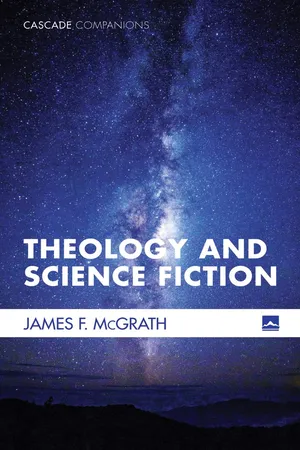
Theology and Science Fiction
About this book
What is the difference between a god and a powerful alien? Can an android have a soul, or be considered a person with rights? Can we imagine biblical stories being retold in the distant future on planets far from Earth? Whether your interest is in Christianity in the future, or the Jedi in the present--and whether your interest in the Jedi is focused on real-world adherents or the fictional religion depicted on the silver screen--this book will help you explore the intersection between theology and science fiction across a range of authors and stories, topics and questions.
Throughout this volume, James McGrath probes how science fiction explores theological themes, and vice versa, making the case (in conversation with some of your favorite stories, TV shows, and movies) that the answers to humanity's biggest questions are best sought by science fiction and theology together as a collaborative effort.
Information
1
Introduction
A light shines down from heaven. Beings from above descend to Earth, take hold of a human male, and return to the place from whence they came, ascending with him. Where they take him, he sees wondrous and horrific things. He learns that in the celestial realm, as in the earthly, there are beings who stand for good and beings who stand for evil. He has confirmed to him what he had already believed—that those beings, good and evil, are not only at war with one another somewhere above the skies, but are involved in terrestrial affairs. Some of that involvement has set human history on course for a terrible end. Once he is returned to earth, the celestial traveler tries to share his knowledge with others, but many scoff at his message. But he writes a book about his experience, in the hope that some will listen.
Is this a summary of a modern story about an alien abduction, or of an ancient apocalyptic work? The fact that it could be either highlights the parallels between much ancient and contemporary storytelling, and the unbroken tradition that connects them. I have introduced the subject of “theology and science fiction” in this way, as the groundwork for plotting a course ahead through the subject of this book, because it would be easy to miss the extent to which theology and science fiction have at times told much the same story. Doing justice to the intersection of theology and science fiction must entail taking the distinctive characteristics of each seriously, as well as recognizing those instances in which there scarcely seems to be any distinction at all.
One popular approach to theology and sci-fi is content to do what we have done above, namely to note parallels between recent books or movies on the one hand, and Biblical or other sacred literature on the other. Indeed, in some circles it is popular to look for “Christ figures” and religious symbols in popular culture, so as to turn stories into allegories or illustrations of religious teachings. This book will not be approaching the relationship of theology and science fiction in that way, for several reasons. First of all, merely noticing similarities is the most superficial level of treatment of the topic, and those who are content with it can find it in plenty of other places. It is also very easy to read parallels into stories in ways that do not detect symbolism in them, so much as impose a particular religious standpoint as the framework for reading, in a way that risks distorting both in the process.
In this book we will try to look deeper at the way that stories themselves tackle theological ideas, sometimes giving expression to the theological vision of the author, in others simply articulating the religious outlook of characters in the stories in the interest of making them seem more realistic. We will also look at the intersection of science fiction with the formulation of theology in the present, as traditional religions discuss topics such as life on other worlds, or whether machines deserve rights or could even have a “soul.” Theology can be expressed in and through science fiction, and science fiction can provide opportunities for the exploration of theological ideas. But before we begin to explore the relationship, we need to first say at least a little about precisely what is meant by the words used in the title of this book.
What is theology?
Whole books have been written about the task of theology, and so readers without at least some background in this area are encouraged to seek more information elsewhere. But it is necessary to say a little here, by way of introduction, about what theology means in the context of the present book, and what it does not. Theology, in terms of its etymology, sounds like it could mean the “study of God,” just as biology studies life and living things. But no one has access to God in a way that would allow God to be placed under a microscope and examined. Indeed, many theologians would emphasize that any being, entity, or reality that can be studied and grasped by the human mind is by definition not God (with a capital “G”) and unworthy of the label. That stance, however, itself assumes a certain theological axiom, namely that there is one God who is greater than human thoughts can conceive and transcends what human words could ever hope to describe. But that definition is not the only one possible. We therefore need to define “theology” here in a manner that encompasses not just one view of the divine, but many possible ones, even as specific theologies may then proceed to offer definitions and to specify attributes of the divine. For the purpose of the present volume, theology may be defined as systematic thought about one’s own beliefs about the divine, spirituality, and/or other religious matters.
The aim here is to discuss ways that diverse theologies may engage with science fiction, not to offer an engagement exclusively from one particular theological perspective. As an academic discipline, theology is often contrasted with religious studies, the latter representing the study of religions mostly by outsiders, while theology is defined as the articulation of a religion’s perspective from the point of view of an insider. Yet even though this volume is not written to advocate one community’s view of God in relation to science fiction, that does not make it a book that is better described as being about religion and science fiction. Theology in the present age can scarcely be done in a serious manner without taking into account the viewpoints of religious others who are our neighbors in both the literal geographic sense as well as in cyberspace. And so one can engage with science fiction as well as with the contemporary terrestrial religious other simultaneously, just as one may encounter fictional religions in sci-fi that may more closely resemble one’s own religion or that of others found in the world in the present day. This book seeks to provide a guide to readers that will help them as they reflect on their own beliefs, and consider those of others, in relation to science fiction, which often provides fictional stories about dealing with entities who are religiously other as well as biologically different from humans.
What is science fiction?
Science fiction is not quite as hard to define as religion, but it isn’t straightforward either. Are works of dystopian futurism “science fiction” even if science does not feature prominently in the story? What if a work is set in a dystopian future in which not only is there no new science, but even much present science has been forgotten? Are superhero comic books science fiction? What about James Bond and other spy thrillers which feature gadgets that did not really exist at the time the story was written? If a TV show depicts people traveling using teleportation technology that could probably never exist in reality, some might challenge its right to be called hard science fiction. But what makes it science fiction at all?
If there is a key distinction to make in relation to science fiction, it is distinguishing it from the genre of fantasy. Both are sometimes placed under the broader heading of “speculative fiction.” But the distinction between fantasy and sci-fi is important as it relates to our interest in religion and theology. One can find many of the same elements in both—worlds different from our own, inhabited by beings like ourselves (often with minor differences like pointed ears), as well as terrifying and dangerous monsters, and the use of weapons that at least seem like magic. The difference is that, in science fiction, the quasi-humans may be called aliens rather than elves, the monsters will likewise be alien animals, and instead of casting spells that fire lightning, one will use a laser rifle. It is the positing of a scientific explanation for these unreal beings and occurrences that distinguishes sci-fi from fantasy. But the distinction is a blurry one, in the sense that there does not need to be a plausible scientific explanation that seems valid based on our current understanding, but merely the assertion that things are realized by scientifically explicable means, rather than actual magic.
And so, minimally, it would seem that any stories in which science—or things which purport to be scientific—feature prominently deserve to be placed in the category of science fiction. Just as one can debate endlessly about what precisely is or is not religion, so too can one debate what deserves to be called science fiction. Fortunately, we can set aside such debates, as there are plenty of uncontroversial examples that could fill a much larger book than this one. But the rejection of magic on the part of most sci-fi, while embracing it under a quasi-scientific guise, is important to keep in mind as a common feature in science fiction. We will find that many sci-fi stories overlap with and even borrow from earlier traditions of storytelling which featured the mythical and the magical. Religion has also regularly sought to distinguish itself from magic, albeit in very different ways and along different lines. And as we proceed, we will find that both religion and science fiction have a more ambiguous relationship to magic and myth than either tends to acknowledge.
Before proceeding, it is worth mentioning that this book will avoid focusing in detail on specific stories. Instead it aims to explore questions and themes that pervade a great deal of science fiction literature, television, and film, using specific stories as examples and illustrations. That way, it shouldn’t matter whether you have read or seen this or that story or television show, making the book more useful to a wider array of readers. Focusing on the details of specific stories would risk unnecessarily alienating the reader (pun intended).
What is theology and science fiction?
There are a great many different ways to relate theology and science fiction. One can approach sci-fi through the lens of one’s own theological assumptions, and treat the text (whether written or cinematographic) as a place to find culturally relevant illustrations of one’s own beliefs. Or, alternatively, if the stories are not malleable enough to allow one to find support for one’s own ideas in them, one can criticize the stories because they oppose one’s own belief system. One can also ask questions about authorial intention, often more easily addressed in relation to sci-fi than ancient sacred texts, because in many cases the authors of the former are still living, while in other cases, merely by virtue of having lived more recently in history, we have more evidence about their views than we have for specific ancient authors, or even entire human cultures of the past. One can also eschew questions about what authors intended and focus on the imaginary world within the text itself, adopting a narrative approach and asking about gods, rituals, and beliefs within the world of the text. And one can look at ways that science fiction stories inspire people to believe and to act in the real world in ways that are at least quasi-religious, and which incorporate theological elements.
One may also ask about the appropriate response to science fiction, and how it compares to the responses to important stories in religious settings. Are science fiction stories—and any theology expressed in them—supposed to be “believed”? Is the suspension of disbelief involved in reading stories in this genre different from what is involved in reading the Bible or the Ramayana or another sacred text, and if so, in what way? Science fiction provides wonderful opportunities to discuss the nature of narrative and of belief in relation to religion. Kronos was the Greek god of time, and not just a character on Doctor Who. When ancient people first depicted time as devouring his children, was this thought of as a literal story about what happened once in ages past, or as a picture of the way time constantly produces things and yet also eventually destroys them? Can we know the answer to this question, given that we have stories which well antedate the time in which these characters were first spoken of? And, given that there were subsequent interpretations of such stories in both a literal and an allegorical fashion in the Greek tradition, what does it indicate that Doctor Who chose to incorporate this entity as a character that literally exists in the fictional world the show depicts?1
Models of interaction Between Theology and Science Fiction
Ian Barbour is well known for having delineated a number of different possible approaches to the relationship between theology or religion on the one han...
Table of contents
- Preface
- Chapter 1: Introduction
- Chapter 2: Space Can(n)ons and Scriptural Canons
- Chapter 3: Science Fiction against Theology and as Theology
- Chapter 4: Theology against Science Fiction and as Science Fiction
- Chapter 5: Theology and Science Fiction at the Intersection with Philosophy and Ethics
- Chapter 6: Science Fiction and Theology in Dialogue and Synthesis
- Chapter 7: Three Theological Science Fiction Short Stories
- Bibliography
Trusted by 375,005 students
Access to over 1.5 million titles for a fair monthly price.
Study more efficiently using our study tools.
Frequently asked questions
Yes, you can cancel anytime from the Subscription tab in your account settings on the Perlego website. Your subscription will stay active until the end of your current billing period. Learn how to cancel your subscription
No, books cannot be downloaded as external files, such as PDFs, for use outside of Perlego. However, you can download books within the Perlego app for offline reading on mobile or tablet. Learn how to download books offline
Perlego offers two plans: Essential and Complete
- Essential is ideal for learners and professionals who enjoy exploring a wide range of subjects. Access the Essential Library with 800,000+ trusted titles and best-sellers across business, personal growth, and the humanities. Includes unlimited reading time and Standard Read Aloud voice.
- Complete: Perfect for advanced learners and researchers needing full, unrestricted access. Unlock 1.5M+ books across hundreds of subjects, including academic and specialized titles. The Complete Plan also includes advanced features like Premium Read Aloud and Research Assistant.
We are an online textbook subscription service, where you can get access to an entire online library for less than the price of a single book per month. With over 1.5 million books across 990+ topics, we’ve got you covered! Learn about our mission
Look out for the read-aloud symbol on your next book to see if you can listen to it. The read-aloud tool reads text aloud for you, highlighting the text as it is being read. You can pause it, speed it up and slow it down. Learn more about Read Aloud
Yes! You can use the Perlego app on both iOS and Android devices to read anytime, anywhere — even offline. Perfect for commutes or when you’re on the go.
Please note we cannot support devices running on iOS 13 and Android 7 or earlier. Learn more about using the app
Please note we cannot support devices running on iOS 13 and Android 7 or earlier. Learn more about using the app
Yes, you can access Theology and Science Fiction by James F. McGrath in PDF and/or ePUB format, as well as other popular books in Literature & Literary Criticism in Science Fiction. We have over 1.5 million books available in our catalogue for you to explore.