eBook - ePub
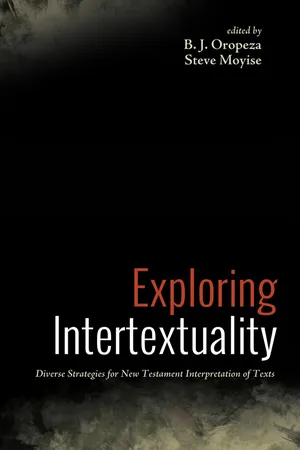
Exploring Intertextuality
Diverse Strategies for New Testament Interpretation of Texts
- 346 pages
- English
- ePUB (mobile friendly)
- Available on iOS & Android
eBook - ePub
Exploring Intertextuality
Diverse Strategies for New Testament Interpretation of Texts
About this book
This book aims to provide advanced students of biblical studies, seminarians, and academicians with a variety of intertextual strategies to New Testament interpretation. Each chapter is written by a New Testament scholar who provides an established or avant-garde strategy in which:
1) The authors in their respective chapters start with an explanation of the particular intertextual approach they use. Important terms and concepts relevant to the approach are defined, and scholarly proponents or precursors are discussed.
2) The authors use their respective intertextual strategy on a sample text or texts from the New Testament, whether from the Gospels, Acts, Pauline epistles, Disputed Pauline epistles, General epistles, or Revelation.
3) The authors show how their approach enlightens or otherwise brings the text into sharper relief.
4) They end with recommended readings for further study on the respective intertextual approach.
This book is unique in providing a variety of strategies related to biblical interpretation through the lens of intertextuality.
Information
Topic
Theology & ReligionSubtopic
Biblical StudiesPart I
Established Strategies
1
Dialogical Intertextuality
Though the study of how texts affect one another is as old as literature itself, Julia Kristeva is generally credited as the first to introduce the term intertextualité into literary discussion in 1969. Drawing on the work of Mikhail Bakhtin, Kristeva suggests a dialogical relationship between “texts,” broadly understood as a system of codes or signs. Moving away from traditional notions of agency and influence, she suggests that such relationships are more like an “intersection of textual surfaces rather than a point (a fixed meaning).”1 As Bakhtin says, “The word lives, as it were, on the boundary between its own context and another, alien context.”2 No text is an island and contrary to structuralist theory, it cannot be understood in isolation. It can only be understood as part of a web or matrix of other texts, themselves only to be understood in the light of other texts. Each new text disturbs the fabric of existing texts as it jostles for a place in the canon of literature. Intertextuality suggests that the meaning of a text is not fixed but open to revision as new texts come along and reposition it.3As the name suggests, “dialogical intertextuality” is interested in the interaction that takes place between such “textual surfaces.” As Harriet Davidson says of T. S. Eliot’s, The Waste Land, “The work alluded to reflects upon the present context even as the present context absorbs and changes the allusion.”4 The point is that if an author points the reader to a particular source (whether that is a specific text, a trope, or other cultural phenomenon), it becomes another “voice” in the process of interpretation. The author may have a specific reason for doing this,5 but once the reader has made the connection, the author cannot control the interactions that may result. Traditional biblical categories, like allegory, typology, and midrash often assume that the source text is entirely malleable to what is being done with it. When the interpretation has been made, there is no further role for the “voice” of the source text. Dialogical intertextuality operates with a more dynamic understanding of meaning, where the particular “voices” (intertexts) are not silenced but continue to affect one another. As Raj Nadella says:
Dialogism is about a lively and constant exchange of ideas among the many, disparate voices. It seeks intersection—rather than integration—of divergent viewpoints, and it provides a platform for them to encounter each other on equal footing without necessarily coming into agreement. . . . Dialogism conceives of truth as that which requires more than one perspective.6
In his analysis of imitation in Renaissance poetry, one of Thomas Greene’s categories is “dialectical imitation.” He defines this as when a source text is allowed a subversive influence on the alluding text. Thus the alluding text “makes a kind of implicit criticism of its subtexts, its authenticating models, but it also leaves itself open to criticism from [the text]. . . it had begun by invoking.”7 The result, Greene says, is that the alluding text is “the locus of a struggle between two rhetorical or semiotic systems that are vulnerable to another and whose conflict cannot easily be resolved.”8 This is in contrast to “heuristic imitations,” which come to us “advertising their derivation from the subtexts they carry with them, but having done that, they proceed to distance themselves from the subtexts and force us to recognize the poetic distance traversed.”9 It is the openness to mutual influence that is the essence of dialogical intertextuality.
Richard Hays draws on Greene (and John Hollander) in his analysis of the relationship between Paul and Moses in 2 Corinthians 3. On the surface, it appears that Paul is simply offering Moses as a “foil against which to commend the candor and boldness of his own ministry.”10 The generation of Moses was unable to see clearly, but those who respond to Paul’s preaching have the “veil” removed (2 Cor 3:16). The reader is led to expect a completely negative verdict of religion under the old covenant, but the mention of “veil” reminds Paul that Moses did in fact remove his veil when he entered God’s presence (Exod 34:34). Thus, Paul is able to “appropriate some of the mythical grandeur associated with the Sinai covenant—particularly the images of glory and transformation—even while he repudiates the linkage of his ministry to that covenant.”11 Hays calls this a “dissimile” and states:
The rhetorical effect of this ambiguous presentation is an unsettling one, because it simultaneously posits and undercuts the glory of Moses’ ministry. . . . Since Paul is arguing that the ministry of the new covenant outshines the ministry of the old in glory, it serves his purpose to exalt the glory of Moses; at the same time, the grand claims that he wants to make for his own ministry require that the old be denigrated.12
A similar example is found in Heb 12:18–25, where the author compares Christian experience with that of the Sinai generation. An initial denial (“You have not come . . .”) is followed by a positive affirmation (“But you have come . . .”):
You have not come to something that can be touched, a blazing fire, and darkness, and gloom, and a tempest, and the sound of a trumpet, and a voice whose words made the hearers beg that not another word be spoken to them. (Heb 12:18–19)
. . . But you have come to Mount Zion and to the city of the living God, the heavenly Jerusalem, a...
Table of contents
- Contributors
- Abbreviations
- Diverse Strategies for New Testament Intertextuality
- Part I: Established Strategies
- Part II: Eclectic and Novel Strategies
Trusted by 375,005 students
Access to over 1.5 million titles for a fair monthly price.
Study more efficiently using our study tools.
Frequently asked questions
Yes, you can cancel anytime from the Subscription tab in your account settings on the Perlego website. Your subscription will stay active until the end of your current billing period. Learn how to cancel your subscription
No, books cannot be downloaded as external files, such as PDFs, for use outside of Perlego. However, you can download books within the Perlego app for offline reading on mobile or tablet. Learn how to download books offline
Perlego offers two plans: Essential and Complete
- Essential is ideal for learners and professionals who enjoy exploring a wide range of subjects. Access the Essential Library with 800,000+ trusted titles and best-sellers across business, personal growth, and the humanities. Includes unlimited reading time and Standard Read Aloud voice.
- Complete: Perfect for advanced learners and researchers needing full, unrestricted access. Unlock 1.5M+ books across hundreds of subjects, including academic and specialized titles. The Complete Plan also includes advanced features like Premium Read Aloud and Research Assistant.
We are an online textbook subscription service, where you can get access to an entire online library for less than the price of a single book per month. With over 1.5 million books across 990+ topics, we’ve got you covered! Learn about our mission
Look out for the read-aloud symbol on your next book to see if you can listen to it. The read-aloud tool reads text aloud for you, highlighting the text as it is being read. You can pause it, speed it up and slow it down. Learn more about Read Aloud
Yes! You can use the Perlego app on both iOS and Android devices to read anytime, anywhere — even offline. Perfect for commutes or when you’re on the go.
Please note we cannot support devices running on iOS 13 and Android 7 or earlier. Learn more about using the app
Please note we cannot support devices running on iOS 13 and Android 7 or earlier. Learn more about using the app
Yes, you can access Exploring Intertextuality by B. J. Oropeza, Steve Moyise, B. J. Oropeza,Steve Moyise, Oropeza, Moyise in PDF and/or ePUB format, as well as other popular books in Theology & Religion & Biblical Studies. We have over 1.5 million books available in our catalogue for you to explore.