eBook - ePub
Divine Election
A Catholic Orientation in Dogmatic and Ecumenical Perspective
- 314 pages
- English
- ePUB (mobile friendly)
- Available on iOS & Android
eBook - ePub
About this book
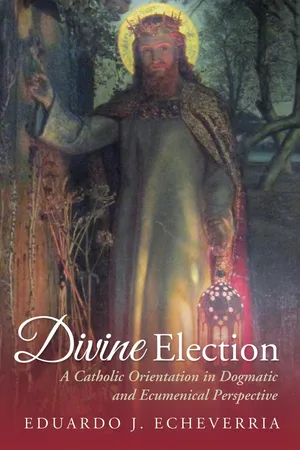
This dogmatic study addresses two perennial questions. First, how do we reconcile God's sovereignty with human freedom, not just in general, but particularly with respect to the Church's full understanding of God's plan of salvation as a work of grace? Second (and equally crucial) is the question of how we reconcile God's universal salvific will with the mystery of predestination, election, and reprobation. The author of this study does theology within the normative tradition of confessional Catholicism, and thus in the light of Catholic teaching. But this study is also an ecumenical work, indeed, a work in receptive ecumenism, and hence he listens attentively to the reflections and arguments not only of his fellow Catholic theologians (Matthias Joseph Scheeben and Hans Urs von Balthasar) but also theologians of the Evangelical and Reformed traditions (John Calvin, Herman Bavinck, Karl Barth, and G. C. Berkouwer). This book concludes with a Catholic synthesis regarding the doctrine of divine election in dogmatic and ecumenical perspective.
Information
Topic
Teologia e religioneSubtopic
Chiesa cristianachapter 1
Revelation, Faith, Doctrine, and Theological Authority
If we take seriously the conviction that election lies at the cor ecclesiae, at the heart of the church, we find ourselves at the center of the church’s faith when we focus on the question of election.1
Predestination is the cause of our salvation, and therefore is of the utmost importance in theology; it is also the object of lively controversy.2
Salvation and damnation are equally grounded in the ineluctable decision of God. . . . They do not, however, stand alongside each other having the same rank, for God’s universal saving will has been revealed in the gospel of Jesus Christ, whereas God’s no is a mystery withdrawn from human knowledge.3
Theology, auditus fidei and intellectus fidei
The practice of Christian theology presupposes the principle that faith seeks a disciplined understanding (intellectus fidei) of the content of revelation. The role of the Christian theologian “is to pursue in a particular way an ever deeper understanding of the Word of God found in the inspired Scriptures and handed on by the living Tradition of the Church. He does this in communion with the Magisterium which has been charged with the responsibility of preserving the deposit of faith.”4 This book takes up the topic of the mystery of God in himself and his relationship with human persons, in short, divine election and human freedom. In other words, how do we reconcile God’s sovereignty of grace with human freedom, not just in general, but particularly with respect to the Church’s full understanding of God’s plan of salvation as a work of grace? Equally crucial to this study is the question of how do we reconcile God’s universal salvific will with the mystery of predestination, election and reprobation.
Divine election is a revealed truth, that is, salvation is a work of God. In this book, I shall reflect, in the light of reason, on this revealed truth and the received tradition and doctrines of the Christian faith. This principle of intellectus fidei is expressive of the dynamism of faith seeking understanding that is found in a correlation of faith and revelation. Inherent, then, within the very nature of Christian revelation is this principle because “rational persons are the beneficiaries of this revelation” who are “impelled by the Spirit of truth, to deepen their understanding of what they believe” (fides quae creditur).5 In short, says Ratzinger, “theological science responds to the invitation of truth as it seeks to understand the faith.”6 The corollary of this theological quest for insight is the auditus fidei—“Faith comes by hearing, and hearing by the Word of God” (Rom 10:17). “Hearing the Word in faith” is followed up by the first theological act of attentive listening to the Word of God. The faith with which one believes (fides qua creditur) is an act of faith that is embedded in and flows from the theological virtue of faith. That virtue—which is a gift of God’s grace—is the permanent disposition in which the theological habit of mind is rooted. “Faith is the theological virtue by which we believe in God and believe all that he has said and revealed to us, and that Holy Church proposes for our belief, because he is truth itself.”7 This theological habit of mind properly orders the mind to the “knowledge that God has revealed in his Word to the church concerning himself and all creatures as they stand in relation to him.”8 The disciplined exploration of the content of revelation involves human reason illuminated by faith, attaining a certain understanding of the mysteries of faith.
Furthermore, the discipline of theology involves philosophy, indeed, a Christian way of philosophizing that is conceived and practiced in dynamic union with faith.9 God’s revelation discloses truth that exceeds human reason’s capacity, but it is not opposed to human reason. “Revelation in fact penetrates human reason, elevates it, and calls it to give an account of itself (cf. 1 Pet 3:15).”10 As John Paul II rightly notes: “Indeed without the help of philosophy theological issues cannot be clarified, as, for example, language concerning God, the personal relations within the Trinity, God’s creative activity in the world, the relationship between God and man, and the identity of Christ as true God and true man. The same applies in various assertions of moral theology, in which certain concepts recur, like the moral law, conscience, freedom, personal responsibility, guilt, and so forth, all of which are defined with reference to philosophical ethics.”11 In addition, the role of reason in doing theology therefore involves not only defending by reasoned argument the truths of revelation, but also demonstrating “the interrelationship between the various truths of faith. This too clarifies and expands the understanding of the truths related.”12 Here, too, John Paul is insightful: “”We ought above all to remember that the divine Truth ‘which is proposed to us in Holy Scripture understood in accordance with the teaching of the Church’ [Aquinas, Summa theologiae, IIa IIae, Q. 5, Art. 3 ad 2] enjoys its own natural intelligibility, which is so logically coherent, that it stands as an authentic wisdom.” The pope continues to explain the intellectual structure of Christian doctrine:
The understanding of faith opens up this truth more clearly, both by perceiving the logical and intellectual structures of the propositions which make up Christian doctrine, and above all by making quite clear the salvific meaning contained by these propositions for the good of individuals and of humanity. From the sum of these propositions taken together the faithful undoubtedly come to knowledge of the history of salvation, the summit of which is found in Christ and in his Pascal Mystery. By their assent of faith they then share in this mystery.13
Yet, as the concluding sentence insists, the assent of faith isn’t just a matter of the internal coherence of the intellectual structure of Christian doctrine, but rather this assent is about participating in the mysteries of faith. In what sense, then, is faith a way of knowing divine reality, sharing in Christ’s Pascal Mystery, and how, as Romanus Cessario asks, “can propositions serve as true objects of faith, even though the act of faith finds its ultimate term in the...
Table of contents
- Acknowledgments
- Chapter 1: Revelation, Faith, Doctrine, and Theological Authority
- Chapter 2: Calvin on the Will
- Chapter 3: Scheeben on God’s Universal Salvific Will, Predestination, Grace, and Freedom
- Chapter 4: Barth on Predestination and Its Implications
- Chapter 5: Bavinck and Berkouwer on Double Predestination
- Chapter 6: Balthasar’s Hopeful Universalism?
- Chapter 7: A Catholic Synthesis
- Bibliography
Trusted by 375,005 students
Access to over 1.5 million titles for a fair monthly price.
Study more efficiently using our study tools.
Frequently asked questions
Yes, you can cancel anytime from the Subscription tab in your account settings on the Perlego website. Your subscription will stay active until the end of your current billing period. Learn how to cancel your subscription
No, books cannot be downloaded as external files, such as PDFs, for use outside of Perlego. However, you can download books within the Perlego app for offline reading on mobile or tablet. Learn how to download books offline
Perlego offers two plans: Essential and Complete
- Essential is ideal for learners and professionals who enjoy exploring a wide range of subjects. Access the Essential Library with 800,000+ trusted titles and best-sellers across business, personal growth, and the humanities. Includes unlimited reading time and Standard Read Aloud voice.
- Complete: Perfect for advanced learners and researchers needing full, unrestricted access. Unlock 1.5M+ books across hundreds of subjects, including academic and specialized titles. The Complete Plan also includes advanced features like Premium Read Aloud and Research Assistant.
We are an online textbook subscription service, where you can get access to an entire online library for less than the price of a single book per month. With over 1.5 million books across 990+ topics, we’ve got you covered! Learn about our mission
Look out for the read-aloud symbol on your next book to see if you can listen to it. The read-aloud tool reads text aloud for you, highlighting the text as it is being read. You can pause it, speed it up and slow it down. Learn more about Read Aloud
Yes! You can use the Perlego app on both iOS and Android devices to read anytime, anywhere — even offline. Perfect for commutes or when you’re on the go.
Please note we cannot support devices running on iOS 13 and Android 7 or earlier. Learn more about using the app
Please note we cannot support devices running on iOS 13 and Android 7 or earlier. Learn more about using the app
Yes, you can access Divine Election by Eduardo J. Echeverria in PDF and/or ePUB format, as well as other popular books in Teologia e religione & Chiesa cristiana. We have over 1.5 million books available in our catalogue for you to explore.