- 214 pages
- English
- ePUB (mobile friendly)
- Available on iOS & Android
eBook - ePub
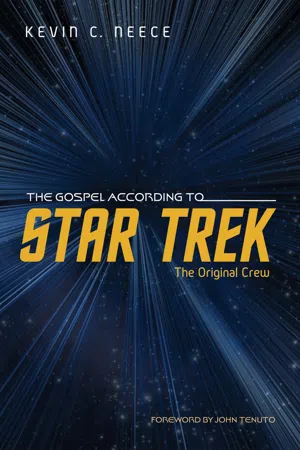
The Gospel According to Star Trek: The Original Crew
About this book
What's Christian about Star Trek? Nothing. That's the way most people see it and that certainly seems to be the way the franchise is intended. There's no question that the Trek universe is based on a doggedly humanistic world view and is set in a future time when religion has essentially vanished from Earth. If that's the case, how can there even be a "gospel according to Star Trek"?
In The Gospel According to Star Trek: The Original Crew, you'll discover how the continuing voyages of Kirk and company aboard the Enterprise--from the original series to the Abramsverse--tell us more about our human quest for God than you ever imagined. You'll learn how Star Trek creator Gene Roddenberry's own spiritual quest informed the franchise, what he and the series really have to say about God and religion, and the amazing image of Christ contained in Star Trek's most popular character.
You'll also see how Star Trek can help us recover a deeper, more fully human gospel that embraces our humanity instead of denigrating it and echoes the call of both Spock and Christ: "Live long and prosper!" (John 10:10).
Information
Topic
Theology & ReligionSubtopic
Christian TheologySection 1
Creator and Questor
The Restless Heart of Gene Roddenberry
1
Creator
In discussing Star Trek from a Christian worldview perspective, it seems best to begin at the source. As vast as its universe is, as varied as its collective of contributors may be, Star Trek is, essentially, a very personal project and reflects above all else the worldview, vision, and beliefs of one man—Gene Roddenberry. It is important, however, to note that Roddenberry is Star Trek’s creator, but he is not its author. He certainly invented the Star Trek universe and guided its creation, but he did more rewriting than writing in the three Trek television series with which he was directly involved, ultimately being more responsible for character than content. Nonetheless, the central themes and structures upon which Star Trek is built begin with him and the resulting series and films—even when they deviate from his original vision—seem to always echo with something of his ideas.
Just as his influence is felt throughout the Trek universe, so we will be frequently returning, throughout this book, to the essential ideals and aspirations upon which he based his vision of the future. In this chapter, then, it is my goal to clarify as best I can what Gene Roddenberry’s beliefs were. Certainly, much of his philosophy is well known, but my intention here is to examine the spirituality inherent in that philosophy and, in particular, to reflect as accurately as possible his beliefs about religion and about the existence and nature of God.
Honestly, this is not entirely necessary. As it is, Star Trek carries a great deal of resonance with a Christian worldview, regardless of its origins. However, I want to avoid the trap of recasting Star Trek in a way that ignores its roots or tries to claim some secretly pro-Christian agenda behind the scenes. I’m interested in critical analysis, not just appropriation. In my view, then, it is essential to a Christian engagement of Star Trek to understand the franchise for what it is, as accurately as possible. For me, that quest begins with Gene Roddenberry.
The religious background of Star Trek’s creator has been recounted often. Born in El Paso, Texas, on August 19, 1921, to Southern Baptist parents, Eugene Wesley Roddenberry grew up in a house where his mother insisted on weekly attendance of Sunday services for Gene and his siblings, but his father rarely joined them. While his exposure to Christianity and the Southern Baptist church was undoubtedly formative for him, it was ultimately his father’s feelings toward religion that shaped young Gene’s views. “He did not think the church was particularly the guidance that he would have pushed me to have,” Roddenberry recounted. “He felt that it was good for me to go to church but that I should be damn careful of what the ministers said.”1
As he often looked to his father as an example of good character (with a few notable caveats), the idea imparted to Gene was that the moral instruction he received in church was often good, but that Christian doctrine was largely to be ignored as nonsense. He never paid much attention to sermons as a child, he said, because he was “more interested in the deacon’s daughter and what we might be doing between services.” As he tells it, he started listening to the pastor’s words at around the age of fourteen. “I listened to the sermon, and I remember complete astonishment because what they were talking about were things that were just crazy.” Communion was particularly puzzling to him, with talk of eating flesh and drinking blood quickly putting him off. “My first impression was, ‘Jesus Christ! This is a bunch of cannibals they’ve put me down among!’” Whether or not it is entirely likely that he had been totally oblivious to the Baptist church’s observance of the Lord’s Supper for the first fourteen years of his life, his account serves to illustrate his profound sense of disconnection from Christian faith and practice, as well as his general lack of understanding regarding Christian doctrine. Whatever the case, it is clear that Roddenberry’s early religious experiences led him to the conclusion that religion primarily consisted of what he called “largely magical, superstitious things.”2
Based on these and many other statements regarding religion and Christianity in particular, Roddenberry has gained a widely accepted reputation as an atheist. The arguments for this idea appear strong. In addition to speaking of religion and the Bible in terms of magic and myth, he often derided traditional Western conceptions of God. At one point, he expressed concern to his assistant, Susan Sackett, about then-President Jimmy Carter’s claim of having a “personal relationship with God,” calling such ideas “petty superstitions.”3 He was well known as a humanist and his signature creation, Star Trek, is widely regarded as one of the great bastions of humanism in popular culture. Of course, as author Joel Engel notes in his biography of Roddenberry, “Not all humanists are necessarily devout atheists.” He adds, however, “But Roddenberry was, and in his atheism he exhibited the same certainty that religious fundamentalists do.”4
While Engel’s biography of Roddenberry is unauthorized, his is far from the only voice of certainty regarding Roddenberry’s atheism. Longtime Star Trek producer and writer Brannon Braga—himself an avowed and vocal atheist—has referred to the world of Star Trek as one in which, “religion is completely gone. Not a single human being on Earth believes in any of the nonsense that has plagued our civilization for thousands of years.” Citing Roddenberry as a “secular humanist” who “made it well-known to writers of Star Trek and Star Trek: The Next Generation that religion and superstition and mystical thinking were not to be part of his universe,” Braga says that “On Roddenberry’s future Earth, everyone is an atheist. And that world is the better for it.”5
As mentioned above, my analysis of Star Trek does not hinge on Roddenberry’s beliefs. Were he as committed an atheist as Engel, Braga, and others claim, my interpretation of his work and its positive impact on my Christian faith would remain almost entirely unchanged. That is, assumin...
Table of contents
- Title Page
- Acknowledgments
- Introduction: The Undiscovered Country
- Foreword
- Section 1: Creator and Questor
- Section 2: The Gospel According to the Original Series
- Section 3: The Gospel According to the Animated Series
- Section 4: The Gospel According to the Original Series Films
- Section 5: The Gospel According to The Kelvin Timeline
- Epilogue: What Does God Need with a Starship?
- Bibliography
Trusted by 375,005 students
Access to over 1.5 million titles for a fair monthly price.
Study more efficiently using our study tools.
Frequently asked questions
Yes, you can cancel anytime from the Subscription tab in your account settings on the Perlego website. Your subscription will stay active until the end of your current billing period. Learn how to cancel your subscription
No, books cannot be downloaded as external files, such as PDFs, for use outside of Perlego. However, you can download books within the Perlego app for offline reading on mobile or tablet. Learn how to download books offline
Perlego offers two plans: Essential and Complete
- Essential is ideal for learners and professionals who enjoy exploring a wide range of subjects. Access the Essential Library with 800,000+ trusted titles and best-sellers across business, personal growth, and the humanities. Includes unlimited reading time and Standard Read Aloud voice.
- Complete: Perfect for advanced learners and researchers needing full, unrestricted access. Unlock 1.5M+ books across hundreds of subjects, including academic and specialized titles. The Complete Plan also includes advanced features like Premium Read Aloud and Research Assistant.
We are an online textbook subscription service, where you can get access to an entire online library for less than the price of a single book per month. With over 1.5 million books across 990+ topics, we’ve got you covered! Learn about our mission
Look out for the read-aloud symbol on your next book to see if you can listen to it. The read-aloud tool reads text aloud for you, highlighting the text as it is being read. You can pause it, speed it up and slow it down. Learn more about Read Aloud
Yes! You can use the Perlego app on both iOS and Android devices to read anytime, anywhere — even offline. Perfect for commutes or when you’re on the go.
Please note we cannot support devices running on iOS 13 and Android 7 or earlier. Learn more about using the app
Please note we cannot support devices running on iOS 13 and Android 7 or earlier. Learn more about using the app
Yes, you can access The Gospel According to Star Trek: The Original Crew by Kevin C. Neece in PDF and/or ePUB format, as well as other popular books in Theology & Religion & Christian Theology. We have over 1.5 million books available in our catalogue for you to explore.