- 122 pages
- English
- ePUB (mobile friendly)
- Available on iOS & Android
eBook - ePub
About this book
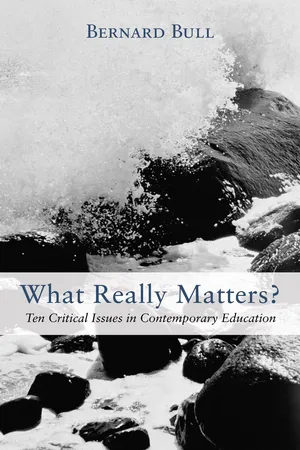
What really matters in education? Amid headlines about standardized test scores, global rankings of students from different countries, technology-enhanced learning, the unreasonable costs of higher education, and preparing the workforce of tomorrow, what really matters? If we want to pursue education reform and improvements that truly benefit the lives of current and future students, where should we focus our efforts? In What Really Matters?, Dr. Bernard Bull draws from over twenty years of research and experience to offer ten issues that truly matter if we are going to create rich, meaningful, rewarding, engaging, and impactful learning organizations that are rooted in the best ideas of the past while preparing people for the challenges and opportunities of the present and future. This is a text for educators, school leaders, community members, parents, students, policymakers, and others who aspire to move from educational buzzwords to some of the most important educational challenges and opportunities of our age.
Information
1
Wasted Talents, Gifts, and Abilities
In a 2015 presentation at the Twenty-First Century Learning Conference in Hong Kong, Mark Treadwell, a leading thinker on how our knowledge about the human brain can and should shape school, argued that schools of the past were good at convincing the majority of students that they were not smart. In fact, Treadwell argued, one of the roles of school in the past was to convince 80 percent of the students that they were not very smart, leading them to be content pursuing less complex jobs that were necessary to keep the economy going. It is not like school leaders or classroom teachers set out to make young people think that they are not smart, but Treadwell argues that this was and is the outcome based upon the system that we have in place. Going into the future, he argued that we need to convince 80 percent of the students that they are smart because the jobs and tasks required of people in the future will demand as much. I’d like to argue for moving that 80 percent to 100 percent, not on the basis of future job demands, but based upon a desire to no longer leave room for wasted gifts, talents, and abilities in our schools and communities.
Whether you agree with Mark Treadwell’s claim that schools convince 80 percent of the students that they are not smart, tempering their ambition and preparing them for the mass workforce, his comments get at the heart of the single most critical educational issue of our time. That issue is the wasted gifts, talents, and abilities of young people in our schools. Allow me to explain.
Perhaps you’ve seen the cartoon where there is a long line of animals: a monkey, penguin, seal, fish, elephant, bird, and a dog. Then there is a man sitting behind a desk saying, “For a fair selection everybody has to take the same exam: please climb that tree.”1 Welcome to the common mindset behind some of the most dominant educational policy discussions of the twenty-first century.
Years ago I talked with the superintendent of a respected school district about the promise and possibility of designing a charter school in the district focused upon project-based learning, personalized learning, and helping students discover their calling. At first this superintendent was excited and welcomed a follow-up meeting. Amid the tyranny of the urgent in our schedules, we didn’t follow up for several months. When I reached out about a lunch appointment, I learned that this superintendent’s viewpoint seemed to have changed. She said that she was happy to have lunch, but that she didn’t have much interest in a project-based charter school. She explained her change of mind with a single sentence: “I’ve been thinking about this, and I tend to think that what is good for one student is good for all students.”
To be fair, we never had a follow-up conversation about this, but this single sentence left me baffled. Is there a different way to read it? What is good for one is good for all? Whether or not it was the intent of the superintendent, there are plenty of people today who advocate for a national reform in education and strive to find the model, method, and universal set of standards that can be applied across the board for the benefit of everyone. The problem is that there is no such thing as a universal model, method, or set of standards that is best for all students.
There are some largely universal principles (like the idea that feedback is important in learning), but principles leave room for diverse applications. None have proven that there is a standard template that will bring the best out in all learners. There is no universal set of academic standards that, if met, will assure that each learner thrives and is a positive and contributing member of society. Standards, models, methods and frameworks are helpful, but they are not universal when it comes to designing learning organizations.
Having a universal model for education is the educational equivalent of claiming to have a single magic pill that treats all ailments and conditions. Yes, there are some largely universal principles. Eat well. Exercise regularly. Get adequate sleep. Yet, even with those three elements, there seems to be plenty of evidence that different people benefit from different types of exercise, different diets, and maybe even different sleeping habits and personalized medications.
People have different gifts, talents, abilities, propensities, life experiences, challenges, opportunities, and ultimately different callings in life. This means that they will benefit from different learning opportunities and experiences. There are good times for shared learning experiences, but what happens when the schooling options available to a student come from a limited perspective on which gifts and abilities should be celebrated and strengthened? Plenty of good can come from a core of shared learning experiences, but we also need to draw out, affirm, and amplify the differences among learners.
At the foundation of every learning organization is a set of values, beliefs, and convictions about education. People don’t agree on these matters. As such, I am not ready to force my philosophy of education on the rest of the world, nor do I want that done to me. I might make persistent and passionate arguments in favor of my positions, but at the end of the day we are better off finding ways to leave room for diverse perspectives on education to live alongside one another. That means a universal commitment to diverse learning environments—to choices.
“Parents have a prior right to choose the kind of education that shall be given to their children.”2 That is a direct quote from the Universal Declaration of Human Rights. I realize that readers of this book hold to diverse viewpoints on this document in general, but this is a portion that I wholeheartedly support. Some have argued that children ultimately belong to the state. Others, including myself, argue that the family unit is a fundamental, foundational unit in society.
The fact that there is disagreement about this re-entered the broader public discourse in 2013 when Melissa Harris-Perry argued that “we have to break through our kind of private idea that kids belong to their parents or kids belong to their families and recognize that kids belong to whole communities.”3 The concerning part in her comment is that she somehow seemed to miss or disregard that there is a real and historical debate about these claims.4
And this is just one of many philosophical differences about education and children. There are many more when we start diving into curriculum and the ultimate aims of education. Given such differences, it seems reasonable that we stick with and maybe even expand a diversity of models and approaches to education. In such a climate, arguing for a universal model is a disregard for these important differences.
Each person is a unique creation, full of potential, too precious to disregard intentionally or unintentionally (but as a result of institutional structures). Our pursuit in education should be to provide an excellent education for all. What is good for one is good for all, and what is good for one is a learning experience that best supports, celebrates, and launches that one person into a life of significance, meaning, and impact. That doesn’t happen with a one-size-fits-all approach to education.
I do not question the value of a common body of knowledge to some extent, but that is different from arguing for the same type of education for every child driven by the same tests. True equity, access, and opportunity will come from educational choice and a diversity of educational options. This is why I continue to argue that a great strength of the United States educational landscape is the rich diversity. On the K–12 level I’m referring to legacy public, public magnet, public charter, independent, parochial, homeschooling, unschooling, world schooling, project-based learning schools, game-based learning schools, STEM academies, bilingual schools, democratic schools, Waldorf schools, Montessori schools, and a myriad of others. On the university level I’m referring to everything from small liberal arts colleges to state universities, blended and online options to technical and community colleges, public to private and faith-based, elite schools to a wonderfully interesting collection of alternative schools, even (maybe especially) the self-directed and non-college options available today.5
In 2015 there were several critiques of Arne Duncan, former US Secretary of Education, for sending his children to the University of Chicago Lab Schools. Part of the critique was that he was sending his kids to a school that does not align with many of his educational reform efforts as Secretary of Education. I appreciate that critique, but from another perspective I commend him for selecting a school that he thinks is the best fit for his kids. Now all we need to do is to pursue more national and state policies that make sure such choice is more widely available to the rest of the families in the country. Duncan knows that you don’t test an elephant by how well it can climb a tree, and he knows that the same thing is true when it comes to finding the right fit between a student and a school.
Signs of a Self-Absorbed Culture?
Isn’t this just another sign of our increasingly self-absorbed culture? Students wanting everything their way instead of sucking it up and doing the work? I’ve talked to more than a few people who think as much, but there is another way of looking at this issue. This is about a more personalized and customized approach to education. It is a recognition that people are different and we can best celebrate and maximize those differences by matching the student with the best-fit school. This isn’t about catering to every whim and preference of a person. It is instead a perspective that doesn’t want to see a single student go to waste, one that aspires for learners to discover their unique contributions to the world. This is ultimately not about self-service, but it is about best positioning students to discover how they can live a rich and fulfilling life that benefits themselves and the people around them. And while some argue that focusing on STEM in our schools is the key to winning some international economic competition, I continue to defend the position that the nation and world will be better off if we invest in maximizing the potential of each person instead of sifting out those who don’t fit the STEM mold. In fact, by choosing a more personalized approach we may find that we gain more traction than ever on everythi...
Table of contents
- Title Page
- Introduction
- Chapter 1: Wasted Talents, Gifts, and Abilities
- Chapter 2: Testing and Assessment
- Chapter 3: Credentialism
- Chapter 4: Non-Cognitive Skills
- Chapter 5: Agency
- Chapter 6: Purpose and Meaning
- Chapter 7: The Digital Divide
- Chapter 8: Edu-Technopoly
- Chapter 9: Vocation and Good Work
- Chapter 10: Truth, Beauty, Goodness
- Bibliography
Trusted by 375,005 students
Access to over 1.5 million titles for a fair monthly price.
Study more efficiently using our study tools.
Frequently asked questions
Yes, you can cancel anytime from the Subscription tab in your account settings on the Perlego website. Your subscription will stay active until the end of your current billing period. Learn how to cancel your subscription
No, books cannot be downloaded as external files, such as PDFs, for use outside of Perlego. However, you can download books within the Perlego app for offline reading on mobile or tablet. Learn how to download books offline
Perlego offers two plans: Essential and Complete
- Essential is ideal for learners and professionals who enjoy exploring a wide range of subjects. Access the Essential Library with 800,000+ trusted titles and best-sellers across business, personal growth, and the humanities. Includes unlimited reading time and Standard Read Aloud voice.
- Complete: Perfect for advanced learners and researchers needing full, unrestricted access. Unlock 1.5M+ books across hundreds of subjects, including academic and specialized titles. The Complete Plan also includes advanced features like Premium Read Aloud and Research Assistant.
We are an online textbook subscription service, where you can get access to an entire online library for less than the price of a single book per month. With over 1.5 million books across 990+ topics, we’ve got you covered! Learn about our mission
Look out for the read-aloud symbol on your next book to see if you can listen to it. The read-aloud tool reads text aloud for you, highlighting the text as it is being read. You can pause it, speed it up and slow it down. Learn more about Read Aloud
Yes! You can use the Perlego app on both iOS and Android devices to read anytime, anywhere — even offline. Perfect for commutes or when you’re on the go.
Please note we cannot support devices running on iOS 13 and Android 7 or earlier. Learn more about using the app
Please note we cannot support devices running on iOS 13 and Android 7 or earlier. Learn more about using the app
Yes, you can access What Really Matters? by Bernard D. Bull in PDF and/or ePUB format, as well as other popular books in Social Sciences & Education General. We have over 1.5 million books available in our catalogue for you to explore.