- 174 pages
- English
- ePUB (mobile friendly)
- Available on iOS & Android
eBook - ePub
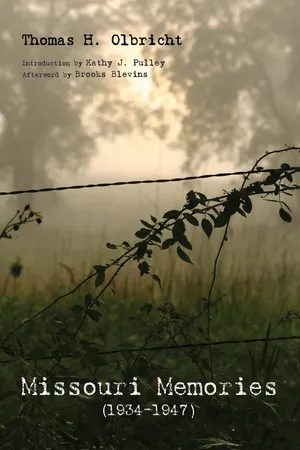
Missouri Memories, 1934–1947
About this book
Thomas H. Olbricht relishes his Missouri upbringing. In this book he narrates the details of his many experiences in the 1930s and 40s. The author was interested in multiple aspects of Ozark terrain, social life, and culture, and often situates them in their historical setting. He writes with multifaceted concretion regarding the influence of his mother, father, and his extended family, which included persons of Irish, Scottish, and German heritages. He not only helped with his grandfather's gas station-grocery but also his uncle's farming operations. Because of his commitment and education he has given special attention to religious activities in the Churches of Christ in the Ozarks. He ends by elaborating upon, in the region of his youth, what it was like to live through World War II and the peace that followed.
Trusted by 375,005 students
Access to over 1.5 million titles for a fair monthly price.
Study more efficiently using our study tools.
Information
Topic
Theology & ReligionSubtopic
Social Science BiographiesChapter I
Memories Embellished?
I was born in Thayer, Missouri, in 1929. I left my Missouri home to enter Harding University as a freshman in the fall of 1947. Since that time I have only returned to visit. But Missouri remains deeply entrenched in my very psyche via indelible memories. “Precious memories, how they linger, how they ever flood my soul,” in the words of the old Gospel song.
I recall late March days, deep blue skies and balmy uplift breezes rustling in the trees. It was great weather for kite flying which I dearly loved. After watching the kite soar aloft on a perfect flying day I lay in the newly blossomed clover with my brothers relishing the warmth and the sweet clover smell. We watched the bees buzz from bloom to bloom. It always seemed a shame to wind up the ball of string in order to go to supper, though we always welcomed a chance to eat.
I also loved the late days of August as the fields dried up. We played in the dusk as the shadows cast long images across the front yard. The cares of the day were past. We played hide and seek, kick the can or similar games. The air was still warm. Sometimes with my uncle we sought out a swimming hole on Warm Fork Creek. The cooler water began to modify the heat at eye level. Most of our swimming holes were surrounded by native sycamores adding a special aroma to the air. I have traveled to Buenos Aries, Lake Louise, Auckland, Nairobi and Beijing, but I have never elsewhere experienced that exact relaxing smell.
I loved walking through the woods on a foggy night in November with my uncle and others as we listened to the baying of our Bluetick “coon hound.” We were surrounded by a damp chill, but our jackets and walking kept us warm. On our caps we wore carbide miner’s lamps so as to navigate through the trees and underbrush. Sometimes the hound picked up a ‘possum’ trail rather than that of a raccoon. We weren’t too interested in possums because coon hides brought about $20 whereas a possum hide at best was $5. We therefore called off the dog when we thought he was on the trail of a possum. In those days neither raccoons nor possums were plentiful because they were constantly hunted for whatever little money their pelts brought.
I loved early spring when woodland grasses had turned brown as well as the fallen leaves and those that remained on the trees. Many farmers burned leaves in order, so they thought, for the grass to get a head start. An acrid, smoky smell filled the cool night air. My uncle, Cleo Taylor, was a Vocational Agriculture Teacher. At that time the studies suggested that burning impeded rather than helped the grass along. My uncle had a thousand acres of woodlands brush and grass. Contiguous neighbors burned their fields and especially if the wind accelerated the fire lines threatened our fields. We were determined to stop the flames from crossing our fence line. We jumped in the pickup taking along hoes, shovels, rakes and pitchforks in order to impede the advance of the flames. Sometimes we set back fires if the wind was right and worked to keep the fires out. It was hard, sweaty, soot-faced work. We often stayed out until one or two A.M. But I loved being out with the sights and smells. I relished the fact that we often were able to impede and contain the soaring flames.
My memory of southern Missouri was that the optimum time of the year weather-wise was the middle of June. The grass was luxurious, the nights cool and day time temperatures mild. A number of field and forest flowers were in bloom giving off pleasant smells. The birds sang all the day long in the words of a Tin-pan Alley tune. By time I was forty I had lived in Illinois, Iowa, Massachusetts, Pennsylvania and Texas. I never experienced a time in these states comparable to June in Missouri. Since in those years I was either going to graduate school or teaching, June was never a convenient time for a visit back home. As the time passed by I got to thinking that perhaps my love of a Missouri June was the figment of a boyhood imagination. I decided it couldn’t be as good as I recalled. But then one year it became possible to visit my home region in June. I just couldn’t believe how the weather and place were almost exactly as I remembered. Both my love for a Missouri June and my boyhood memories were fully vindicated.
I remembered Missouri especially because of warm relationships experienced in an extended family of grandparents, uncles and aunts and cousins galore. We often visited our relatives in town and on farms. Sometimes I stayed overnight with cousins. We played, fished and worked in gardens. Our more immediate family always gathered on holidays and on Sundays after church. We played football and softball. We sometimes checked out the cattle and goats. The woods were full of all sorts of relatives several with whom we had little contact. But we and they knew who we were. We had our place in the sun and in the community. We clearly identified with the time and place. These memories had few glitches that cast a dark spell over the realities. Missouri was a place of fulfillment and contentment as I reflect back upon the halcyon days of my youth.
My Missouri heritage has served me well. When asked I have always been pleased to announce that I spent my first, almost eighteen years in Missouri (1929–1947). I grew up on the Arkansas border so that I often made short trips into that state but spent less than a week overnight there. Otherwise my early years were spent in Missouri. I did not visit another state until well into my eighteenth year. In June 1948 I traveled to DeKalb, Illinois, to work for the summer canning peas and corn for the California Packing Company and detasseling corn for the DeKalb Agriculture Association. While there I also ventured into Wisconsin. I have fond memories of growing up in Missouri. I learned much from relatives, teachers and friends that has served me well in life. I have always appreciated my past even though I have made every effort to live in the present. I have relished reliving these events as I recounted the memories of that time and place.
I was born in the house of my parents a hundred yards south of the Thayer, Missouri, city limits. Thayer did not have a hospital and most babies were born at home. Dr. Barnes was called when it was apparent the time drew near. Women relatives may have been present in the house, but Barnes requested that the father absent himself. I was the second child of my parents, my sister Nedra being fourteen months older. The circumstances as to why I was born in Missouri are unusual.
Why I was born in Missouri
I was born in Missouri on my mother’s side because of a failed mortgage and on my father’s side because of a major snow storm. Since my mother’s forbears came to Missouri a half century before my father’s I will recount the story of the failed mortgage first.
A Failed Mortgage
My great-grandparents John Moody Taylor (1829–1909) and Amy AnthumWaits Taylor (1837–1901) came to Oregon County in 1869 from Franklin County, Alabama. Altogether they had thirteen children and by 1919 sixty-eight grandchildren. Most of their descendents into the second generation were members of the Churches of Christ, and many into the sixth plus generation.1
John Moody may have been born in Franklin County, Tennessee, or perhaps Mississippi. Before the Civil War he moved to Alabama. Traditions held that his father, John Taylor, was born either in Northern Ireland or Indiana. My grandfather, Thomas Shelton Taylor, always called himself an Irishman. In 1854 John Moody and Amy Anthum Waits were married in northwest Alabama. She was born in Muscle Shoals, Alabama, in 1837. Her parents were Simeon C. Waits (1803–1880), born in Franklin County, Alabama and Judah (Judy) Hester Waits (1814–1899), born in Person County, North Carolina. It is likely that John Moody Taylor and Amy Anthum Waits were baptized and became members of the Churches of Christ at the same time, perhaps a few years after they were married in 1854. A Restorationist preacher by the name of John Taylor who as far as I can discover was not related baptized John and Amy. John Taylor was influenced by Tolbert Fanning (1810–1874) the latter who in turn was influenced by Alexander Campbell. Fanning was a Nashville preacher who spent considerable time evangelizing in northern Alabama. My grandfather, T. Shelt Taylor, reported that the Taylors heard the famous Churches of Christ evangelist, T. B. Larimore (1843–1929) preach meeting sermons. Larimore evangelized in various places in Northern Alabama in 1868 with John Taylor.2 John and Amy Taylor left Alabama for southern Missouri the next year in 1869.
Three sisters of Amy Anthum Waits Taylor, the mother of my grandfather Taylor, were the first of my ancestors to move to Oregon Country from Franklin Country Alabama. One married M. George Norman, who became a judge, and the other Jesse Morris, who owned a major lumberyard. They came to Oregon County about 1849 from Alabama.3 Another sister, Martha Ann Waits, married Richard Livingston Langley, born in Franklin County Alabama. A brother of Amy Anthum Waits Taylor, Simon C. Waits, Sr., later also came to Missouri. To my knowledge those who moved to Missouri before the Civil War were not Restorationists but mostly Baptists.
My great grandfather Taylor, John Moody Taylor, was an Alabama confederate soldier in the Civil War. Before the war he had been a slave overseer for a wealthy widow who owned a plantation. He was known as a compassionate manager who fed and treated his subordinates well.
After the war John Moody Taylor farmed near Belgreen, in northwestern Alabama. In the 1960s my Uncle Tom Taylor became interested in family genealogy. One day while visiting with his father T. Shelt Taylor, Tom mentioned that he and his wife Dortha planned a trip to northern Alabama to look into certain details regarding the family history. My grandfather became patently agitated and told my uncle that under no circumstances was he to take this trip. He informed Uncle Tom that he needed to know something about the reason his parents left Alabama that had not been reported to Tom and his siblings.
Grandpa related this story. In the early days of reconstruction John Moody’s brother Thomas bought a farm for which John Moody also signed the note. After a few years it became clear to Thomas that he would be unable to make enough money to meet the mortgage payments. After the note holders pressed Thomas, he disappeared, perhaps first to Texas and then on to California. He was never heard of again. John Moody had little money either, and much of the white population at that time was migrating west from Alabama. Since his wife’s sisters had moved to Missouri, John and his family pulled up stakes in 1869 and settled in Oregon County around Couch. The precipitating event of the unpaid mortgage therefore became a critical reason why my mother’s grandparents migrated by covered wagon to southern Missouri and northern Arkansas. My grandfather T. Shelt Taylor was afraid that if my uncle nosed around too much there might be repercussions from the failure to pay off the century-old mortgage.
A Major Snow Storm
My father’s parents moved to Missouri because of Nebraska snow storms. In 1910 my German-born grandfather Henry Olbricht (1856–1941) decided that he did not care for the blizzards that swept across Western Nebraska. He was born in what was then Glatz, Silesia, Germany (now Klodzko, Poland), and migrated to the United States in 1878. He was nominally Roman Catholic, which he remained until his death. His first wife, my grandmother Katherine Eick, was born in Regensberg, Germany. They both lived in Elizabeth, New Jersey, when they met. She died in 1889. My grandfather remarried a widow, Bertha Lange Sauser, in 1900, a sister of his brother Joseph’s wife. She was born in a German-speaking village that was variously in Poland or Russia and was Lutheran. After living in Nebraska for 18 years my grandfather started looking for a warmer climate and knew a man who had moved from Nebraska to Missouri. In scrutinizing real estate ads Grandpa Henry was attracted by the description of a farm near Mountain Grove, Missouri. He and my step-grandmother took a train from Crawford, Nebraska, visited the farm, and left a down payment. They next decided...
Table of contents
- Title Page
- Acknowledgments
- Introduction
- Chapter 1: Memories Embellished?
- Chapter 2: A Depression Child
- Chapter 3: Ozark Christmas in 1936
- Chapter 4: Later Depression Years
- Chapter 5: Childhood Activities
- Chapter 6: My Religious Upbringing
- Chapter 7: Missouri Evangelism
- Chapetr 8: War
- Chapter 9: Peace
- Afterword
- Bibliography
- Images
Frequently asked questions
Yes, you can cancel anytime from the Subscription tab in your account settings on the Perlego website. Your subscription will stay active until the end of your current billing period. Learn how to cancel your subscription
No, books cannot be downloaded as external files, such as PDFs, for use outside of Perlego. However, you can download books within the Perlego app for offline reading on mobile or tablet. Learn how to download books offline
Perlego offers two plans: Essential and Complete
- Essential is ideal for learners and professionals who enjoy exploring a wide range of subjects. Access the Essential Library with 800,000+ trusted titles and best-sellers across business, personal growth, and the humanities. Includes unlimited reading time and Standard Read Aloud voice.
- Complete: Perfect for advanced learners and researchers needing full, unrestricted access. Unlock 1.5M+ books across hundreds of subjects, including academic and specialized titles. The Complete Plan also includes advanced features like Premium Read Aloud and Research Assistant.
We are an online textbook subscription service, where you can get access to an entire online library for less than the price of a single book per month. With over 1.5 million books across 990+ topics, we’ve got you covered! Learn about our mission
Look out for the read-aloud symbol on your next book to see if you can listen to it. The read-aloud tool reads text aloud for you, highlighting the text as it is being read. You can pause it, speed it up and slow it down. Learn more about Read Aloud
Yes! You can use the Perlego app on both iOS and Android devices to read anytime, anywhere — even offline. Perfect for commutes or when you’re on the go.
Please note we cannot support devices running on iOS 13 and Android 7 or earlier. Learn more about using the app
Please note we cannot support devices running on iOS 13 and Android 7 or earlier. Learn more about using the app
Yes, you can access Missouri Memories, 1934–1947 by Thomas H. Olbricht in PDF and/or ePUB format, as well as other popular books in Theology & Religion & Social Science Biographies. We have over 1.5 million books available in our catalogue for you to explore.