eBook - ePub
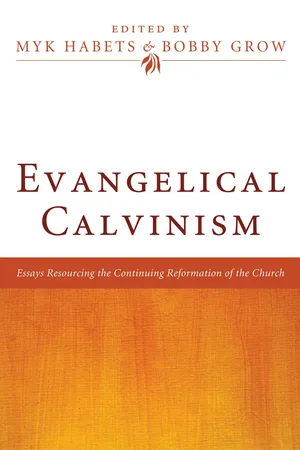
Evangelical Calvinism
Essays Resourcing the Continuing Reformation of the Church
- 480 pages
- English
- ePUB (mobile friendly)
- Available on iOS & Android
eBook - ePub
Evangelical Calvinism
Essays Resourcing the Continuing Reformation of the Church
About this book
In this exciting volume, new and emerging voices join senior Reformed scholars in presenting a coherent and impassioned articulation of Calvinism for today's world. Evangelical Calvinism represents a mood within current Reformed theology. The various contributors are in different ways articulating that mood, of which their very diversity is a significant element. In attempting to outline features of an Evangelical Calvinism, a number of the contributors compare and contrast this approach with that of Federal Calvinism currently dominant in North American Reformed theology, challenging the assumption that Federal Calvinism is the only possible expression of orthodox Reformed theology. This book does not, however, represent the arrival of a "new Calvinism" or even a "neo-Calvinism," if by those terms are meant a novel reading of the Reformed faith. An Evangelical Calvinism highlights a Calvinistic tradition that has developed particularly within Scotland, but is not unique to the Scots. The editors have picked up the baton passed on by John Calvin, Karl Barth, Thomas Torrance, and others, in order to offer the family of Reformed theologies a reinvigorated theological and spiritual ethos. This volume promises to set the agenda for Reformed-Calvinist discussion for some time to come.
Information
Topic
Theology & ReligionSubtopic
Christian Church1
Introduction
Theologia Reformata et Semper Reformanda
Towards an Evangelical Calvinism
Evangelical Calvinism1
The Quincentenary of Calvin’s birth in 2009 provided an opportunity for Calvinists around the world to celebrate his life, thought, and influence. The Calvin 500 Tribute Conference in Geneva, and the many other gatherings of Reformed thinkers around the globe, were occasions for joy and celebration as academic papers were read and expository sermons were preached, all under the banner of Calvinism.2 In addition to a celebration of the past, the Quincentenary was also an occasion to reconsider the future of Reformed thought: what it may look like, where it may go, and who may lead such a future. As questions such as these were considered it quickly became evident that there were no easy or even obvious answers. Calvinism, in various guises, has a global reach and influence. While there is geographical diversity there is also theological diversity. For the contributors to this book, this is not only to be expected but actually encouraged, for unity in diversity brings with it new perspectives, correctives, and opportunities for enrichment.
The contributors to this volume are Reformed theologians from various denominations who love their theological tradition and are committed to its truths, but understand that their tradition is a variegated one, with many tributaries and eddies. They represent a consistent feature of Reformed theology—the willingness and ability to enrich their tradition by mining its past and contributing to its future.3 This is not, however, an expression of a “new-Calvinism” or even a “neo-Calvinism,” if by those terms are meant a novel reading of the Reformed faith. We, along with the Reformed theologian Donald McKim, consider the Reformed faith an expansive tradition with many threads that make up the fabric of our tradition. McKim captures this well:
The Reformed faith impels persons to confess their faith as part of the ecumenical church, the whole people of God. The movement here is first from what Christians believe to what Reformed Christians believe. Reformed churches are a portion of the full household of faith. As such, Reformed theology and Reformed faith are open to hearing, dialoguing with, and learning from other theological viewpoints and Christian communions. Though some Reformed bodies have tended to become more narrow and almost assume that their formulations are the only means of expressing God’s truth, this impulse runs counter to the genuine heartbeat of Reformed faith. Reformed faith is open to God’s Spirit, who may encounter us at any time in any place. Reformed Christians should see and listen to other voices since perhaps through them an essential theological insight will be given.4
Evangelical Calvinism is not a new movement, it does not to belong to any particular denomination, nor is it aligned with any particular seminary; there are no catch words that it sponsors, nor are there any high profile media stars that campaign on its behalf. Evangelical Calvinism as we suggest here, is more of a mood than a movement. The various contributors to the present volume are in their own ways taking steps toward articulating what that mood might look like, and their differences are part of a necessary element in that very mood of witness and argument. In attempting to outline features of an Evangelical Calvinism a number of the contributors compare and contrast this approach with that of Federal Calvinism. This latter form of Calvinism is currently dominant in North American Reformed theology and is considered, by many, to be the only orthodox Reformed theology acceptable; the present volume clearly challenges such assumptions.5
In the preface to one of his later works, Scottish Theology from John Knox to John McLeod Campbell, Thomas Torrance set out his understanding of the differences that exist between Classical and Evangelical Calvinism:6
Following upon the teaching of the great Reformers there developed what is known as “federal theology,” in which the place John Calvin gave to the biblical conception of the covenant was radically altered through being schematised to a framework of law and grace governed by a severely contractual notion of covenant, with a stress upon a primitive “covenant of works,” resulting in a change in the Reformed understanding of “covenant of grace.” This was what Protestant scholastics called “a two-winged,” and not “a one-winged” covenant, which my brother James has called a bilateral and a unilateral conception of the Covenant. The former carries with it legal stipulations which have to be fulfilled in order for it to take effect, while the latter derives from the infinite love of God, and is freely proclaimed to all mankind in the grace of the Lord Jesus Christ. It was the imposition of a rigidly logicalised federal system of thought upon Reformed theology that gave rise to many of the problems which have afflicted Scottish theology, and thereby made central doctrines of predestination, the limited or unlimited range of the atoning death of Christ, the problem of assurance, and the nature of what was called “the Gospel-offer” to sinners. This meant that relatively little attention after the middle of the seventeenth century was given to the doctrine of the Holy Trinity and to a trinitarian understanding of redemption and worship.7
Torrance highlights the development of a tradition of Calvinism that is particular to Scotland but is not unique to the Scots. Elements of what we are calling an Evangelical Calvinism may be found, to a greater or lesser extent, in the theology of such figures as John Calvin, John Knox, aspects of Scottish Reformed theology,8 and Scottish divines specifically Henry Scougal, John Craig, Hugh Binning, The Marrow Men,9 John McLeod Campbell, Thomas Torrance, and James Torrance. Evangelical Calvinism, though, is not limited to Scottish theology. One might naturally think of the English Particular Baptist John Gill who emphasized the duplex gratia as did Calvin,10 or the Baptist pastor Charles Spurgeon, one of the few preachers in history able to preach adequately an evangelistic sermon based on the “Five Points of Calvinism”!11 In American history one may think of Augustus H. Strong, the Reformed Baptist theologian who came to reject Federal Theology and its account of imputation in favor of something her termed “ethical monism.”12 In this briefest of surveys we should also mention such thinkers as what Janice Knight has called “The Spiritual Brethren,”13 among many others, who could be considered its forebears. On the Continent it is, of course, Karl Barth who stands above all others in what we believe approximates an Evangelical Calvinist orientation.
This encapsulates something of the motivation for the present volume. The editors have picked up the baton passed on by Torrance and others in order to offer the family of Reformed theologies a theological and spiritual ethos. In terms of its confessional stance, Evangelical Calvinism follows the trajectory more in line with the Scots Confession (1560) than with the Westminster Confession (1647). It is not that the theology of the two is antithetical, despite there being substantial differences, but more in the tone of the two.14 The inclusion of Matthew 24:14 on the title page of the first printing of the Scots Confession in 1561 already gives the reader reason to pause: “And this glaid tydinges of the kingdom shalbe preached throught the hole world of a witness to all nations and then shall the end cum.” As T. F. Torrance remarks, “This is quite startling, for, in contrast to every other confessional statement issued during the Reformation, it gives primary importance to the missionary calling of the Church.”15 Wright says of the confession “it illustrates the characteristically kerygmatic and pastoral tone that, through Knox, informed Scottish reformation theology.”16 In effect, then, Evangelical Calvinism stands in a heritage that provides theological ground to heed God’s...
Table of contents
- Title Page
- Contributors
- Foreword
- Acknowledgments
- Prologue: Union in Christ: A Declaration for the Church
- Chapter 1: Introduction
- Part One: Prolegomena—Historical Theology
- Part Two: Systematic Theology
- Part Three: Applied Theology
- Part Four: Prospect
Trusted by 375,005 students
Access to over 1.5 million titles for a fair monthly price.
Study more efficiently using our study tools.
Frequently asked questions
Yes, you can cancel anytime from the Subscription tab in your account settings on the Perlego website. Your subscription will stay active until the end of your current billing period. Learn how to cancel your subscription
No, books cannot be downloaded as external files, such as PDFs, for use outside of Perlego. However, you can download books within the Perlego app for offline reading on mobile or tablet. Learn how to download books offline
Perlego offers two plans: Essential and Complete
- Essential is ideal for learners and professionals who enjoy exploring a wide range of subjects. Access the Essential Library with 800,000+ trusted titles and best-sellers across business, personal growth, and the humanities. Includes unlimited reading time and Standard Read Aloud voice.
- Complete: Perfect for advanced learners and researchers needing full, unrestricted access. Unlock 1.5M+ books across hundreds of subjects, including academic and specialized titles. The Complete Plan also includes advanced features like Premium Read Aloud and Research Assistant.
We are an online textbook subscription service, where you can get access to an entire online library for less than the price of a single book per month. With over 1.5 million books across 990+ topics, we’ve got you covered! Learn about our mission
Look out for the read-aloud symbol on your next book to see if you can listen to it. The read-aloud tool reads text aloud for you, highlighting the text as it is being read. You can pause it, speed it up and slow it down. Learn more about Read Aloud
Yes! You can use the Perlego app on both iOS and Android devices to read anytime, anywhere — even offline. Perfect for commutes or when you’re on the go.
Please note we cannot support devices running on iOS 13 and Android 7 or earlier. Learn more about using the app
Please note we cannot support devices running on iOS 13 and Android 7 or earlier. Learn more about using the app
Yes, you can access Evangelical Calvinism by Myk Habets,Bobby Grow, Habets, Grow in PDF and/or ePUB format, as well as other popular books in Theology & Religion & Christian Church. We have over 1.5 million books available in our catalogue for you to explore.