eBook - ePub
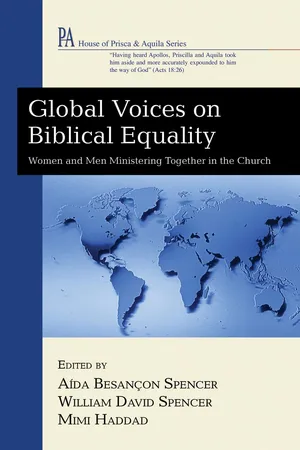
Global Voices on Biblical Equality
Women and Men Ministering Together in the Church
- 264 pages
- English
- ePUB (mobile friendly)
- Available on iOS & Android
eBook - ePub
Global Voices on Biblical Equality
Women and Men Ministering Together in the Church
About this book
Global Voices on Biblical Equality is a fresh look at the contextualizing of gender equality throughout the world. Biblical equality is a burgeoning, global reform movement led by scholars and leaders not only in North America but also on every continental landmass in the world. What inroads is biblical equality making around the globe? What is its appeal? What still needs reform? How is biblical equality transforming each culture? In this book, female and male writers who are ethnically part of every continent explore the contextual challenges, successes, and adaptations of engaging the biblical text on gender and ministry.
The contributors write on Asia and Asian America (India, China, Korean America), Africa (Zimbabwe)and African America Indigenous America and Latin America (Native America, Hispanic America, Brazilian America), and Western Europe and Australia and North America. The editors and authors are Aida Besancon Spencer, William David Spencer, Ranked Adjunct, and Mimi Haddad. Other contributors are Ellen Alexander, Beulah Wood, Cecilia Yau, Matthew D. Kim, Constantine M. Murefu, Darin Vincent Poullard, Sandra Gatlin Whitley, Awilda Gonzalez-Tejera, John Runyon, and Eliana Marques Runyon, Elke Werner, Roland Werner, Kevin Giles, and Roberta Hestenes.
Information
Subtopic
Église chrétienne1
Reform Movements: How They Revive the Church
Mimi Haddad
Introduction
Throughout history, the church has altered its perspective on significant theological and social issues. Through scholarly inquiry, debate, and global dialogue, the church has reformed its viewpoint, admitting error in areas such as science, theology, and the impact of ethnicity and gender on church leadership. What have been the more significant areas on which the church has amended its opinion? Consider the following:
Copernicus Reform
Under the Copernicus reform, the church was forced to retract senseless dogma regarding the orbit of the planets, recognizing that the essentials of Christian faith are not compromised by scientific inquiry. Through this challenge, the church was freed to pursue scientific inquiry as God-given and integral to God’s purposes for humanity. Scientific discovery not only may advance the wellbeing of human existence, but may also assure us that all truth is God’s truth.
Protestant Reform
As a system of indulgences sold by the church overshadowed the doctrine of the atonement, theologians throughout Britain and Europe (especially Martin Luther in Germany) demanded that the church embrace Christ’s completed work on Calvary as the only path to salvation and as integral to biblical revelation and Christian faith.
Abolition Reform
The abolitionists considered anew the scriptural challenge to ascriptivism—the notion that one’s value and sphere of influence was determined by one’s ethnicity or class. Discerning the difference between the moral teachings of the Bible and “Bible culture” (that is, the ancient culture in which God inspired the original authors), the abolitionists advanced a method of biblical interpretation that exposed prejudice, self-interest, and a shallow reading of Scripture that circumvented the biblical ethic to love one’s neighbor as oneself.
Gender Reform
Like abolition, the first wave feminists in the late 1800s argued that the whole of Scripture, from Genesis to Revelation, expands rather than limits opportunities for women’s service. Christians such as Frances Willard, A. J. Gordon, Fredrick Franson, Katharine Bushnell, Catherine Booth, Sojourner Truth, and others presented a cohesive and comprehensive biblical case that challenged the longstanding view that women are ontologically inferior to men and should therefore submit to male authority in church, home, and society. Like the abolitionists and parallel to them, egalitarians developed methods of interpreting Scripture that freed the church from theological and moral error regarding the treatment of women and the stewardship of their God-given gifts.
Characteristics of Reform Movements
Throughout its earthly pilgrimage, the church continues to undergo renewal and reform. To put it another way, the Holy Spirit “cleans house” in each generation, allowing the church to reflect more perfectly God’s holiness and justice in the world. In every age, God corrects error and sin through the work of reformers or prophets who help us to confront our indifference, ignorance, or moral failings as the church.
In assessing reform and renewal movements, it is important to note that its leaders perceive, through a rigorous engagement with Scripture, a truth that has gone unobserved by the church. They articulate the need for biblical reform, and their theological scholarship has sweeping global influence. As God prompts the church to examine the biblical texts anew, the Spirit works within the text, as Gordon Fee points out, leading us, sometimes kicking and screaming, to a better understanding of God’s purpose for the church.1 Thus, throughout church history, Christians continually depend upon their biblical moorings in order to address the challenges of each age.
Thus, a passionate return to Scripture is frequently the first quality noted in reform movements. As reform movements progress, they often move through stages and exhibit similar qualities as they prompt us to perceive and act on truth. Not all reform movements progress in a linear fashion; yet, by outlining qualities shared by reform movements, we hope to develop a framework that assists us in identifying whether a given movement is an authentic reform movement. In general, reform movements often begin with a rigorous intellectual engagement with an issue. Once scholars shape and debate their ideas, artists make academic concepts compelling emotionally, prompting a global discussion. As popular and academic leaders press for reform, the position under critique typically modifies its opinion, often by developing a more moderate perspective. In an authentic reform, the church changes its view both in terms of theology and practice. Let us consider the stages of reform in greater detail.
1. An Intellectual Appeal to Scripture
Reformers see, in profound ways, a deep biblical truth that has not been observed by their peers. As their insights expose error, their scholarship appears initially aberrant to the whole of the church. Eventually, the logic of reformers garners the respect of others, and their work engages and enriches the global church both intellectually and also morally. Ultimately, reform movements call to the church, “Come, let us reason together.” A deeper grasp of biblical revelation is often accompanied by another quality of renewal movements—prayer!
2. Prayer
Prayer guides and ignites reform movements. As prayer meets God’s reforming work in the church, humans become vibrant vehicles of God’s renewing power. Mary Queen of Scots said she “feared the prayers of John Knox more than all the assembled armies of Europe.”2 Prayer fueled the abolitionist movement and the revivals that swept through slave communities as God quickened the oppressed to become leaders of reform. Their prayers and songs of lament and praise awakened reform globally. The arduous work of church reform is accomplished best through the strategic tools of prayer and worship.3
3. The Popularization of Theological Ideas
Once the case has been made intellectually for reform, after key visionaries articulate their ideas, God recruits the troubadours—the artists, musicians, activists, and literary geniuses who make intellectual arguments compelling to popular audiences. Artists function as activists by infusing reformist ideas into human hearts, enabling the layperson to perceive the need for reform. While making a reformist case rationally and intellectually is necessary, it is never sufficient. Art enables the human heart first to understand and then to take action. Here are a few examples:
The Protestant reform harnessed the printing press and also music, building consensus among non-intellectuals. A Mighty Fortress is thought to have been a popular German beer-drinking song that reformers shaped into a Protestant hymn. The tune was beloved, though the words were entirely new. The hymn planted Protestant theology into minds and hearts of everyday people. It serves that purpose today.
The abolitionist reform published slave narratives such as the story of Sojourner Truth, African spirituals like Swing Low, and literary works such as Uncle Tom’s Cabin to popularize the need for abolition. These songs and literary works enabled non-slaves to feel the injustice of slavery. It was the burden of reformers to expose the moral failings and injustice of slavery, an institution the world had always known and never questioned. Artists taught the world to feel as slaves felt about slavery.
Once the call for reform had been made theologically, spiritually, and emotionally, reformist ideas gained global momentum. A true reform is a global reform.
4. A Global Scope
Reformers find each other across cultural and continental lines. Discussion begins among like-minded individuals who see the same truth, though from within different cultural contexts. What began as a local concern becomes a global conversation. Christians in America join Christians in Europe, who join those in Africa, South America, and Asia. It is the whole body of Christ, praying, writing, thinking, and exploring reformist ideas as the global body of Christ. It is as if reformers wake up the whole church to the need for reform from within their own cultural context.
The engagement of Christians from around the globe inspires a sharpening of reformist ideas and provides clarity, biblical definition, and conviction to the rightness of the reform. The international discussion grows into a global solidarity, and the internal cohesiveness lends a legitimacy and momentum gained through the agreement of the global church. The poin...
Table of contents
- Title Page
- Contributors
- Preface
- Chapter 1: Reform Movements: How They Revive the Church
- Chapter 2: Steps Forward on a Journey in India
- Chapter 3: The Path of Biblical Equality for the Chinese Women
- Chapter 4: Challenging the Patriarchal Ethos: Gender Equality in the Korean American Church
- Chapter 5: Biblical Equality in Zimbabwe, Africa
- Chapter 6: Gifted for Leadership: Gender Equality from an African American Perspective
- Chapter 7: Equality and Native Americans in North America
- Chapter 8: Biblical Equality and United States Latino Churches
- Chapter 9: Biblical Equality among Pastoring Couples in the New England Portuguese District of the International Church of the Foursquare Gospel
- Chapter 10: The Cause of the Gospel for Men and Women in Europe
- Chapter 11: A Long Hard Struggle: The Australian Story and the Australian Churches and Women
- Chapter 12: Biblical Equality in the United States: Signs of Hope and Difficult Challenges
- Conclusion
- Bibliography
Trusted by 375,005 students
Access to over 1.5 million titles for a fair monthly price.
Study more efficiently using our study tools.
Frequently asked questions
Yes, you can cancel anytime from the Subscription tab in your account settings on the Perlego website. Your subscription will stay active until the end of your current billing period. Learn how to cancel your subscription
No, books cannot be downloaded as external files, such as PDFs, for use outside of Perlego. However, you can download books within the Perlego app for offline reading on mobile or tablet. Learn how to download books offline
Perlego offers two plans: Essential and Complete
- Essential is ideal for learners and professionals who enjoy exploring a wide range of subjects. Access the Essential Library with 800,000+ trusted titles and best-sellers across business, personal growth, and the humanities. Includes unlimited reading time and Standard Read Aloud voice.
- Complete: Perfect for advanced learners and researchers needing full, unrestricted access. Unlock 1.5M+ books across hundreds of subjects, including academic and specialized titles. The Complete Plan also includes advanced features like Premium Read Aloud and Research Assistant.
We are an online textbook subscription service, where you can get access to an entire online library for less than the price of a single book per month. With over 1.5 million books across 990+ topics, we’ve got you covered! Learn about our mission
Look out for the read-aloud symbol on your next book to see if you can listen to it. The read-aloud tool reads text aloud for you, highlighting the text as it is being read. You can pause it, speed it up and slow it down. Learn more about Read Aloud
Yes! You can use the Perlego app on both iOS and Android devices to read anytime, anywhere — even offline. Perfect for commutes or when you’re on the go.
Please note we cannot support devices running on iOS 13 and Android 7 or earlier. Learn more about using the app
Please note we cannot support devices running on iOS 13 and Android 7 or earlier. Learn more about using the app
Yes, you can access Global Voices on Biblical Equality by Aída Besançon Spencer,William David Spencer,Mimi Haddad, Spencer, Spencer in PDF and/or ePUB format, as well as other popular books in Théologie et religion & Église chrétienne. We have over 1.5 million books available in our catalogue for you to explore.