eBook - ePub
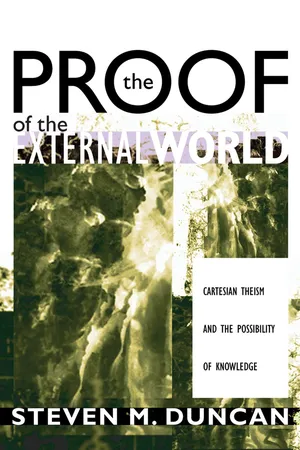
The Proof of the External World
Cartesian Theism and the Possibility of Knowledge
- 244 pages
- English
- ePUB (mobile friendly)
- Available on iOS & Android
eBook - ePub
About this book
"Descartes' attempt to ground the possibility of human knowledge in the existence of God was judged to be a complete failure by his contemporaries, and this remains the universal opinion of philosophers to this day, despite the fact that three and a half centuries of secular epistemology--which attempts to ground the possibility of knowledge either in the unaided human intellect or in natural processes--has failed to do any better. Further, the leading twentieth-century attempts at theistic epistemology reject both the conception of knowledge and the standards of epistemic evaluation that Descartes takes for granted.
"In this book--partly an interpretation of Descartes and partly an attempt to complete his project-- the author attempts to show that a theistic epistemology incorporating Platonic and Aristotelian/Thomist elements can revitalize the Cartesian approach to the solution of the central problems of epistemology, including that most elusive of prizes--the proof of the external world."
--From the author's preface
Information
Topic
PhilosophySubtopic
Philosophy History & Theory1
The Perils of Methodological Doubt
Recent scholarship has noted that Descartes was the first to use the traditional skeptical arguments to call into question our knowledge of the external world, something that we find absent both in classical skepticism and in the skeptical revival that began in the Renaissance.1 Less often is there any discussion of the reason why Descartes applies the skeptical arguments in this way. For my part, I believe that answering this question is the key to understanding the dialectical strategy of the first Meditation both with regard to its target and the way in which the various skeptical arguments used by Descartes are intended to be understood. As I understand it, the Cartesian project in the first Meditation is to present a critique of Aristotelianism, and in particular the Aristotelian version of common-sense empiricism and that this is the basis for understanding how Descartes intended his skeptical arguments to function within the overall economy of the Meditations as a whole.2 To claim that Descartes desires to critique the foundations of Aristotelian physics is perhaps not very surprising or novel. It is well known that Descartes was an ardent enthusiast for the so-called New Physics, to which his friend Isaac Beeckman introduced him in 1618. Although Descartes achieved his greatest fame as a philosopher and arguably made his most signal contributions to the advance of human knowledge as a mathematician, natural science was Descartes’ peculiar and abiding interest, to which his other studies were at best mere preliminaries. The bulk of Descartes’ works are on topics that today we would recognize as belonging to natural science; his unpublished system of physics and astronomy, Le Monde, was completed years before the Discourse on Method and the publication of the Meditations and nearly three-fourths of the Principles of Philosophy concerns substantive topics in physics and the other sciences. It was in solving the problems of physics that he hoped to find the vindication of his philosophical principles, as the Dioptrics, Meteorology, and Geometry, attached as appendices to the Discourse, were self-consciously intended to demonstrate.3
However, the critique of the then-dominant Aristotelian paradigm was no small matter in Descartes’ time. The traditional story, which most of us still believe despite the deflationary studies of more recent historians of science, is that the confrontation between the Aristotelian and Galilean physical paradigms was one in which the superiority of the New Physics was obvious from the very first to every competent judge due to the fact that Galilean physics outperformed its Aristotelian counterpart in every way in which they could be compared, such that only academic inertia and the threat of ecclesiastical persecution could retard its progress through the learned world.4 However, if I am right, there is at least one area in which the New Physics was decidedly inferior to its Aristotelian competitor and that Descartes was, however inchoately and implicitly, aware of this fact. Further, this disadvantage of the New Physics was so great that it threatened to undermine its credibility even before it could find a hearing. Essentially, I shall argue that the difficulty with the New Physics is that it is self-undermining in such a way that the substantive truth of the theory makes it impossible that we should ever be able to know that it is true about reality.5 As such, the truth of the New Physics rules out that we could ever have any justification for believing that it is so, at least if we adopt the perspective of scientific realism. By contrast, the Aristotelian paradigm, as we shall see, does not generate this particular problem, whatever its defects as a foundation for empirical science as we now understand the term. As such, the New Physics is in a decidedly inferior position, epistemically speaking, to its Aristotelian competitor and widespread appreciation of this fact would certainly have slowed down and even possibly prevented its acceptance by the learned world.
Descartes’ strategy for dealing with this problem is not to try to resolve it from within the perspective of the New Physics itself. This is just as well, since, as I shall argue, the problem is not soluble within that framework. Instead, Descartes attempts to show that the Aristotelian paradigm does not ultimately escape the problem by showing that it is a perfectly general epistemological problem, one that can be generated from the very assumptions of common-sense empiricism that underlie the Aristotelian paradigm. This problem, the problem of the external world, becomes the central problem in a new philosophical enterprise, theory of knowledge or epistemology, that will dominate philosophy for the next 350 years. By converting the problem as it arises within the New Science into a general epistemological problem that afflicts every scientific paradigm, Descartes was successful in deflecting any criticism of the New Science capable of being constructed by reference to that problem and thus helped advance the acceptance of that new physical paradigm. Ironically, it also made problem of the external world apparently dismissible on the part of those exponents of the New Science who accept scientific realism and the autonomy of science thesis, i.e. the claim that the methods and results of scientific inquiry cannot be critiqued from any perspective external to that of the natural sciences. The problem of the external world, now made abstract and general rather than internal to the perspective of the New Science arising from its ontological commitments, becomes just another idling “philosophical problem” the solution of which has only academic interest. However, as I will also shortly argue, Descartes cannot generate the sort of skepticism he needs to undermine the Aristotelian paradigm without adopting some fairly radical means: in particular, only the Deceiver hypothesis introduced at the end of the first Meditation is sufficient to accomplish his goal. The question then arises whether or not Descartes has gone too far and left himself without any means of escape from methodological doubt. I shall argue that Descartes can, in fact, escape skepticism without arguing in a circle, whether or not he does in fact do so in the text of the Meditations itself. Further, I will argue that he could have done this in a manner consistent with his main ideas, though not perhaps as he would have understood them. This project will occupy us for the next two chapters. To begin with, we need to review the general outlines of the Galilean paradigm, the centerpiece of which is a view I shall call Galilean Physicalism.
Placing the Cartesian Project in Meditation I
The Ontology of Galilean Physicalism
Historians of philosophy and science generally trace the notorious primary/secondary quality distinction to Galileo’s Dedicatory Letter to his patron, Cardinal Cesarini, introducing Il Saggiatore (“The Assayer”), a treatise on comets.6 According to this distinction, all the qualitative properties we attribute to external bodies based on sense-perception, such a color, taste, smell, texture, sound, heat, and cold exist as we experience them only in consciousness and in the things themselves only as dispositional properties they possess due to the configurations of the matter-in-motion out of which they are composed by which it is possible for them to cause us to have certain ideas. These are what Locke will call secondary qualities of body which, as they exist in bodies themselves, are reducible to combinations of what Locke will call primary qualities, the quantitative, measurable properties of bodies attributed to them in accordance with the New Physics, such as size, shape, solidity, extension, and motion/rest. Only the primary qualities belong to the bodies inherently and non-dispositionally, i.e. independently of reference to a perceiving subject. By contrast, secondary qualities, considered as the causal effects of concatenations of the primary qualities of bodies existing in consciousness, make inevitable reference to perceiving subjects and thus depend on such subjects in order to exist.
Galileo, of course, has no proof or evidence for the existence of these two sets of properties or for attributing one set of them to bodies and the other only to minds beyond using the a priori argument, familiar to students of Locke, that the primary qualities are inseparable from the concept of body, hence essential to it. Galileo’s drawing of this distinction is motivated by his fundamental commitment to physicalism, i.e., the view that nothing exists—in the external, non-mental, world at any rate—except those entities and properties of entities that would be attributed to them by a completed theory of physics; we might therefore describe Galilean physicalism as physicalism about the external world, of everything other than consciousness and its contents. On this view, physics is both omnicompetent to describe the external world and thus capable in principle of exhaustively describing it. Since the purely qualitative qualities of bodies—what we might call their observable surface properties—cannot be accommodated by the New Physics except by reduction to the quantitative properties required for its mathematical laws to be descriptive of external reality, those properties as we experience them must be banished from the external world and deposited in another realm, the mind or soul (where conscious experience takes place) and treated as fundamentally subjective and non-physical because qualitative and incapable of mathematical description. Descartes’ commitment to this view is surely beyond serious doubt.
Galilean physicalism, as described above, is fully committed to the view known nowadays as scientific realism, the philosophical position which asserts that the well-confirmed theses of natural science (of which the laws of physics are a part, and constitute perhaps the most fundamental part) describe the world as it in itself, or the way it really is and thus are objectively true or (at any rate) possess a high degree of verisimilitude. According to scientific realism, the goal of natural science is to discover the truth about the physical universe and the use of the scientific method (that collection of techniques and procedures used by working scientists to formulate, address and answer questions about that universe) is the only effective means of accomplishing this end. Physicalism and scientific realism are compatible but not equivalent; one can be a scientific realist but not a physicalist simply by declining the omnicompetence thesis, i.e., the claim the external world is exhaustively described by the categories of mathematical physics. Aristotelians, for example, also embraced scientific realism but not physicalism, since they maintained that the qualitative properties of bodies were just as real and objective as their purely quantitative ones and irreducible to them. However, for Galileo, Descartes and other exponents of physicalism both ancient and modern, the doctrine of physicalism is an ontological thesis about the way the world is, hence an essentially metaphysical one underwriting the realist interpretation of modern physical theory as the truth about the nature of external reality.
It is just here, however, that the primary difficulty for any form of physicalism, including Galileo’s, arises. On the one hand, we will only have a good reason for supposing that physicalism is true if we are confident about scientific realism. However, as it turns out, physicalism undermines all of the evidence we think we have for scientific realism, so that if physicalism is true, we would never have any reason to think that it is—or, at any rate, no scientific reason for so thinking. So, paradoxically, the truth of physicalism is incompatible with our having any reason that will pass scientific muster for thinking that it is. As such, physicalism is self-refuting inasmuch as it is self-undermining. Let me now illustrate in detail just how this is the case.
The Epistemic Consequences of Galilean Physicalism
No one familiar with history of modern philosophy needs to be informed of the epistemic consequences of the causal theory of perception generated by the foregoing views. However, since perhaps not all the consequences of these theoretical commitments have been properly appreciated from within the perspective of the New Science itself, it will be worth our while to review those consequences here. Essentially, Galilean physicalism, with its commitment to scientific realism, purports to be describing the external world as it exists in and of itself, independently of our experience of it. At the same time, it implies that the immediate objects of our experience (qualia, sense-data, ideas—call them what you will) are merely subjective, mind-dependent contents of consciousness that are at best the causal products of certain physical processes occurring in the external world. Although these immediate objects of our experience are said to represent external...
Table of contents
- Title Page
- Preface
- Chapter 1: The Perils of Methodological Doubt
- Chapter 2: The Deceiver Hypothesis
- Chapter 3: Skepticism and the Cogito
- Chapter 4: Thinking
- Chapter 5: Being
- Chapter 6: How Can God Be Apprehended?
- Chapter 7: The Cartesian Cosmological Argument
- Chapter 8: The Concept of God
- Chapter 9: God and Knowledge in the Meditations
- Chapter 10: Descartes’ Arguments for God’s Existence
- Bibliography
Trusted by 375,005 students
Access to over 1.5 million titles for a fair monthly price.
Study more efficiently using our study tools.
Frequently asked questions
Yes, you can cancel anytime from the Subscription tab in your account settings on the Perlego website. Your subscription will stay active until the end of your current billing period. Learn how to cancel your subscription
No, books cannot be downloaded as external files, such as PDFs, for use outside of Perlego. However, you can download books within the Perlego app for offline reading on mobile or tablet. Learn how to download books offline
Perlego offers two plans: Essential and Complete
- Essential is ideal for learners and professionals who enjoy exploring a wide range of subjects. Access the Essential Library with 800,000+ trusted titles and best-sellers across business, personal growth, and the humanities. Includes unlimited reading time and Standard Read Aloud voice.
- Complete: Perfect for advanced learners and researchers needing full, unrestricted access. Unlock 1.5M+ books across hundreds of subjects, including academic and specialized titles. The Complete Plan also includes advanced features like Premium Read Aloud and Research Assistant.
We are an online textbook subscription service, where you can get access to an entire online library for less than the price of a single book per month. With over 1.5 million books across 990+ topics, we’ve got you covered! Learn about our mission
Look out for the read-aloud symbol on your next book to see if you can listen to it. The read-aloud tool reads text aloud for you, highlighting the text as it is being read. You can pause it, speed it up and slow it down. Learn more about Read Aloud
Yes! You can use the Perlego app on both iOS and Android devices to read anytime, anywhere — even offline. Perfect for commutes or when you’re on the go.
Please note we cannot support devices running on iOS 13 and Android 7 or earlier. Learn more about using the app
Please note we cannot support devices running on iOS 13 and Android 7 or earlier. Learn more about using the app
Yes, you can access The Proof of the External World by Steven M. Duncan in PDF and/or ePUB format, as well as other popular books in Philosophy & Philosophy History & Theory. We have over 1.5 million books available in our catalogue for you to explore.