This study explores the theological presuppositions that have informed the major explanations of the work of Christ from the perspective of Wesleyan theology’s commitment to the universality of the atonement and its provision for both justification and sanctification. The Whole Christ for the Whole World proposes a paradigm that the author describes as “personal-relational” for understanding the work of Christ. Dunning argues that this “personal-relational” paradigm more adequately captures the “whole tenor of Scripture” than do the legal paradigms that have dominated the Western church, and Dunning seeks to demonstrate that the Wesleyan understanding of the work of Christ has been significantly informed by the mentality of the Eastern church.
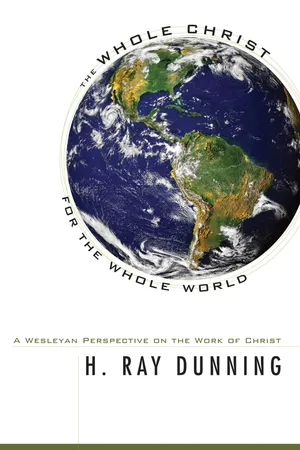
eBook - ePub
The Whole Christ for the Whole World
A Wesleyan Perspective on the Work of Christ
- 142 pages
- English
- ePUB (mobile friendly)
- Available on iOS & Android
eBook - ePub
About this book
Information
Topic
Theology & ReligionSubtopic
Christian Theology1
Introduction
Paradigm” and “paradigm shift” are familiar terms today, thanks in part to the work of Thomas Kuhn in the field of natural science. These tools have been useful as a way of interpreting the history of theology, which may be seen as a series of paradigm shifts.1 This approach is certainly apropos to theological methodology, the understanding of the divine nature and many other issues central to the theological task. It is critically important for understanding the history of theological reflection about the work of Christ. Perhaps in no other area has the influence of culture been more pronounced than in the shifting paradigms of atonement theories. Numerous scholars have called attention to this factor in shaping various explanations of the work of Christ. But as R. Larry Shelton says:
While these theories have been useful within their cultural contexts, the very fact that they have arisen out of specific cultural/historical settings has tended to limit the universality of their relevance. Theological creativity in expressing the Gospel in relevant cultural terms is to be encouraged, but the freezing of some of these theories into creedal and dogmatic forms tends to diminish their effectiveness when the cultural and historical milieu changes.2
This interplay between theology and culture has both strengths and weaknesses, as Shelton’s comment suggests. One major strength lies in the possibility of contextualizing the Christian message, a possibility that is justified by the fact that unlike certain other central Christian beliefs, there was no orthodox doctrine approved by the undivided church. One weakness lies in the danger that thought-forms derived from culture may distort the truth in diverse ways.
An important source for the variety of so-called atonement theories is the fact that there is such a diversity of images in the New Testament itself. This variety of metaphors may be explained in terms of the perception of the human predicament by those to whom the messages were addressed (as well as by the writer). In order to get some sense of the wide variety of concepts in the scripture, we may note a very generalized taxonomy of the way the major segments of the New Testament view the work of Christ.
In the Synoptic Gospels, Jesus is seen as the one who brings in the Kingdom of God (or heaven [Matthew]) by overpowering the demonic powers that control this age through living out the vision of the servant ideal pictured in Isaiah 40–55. In this imagery, sin is seen as bondage.
In the Fourth Gospel, Jesus is described as the one who brings light, life and truth by revealing the Father. Sin is to be in darkness and death.
With Paul, Jesus is the one who reconciles humanity to God, offering acceptance through the righteousness of God and through his Spirit renewing his people in the divine image. Sin is alienation from God and one’s created destiny.
In the letter to the Hebrews, the Son is the one who “tastes death for every man.” This metaphor is alluded to only briefly but here sin is standing under the penalty of death. More centrally, Jesus is interpreted as the perfect priest and sacrifice whose work perfects his people (sanctification). Sin in this context is cultic impurity. As Donald Baillie correctly notes, “The initial function of sin-offerings and guilt-offerings in Israel was the wiping out of ceremonial offences.”3 Since it is the cultic rituals of Israel that inform the theology of Hebrews related to sin, this has important implications for a full canonical interpretation of the work of Christ.
The book of Revelation depicts Jesus as the one who restores all things to their divinely appointed destiny by bringing to consummation the victory he won through his suffering during his earthly ministry. In this sense, while its literary form may be apocalyptic, its theology is not.
An important principle of interpretation that should be mentioned here is that metaphors in the New Testament used to describe the results of the work of Christ are drawn chiefly from the Old Testament: reconciliation, justification, sanctification, salvation, redemption, etc. As Ronald Wallace says: “We cannot fully understand what they [the writers] were saying unless we try to interpret precisely what these words meant within the contexts in which they were used.”4 And the conceptual context is primarily the Old Testament, not Greek philosophy, Roman law, or pagan usage.
Anyone who believes that his or her proposal is the final word is simply failing to recognize the human character of theological constructs. However, one important stipulation must be honored, at least from my point of view. The adequacy of any explanation of the work of Christ should be constantly tested by scripture seen in its wholeness rather than by proof-texting dogmatic conclusions.
A number of other factors have been influential in theologizing about the work of Christ. Perhaps the most important for the Western church (both Roman Catholic and Protestant) has been an intellectual perspective formed by juridical modes of thought. Many scholars have taken notice of this fact.5 This perspective has resulted in interpretations that tend to limit the doctrine of the atonement in at least two major ways:
1) with regard to its inclusiveness and
2) with regard to the extent of its redemptive provision.
While these limitations will occupy our primary attention in the subsequent analyses, there are also other factors that have called into question the dominant evangelical doctrine of the work of Christ in the West. The challenge of post-modernism has raised numerous issues.6 A charge from the feminist perspective that the penal satisfaction theory of the atonement implicitly approves child abuse and other forms of patriarchal violence is widely discussed.7 From within the evangelical tradition itself, various theological charges have been leveled. It has been questioned on the grounds that it entails a mistaken doctrine of God,8 that it conflicts with the orthodox doctrine of the trinity by setting the persons of the trinity against each other,9 and that it thrives in the soil of modern Western individualism.10 Each issue no doubt deserves extensive consideration. However my purpose is to examine the evangelical tradition from the perspective of Wesleyan theology, which brings some of them only peripherally into view.
Beyond mere analysis, I propose to explore the possibilities of a paradigm that I call the personal-relational paradigm. It is my belief that this model best reflects the “whole tenor of scripture” (John Wesley’s term) in the light of the present findings of biblical theology. I am further convinced that this paradigm is the most appropriate one to inform preaching in the contemporary situation.
The limitation relating to the redemptive provisions of the dominant evangelical way of interpreting the work of Christ referred to above became obvious to me out of the attempt to develop a systematic theology from a Wesleyan perspective. A number of factors came to light that intensified my realization that as a Wesleyan I could not consistently accept certain traditional evangelical options about the work of Christ because of their restrictive implications. More importantly, I found these to be, at best, in tension with biblical theology as I had come to understand it, i...
Table of contents
- Title Page
- Chapter 1: Introduction
- Chapter 2: Formation of the Eastern Perspective
- Chapter 3: Development of the Western Tradition
- Chapter 4: The Atonement in Protestant Theology
- Chapter 5: Responses to “Orthodoxy”
- Chapter 6: Atonement: Objective or Subjective
- Chapter 7: Changing Emphases in Atonement Theology
- Chapter 8: Insights from Biblical Theology
- Chapter 9: The Rythmn of Redemption
- Chapter 10: The Holy Spirit and the Atonement
- Bibliography
Trusted by 375,005 students
Access to over 1.5 million titles for a fair monthly price.
Study more efficiently using our study tools.
Frequently asked questions
Yes, you can cancel anytime from the Subscription tab in your account settings on the Perlego website. Your subscription will stay active until the end of your current billing period. Learn how to cancel your subscription
No, books cannot be downloaded as external files, such as PDFs, for use outside of Perlego. However, you can download books within the Perlego app for offline reading on mobile or tablet. Learn how to download books offline
Perlego offers two plans: Essential and Complete
- Essential is ideal for learners and professionals who enjoy exploring a wide range of subjects. Access the Essential Library with 800,000+ trusted titles and best-sellers across business, personal growth, and the humanities. Includes unlimited reading time and Standard Read Aloud voice.
- Complete: Perfect for advanced learners and researchers needing full, unrestricted access. Unlock 1.5M+ books across hundreds of subjects, including academic and specialized titles. The Complete Plan also includes advanced features like Premium Read Aloud and Research Assistant.
We are an online textbook subscription service, where you can get access to an entire online library for less than the price of a single book per month. With over 1.5 million books across 990+ topics, we’ve got you covered! Learn about our mission
Look out for the read-aloud symbol on your next book to see if you can listen to it. The read-aloud tool reads text aloud for you, highlighting the text as it is being read. You can pause it, speed it up and slow it down. Learn more about Read Aloud
Yes! You can use the Perlego app on both iOS and Android devices to read anytime, anywhere — even offline. Perfect for commutes or when you’re on the go.
Please note we cannot support devices running on iOS 13 and Android 7 or earlier. Learn more about using the app
Please note we cannot support devices running on iOS 13 and Android 7 or earlier. Learn more about using the app
Yes, you can access The Whole Christ for the Whole World by H. Ray Dunning in PDF and/or ePUB format, as well as other popular books in Theology & Religion & Christian Theology. We have over 1.5 million books available in our catalogue for you to explore.