Have you ever wondered . . .
. . . what a worldview is, and why it’s so important?
. . . how liberal and conservative Christians both claim the Bible as their foundation?
. . . why different worldviews attempt to solve the same problems in different ways?
. . . how two people who formally espouse different worldviews can agree on so many issues?
. . . why secularism is just as “religious” as Christianity?
. . . why secularism has its own mythology?
. . . why secularists want to silence Christianity in America’s legislatures, courts, schools, and churches?
. . . why education is nearly always offered as a solution to society’s ills (and why it won’t work)?
. . . how to formulate positions on contemporary issues not directly mentioned in the Bible?
. . . why Christians are often ineffective at influencing culture?
Abernathy answers these questions (and many more) by examining the relationship between ideas and their real-world consequences. This foundational relationship is key to understanding secularism, to understanding why its attempts to solve society’s problems produce disastrous real-world consequences, and how its ideas infiltrate the biblical principles of even the most committed Christians.
Abernathy sifts through the deceptive language of secular orthodoxy and shows how secularism “by any other name” still has tragic real-world consequences. Ideologies such as humanism, postmodernism, and liberal Christianity are exposed as repackaged havens of a failed worldview. Seemingly well-intentioned notions such as “progressive education,” pacifist foreign policy, “tolerance,” and wealth redistribution are debunked as deceptive myths peddled by an impoverished faith. By Any Other Name shatters the secular barrier erected to exclude Christianity from the marketplace of ideas and lays the groundwork for engaging a culture contaminated by secular mythology.
eBook - ePub
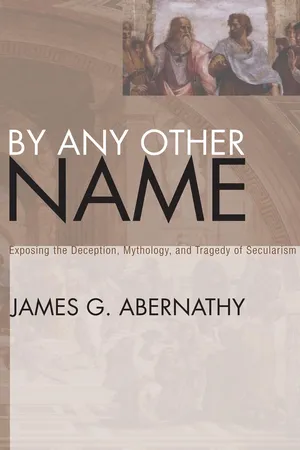
By Any Other Name
Exposing the Deception, Mythology, and Tragedy of Secularism
- 328 pages
- English
- ePUB (mobile friendly)
- Available on iOS & Android
eBook - ePub
About this book
Information
Topic
Theology & ReligionSubtopic
Christian ChurchPart One
The Battlefield
1
The Issue at Hand What Is the Real Issue?
If you’ve ever traveled to a foreign country where the dominant language was not your own, you are well aware of the communication problems that arise due to the language barrier. A “language barrier” is a metaphor that illustrates the futility of communication without a common vocabulary. There is no common medium that allows for effective dialogue. For example, if you go to a restaurant in Italy where the server understands and speaks only Italian, you may have problems ordering the meal you want. You have no idea what the Italian server is saying to you, and, likewise, the words you are using have no meaning to the Italian-speaking server. This barrier is often overcome by pointing to a fellow customer who is eating what you want or to a picture in the menu. This solves the problem, because you and the Italian server are now communicating using a medium or “language” (i.e., pictures) with which you are both familiar.
Language is the foundation of communication. The success or failure of communication will determine, in this case, what you will eat for dinner—if anything. Without first establishing a foundation upon which to communicate, you and the server have no hope of arriving at a consensus regarding what you want for dinner. In this example, language is the primary issue that needs to be resolved. Only then will the secondary issue (what you would like to eat for dinner) be resolved. Unless you and the Italian server utilize the same foundational starting points, there is no hope for consensus regarding contingent subsequent points (what you want for dinner).
This concept applies whenever two or more people engage in dialogue about anything. Unless those dialoguing utilize the same “vocabulary,” progress will remain elusive. This is especially true in the public forum where controversial issues that directly affect the direction of our country are discussed. In our current political system, debate seems useless and often digresses into pointless bantering where little, if any, progress is made.
For example, when conservative and liberal presidential candidates debate one another, they spend most of their time debating contingent secondary issues rather than foundational issues. Little to no effort is expended trying to define terms. Thus, when a conservative supports “free enterprise and equal opportunity,” he means something completely different from his liberal counterpart when he, too, claims to support “free enterprise and equal opportunity.” In this case, the words may be the same, but they have drastically different meanings—or essences. The debaters are uttering the same words, but—like the Italian server and American tourist—they are speaking two different “languages.” They are debating what to have for dinner (a secondary issue) in different languages and have little hope of arriving at a consensus. This is because the foundational ideas informing their basic thought process, or “language,” are ignored. Such foundational ideas form the “first principles” upon which all thought is based. Only when first principles (or presuppositions) are defined can meaningful debate about secondary issues occur.
In his book, The Post-Christian Mind, Harry Blamires discusses the importance of first principles. In fact, a chapter in his book is entitled just that, “First Principles.” He states, “So far as moral and behavioral problems are concerned, the post-Christian mind operates on a level of derivation and subsidiarity. It bypasses the basic rational determinants of the situations it chooses to discuss.”1 (Emphasis added.) In short, our post-Christian (a synonym for secular) generation puts the cart before the horse. Too much time is spent debating subsidiary (or secondary) rather than foundational issues. The foundational issues at the core of the disagreement are too often neglected during dialogue. Consensus on subsidiary issues then becomes an impossibility, leaving us destined to an eternity of struggle. Only after the foundational issues of a subject have been identified can there be progress in dialogue.
A Few Examples
Abortion
Take the issue of abortion, for example. Abortion’s legality, availability, and funding from tax revenues are subsidiary issues. They are conclusions derived from logically prior claims that cannot be empirically proved or reasoned, i.e., foundational presuppositions (Blamires calls them first principles and rational “determinants”). Before progress can be made toward a resolution, those in dialogue must first answer two foundational questions: 1) When does human life begin? and 2) What is human life worth (unborn life in this case)?
The first concerns the beginning of life. Answering this question will define exactly what abortion is. Does abortion end the life of a human being or doesn’t it? The second question concerns the value of life. Answering this question will define the moral status of abortion. If those in dialogue disagree on the first question, there is little hope of agreement on any secondary issues (abortion’s legality, funding, etc.). Furthermore, the second question doesn’t apply if human life doesn’t begin at conception, because unborn fetuses wouldn’t fall under the category of “human life.”
If the answer to the first question is agreed upon, the second question still must be answered, because agreement on the first question doesn’t logically require agreement on the second. For example, a pro-life advocate and a pro-abortion advocate may agree that life begins at conception but differ on the relative value of the unborn child. The pro-life advocate may hold the value of the unborn child as equal to that of the mother (and every other human), while the pro-abortion advocate may place more value on the mother. Just as disagreement regarding question #1 precludes agreement on subsidiary issues, so does disagreement on question #2. Furthermore, someone (a consistent secularist, for example) who concludes no human life has inherent value, may agree with the Christian that life begins at conception but disagree about question #2 because of his commitment to secularism’s presuppositions concerning what a human being is (merely physical matter guided by physical laws).
The answer to question #2 cannot be empirically proved or concluded based on reason. The claim “Human beings have inherent value” cannot be proved or disproved. It cannot be reproduced in a laboratory. You either believe it or you don’t. This is the very definition of a first principle, or “foundational presupposition” (as it will be referred to in this book). If two (or more) people disagree on this presupposition, they will be speaking different languages when discussing subsidiary issues, and they will have no hope of ever arriving at a consensus. Reason/logic (terms that will be used synonymously) properly used guarantees this eternal dissonance.2
Apologetics
Another area where it is vital to address foundational issues is apologetics (defending the Christian faith). In dialogue between Christians and secularists, many Christians neglect foundations and fall prey to subsidiary thinking when they “overshoot the bow” of secularists. For example, Christians often cite evidence that, due to the secularist’s foundational beliefs, will not and indeed cannot be accepted. A Christian can present a mountain of evidence supporting the resurrection of Christ and other particular miracle claims, but such evidence will do little in persuading the secularist. This is because secularists object not to the particular miracle claims of the Bible but to the notion of miracles in general. Rejection of every particular miracle claim in history would require extensive historical and empirical research. Thus, the rejection of miracles usually stems from an objection in principle rather than in particular. Miracles are impossible within the secular worldview. Therefore, every particular miracle claim is false. The Christian must first persuade the secularist that miracles are possible. Only then is there hope for consensus.
Trick Questions
Blamires analyzes a real-world example of subsidiary thinking using a situation that reared its ugly head in a British city in the 1980s. Due to a number of factors, addiction to heroin spread among the men and women of the community. To counter this trend, police imposed a limitation on the sale of hypodermic syringes. Addicts began sharing syringes as a result of the decreased supply. This sharing resulted in the spread of the human immunodeficiency virus (HIV) among addicts. Subsequent sexual promiscuity and needle-sharing led to a breakout of HIV in the community—including those who were not addicted to heroin. Thus arose the question, “Should hypodermic syringes be made freely available to drug addicts in light of the way HIV is being spread?” Making syringes freely available to addicts (or even providing them) seemed like the best way to prevent the spread of HIV.
It should be realized, however, that such a question is secondary. Answering this question and basing attempts to alleviate this problem on such a question will not solve the problems of heroin addiction and the spread of HIV. The more foundational “should” questions are: 1) Should people engage in sexually promiscuous behavior? and 2) Should people be addicted to heroin?
In the name of compassion, the secularist may claim that society has an “obligation” to make hypodermic syringes freely available to heroin addicts, but the Christian will place society’s “obligation” prior to the debate regarding the availability of syringes. Blamires claims the word “should” must be clarified. He writes, “This has to be said because the post-Christian mind has become obsessed with sometimes specious ‘obligations’ which arise only because fundamental obligations have been ignored.”3 Merely addressing the symptoms of a more fundamental problem will accomplish nothing except the raising of false hopes . . . and taxes.
A Christian confronted with the question regarding the availability of syringes must realize the question assumes the moral acceptability of a very destructive behavior. Neither a “yes” nor a “no” answer will solve the problem at its foundation. The Christian must go beyond the biased question to the foundational issues involved, i.e., sexual promiscuity and drug use. In short, there is no Christian answer to the subsidiary question, “Should hypodermic syringes be made freely available to drug addicts in light of the way HIV is being spread?” Christians who attempt to answer this trick question have already lost the debate. The question itself assumes the legitimacy of two behaviors that the Christian finds immoral. Blamires asserts, “Christians cannot possibly have at their fingertips immediate remedies for problems produced by behavior which they utterly deplore.”4
This will no doubt result in secularists labeling Chri...
Table of contents
- Title Page
- Foreword
- Introduction
- Part One: The Battlefield
- Part Two: Secular Gnosticism
- Part Three: Takeover
- Bibliography
Trusted by 375,005 students
Access to over 1.5 million titles for a fair monthly price.
Study more efficiently using our study tools.
Frequently asked questions
Yes, you can cancel anytime from the Subscription tab in your account settings on the Perlego website. Your subscription will stay active until the end of your current billing period. Learn how to cancel your subscription
No, books cannot be downloaded as external files, such as PDFs, for use outside of Perlego. However, you can download books within the Perlego app for offline reading on mobile or tablet. Learn how to download books offline
Perlego offers two plans: Essential and Complete
- Essential is ideal for learners and professionals who enjoy exploring a wide range of subjects. Access the Essential Library with 800,000+ trusted titles and best-sellers across business, personal growth, and the humanities. Includes unlimited reading time and Standard Read Aloud voice.
- Complete: Perfect for advanced learners and researchers needing full, unrestricted access. Unlock 1.5M+ books across hundreds of subjects, including academic and specialized titles. The Complete Plan also includes advanced features like Premium Read Aloud and Research Assistant.
We are an online textbook subscription service, where you can get access to an entire online library for less than the price of a single book per month. With over 1.5 million books across 990+ topics, we’ve got you covered! Learn about our mission
Look out for the read-aloud symbol on your next book to see if you can listen to it. The read-aloud tool reads text aloud for you, highlighting the text as it is being read. You can pause it, speed it up and slow it down. Learn more about Read Aloud
Yes! You can use the Perlego app on both iOS and Android devices to read anytime, anywhere — even offline. Perfect for commutes or when you’re on the go.
Please note we cannot support devices running on iOS 13 and Android 7 or earlier. Learn more about using the app
Please note we cannot support devices running on iOS 13 and Android 7 or earlier. Learn more about using the app
Yes, you can access By Any Other Name by James G. Abernathy in PDF and/or ePUB format, as well as other popular books in Theology & Religion & Christian Church. We have over 1.5 million books available in our catalogue for you to explore.