eBook - ePub
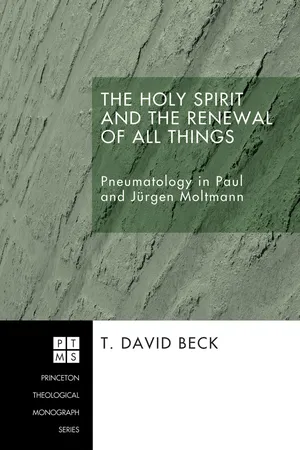
The Holy Spirit and the Renewal of All Things
Pneumatology in Paul and Jurgen Moltmann
- 278 pages
- English
- ePUB (mobile friendly)
- Available on iOS & Android
eBook - ePub
About this book
This volumes explores the shape pneumatology takes when we develop the theology of the Holy Spirit within an eschatological framework that has a universal scope and an unlimited history. When we do so, we find that pneumatology deriving from questions about what the Spirit does for us needs to give way to pneumatology that derives from questions about how the Spirit can draw us into the saving history of the triune God.
Information
Topic
Theology & ReligionSubtopic
Christian Theology1
An Eschatological Orientation in Pneumatology
Pneumatology in the Protestant Tradition
Throughout the history of Western Christian thought, one of the most persistent difficulties has been the role of the doctrine of the Holy Spirit within theology. Consistent with the logic of the filioque clause, the Holy Spirit has been overshadowed by the preeminent figure of the Son. Consequently, the Holy Spirit has been “the forgotten Person of the Trinity,” and pneumatology has become a backwater of Western theology. It is not without reason that the Eastern tradition has accused the Western tradition of subordinationism and neglect of the Third Person of the Trinity.
Considering the tendency toward pneumatological imbalance in the West, it should come as no surprise that the theology of the Holy Spirit within Protestantism has been marked by a tendency toward bipolarity. The theology of the Holy Spirit has swung back and forth between what I will call an “institutional” tendency and an “experiential” tendency.
On one side stand Luther, Calvin, and the institutional churches of the Reformation. Whereas the Catholic church had located the work of the Spirit mainly in the sacramental function of the church, the Reformers emphasized its location not only in the sacraments but also in the Word. In addition, they also tied the Spirit to Christ. They identified the Holy Spirit as the agent through whom atonement in Christ is applied to all believing human beings. As it has worked out in the institutional churches of the Reformation, pneumatology has taken on a subordinationistic tone. The Spirit’s work has tended to be confined to ecclesiology (Word and sacrament) and christology. It has become a function of the church and Christ.
On the other side of the Protestant tradition is the long line of protest movements—the “enthusiasts,” Anabaptists, pietists, Methodists, Pentecostals, and charismatics—which have reacted to the institutional church’s subordination of pneumatology with a corresponding elevation of pneumatology. In particular, these movements have stressed the necessity of personal experience of the Spirit as a component of the authentic Christian life. They have been perceived as “enthusiasts” by the institutional churches for failing to exert proper controls on manifestations of the Spirit, and for seeking experience of the Spirit with what is seen as imprudent eagerness. In return, they have on occasion been highly critical of the institutional churches’ overly restrictive conception of the work of the Spirit. One can reference, for instance, the vituperation in Thomas Müntzer’s treatise directed against Luther: Highly Provoked Defense and Answer against the Spiritless, Soft-living Flesh at Wittenberg, Which has Befouled Pitiable Christianity in Perverted Fashion by its Theft of the Holy Spirit.
Thus, the doctrine of the Holy Spirit has swung back and forth between an institutional tendency and an experiential tendency. I will argue that both of these tendencies make significant offerings to the ongoing understanding of the person and work of the Holy Spirit, but they also come with unwanted baggage. Rather than trying to rehabilitate one of these models, the burden of this dissertation will be to propose and explicate a third option that comes not out of the Protestant tradition but out of the original language of pneumatology: Christian eschatology.
The Institutional Tendency in Protestant Pneumatology: Karl Barth
One of the paramount figures in twentieth-century theology is Karl Barth. He is known for opposing Protestant liberalism with a theological vision defined by the sovereignty and otherness of God, and God’s gracious outreach to humanity in the person of Jesus Christ. Concerning the Holy Spirit, Barth serves as an illustration of the institutional tendency in Protestant pneumatology. To illustrate this point, I will discuss the pneumatological dimensions of two key doctrines: reconciliation and revelation.1
Reconciliation between human beings and God comes through divine grace as enacted in the life, death and resurrection of Christ. It is the history of Christ, being epitomized in Calvary and the empty tomb, but also continued in Christ’s presence in the church through the Holy Spirit and in his second coming. All of this takes place on behalf of humanity (and all of creation); it is the divine plan of redemption. In the history of Christ, God confronts humanity with the truth of humanity’s need for salvation and the gracious offer of it. The saving work of God in Christ is the objective side of reconciliation. It is only by the objective work of Christ that human beings can be saved; not by their own efforts.
Corresponding to the objective side of the reconciliation of human beings with God there is a subjective side. Salvation involves the free and intentional act of believing in Christ by faith. But Barth is clear that the freedom and ability to believe are strictly gifts from God—specifically the Holy Spirit (CD IV.1: 645). The Spirit comes as the awakening power of the believing person.
The revelation of God to humanity, which is closely connected with the divine ministry of reconciliation, consists in large part of the unveiling of the mystery of Christ dying in shame on the cross and rising again for the sake of all human beings. This mystery is not accessible by means of human discovery; it must be revealed by God to human beings. Revelation takes on a three-fold form corresponding to the Trinity. It is a process involving God the Revealer making known to human beings his Word, the Revealed, the content of the revelation. Because sinful humanity is unable to independently comprehend the mystery of Christ, it is necessary for God to instill in human beings the power to grasp divine truth. This power is the Holy Spirit, who is referred to in this scheme as God’s Revealedness. Thus, the Holy Spirit is the revelatory bridge between human beings who are predisposed to misunderstand God and that same God reaching out to them in mercy. In the Spirit, God empowers people from within to acknowledge divine truth.
Although Barth does not equate divine revelation with the written Word of God, he strongly believes that revelation happens in conjunction with the Bible. Natural theology is both superfluous and impossible, for God is unknowable unless he chooses to reveal himself to us. Revelation is an event in which the message of Scripture, either read or proclaimed, becomes the dynamic and effectual Word of God. The Word of God, in turn, is centered in the person of Christ. That is, Christ is revealed in the activity of the Holy Spirit, through the occasions of the reading or proclamation of Scripture.
Like reconciliation, revelation has an objective side and a subjective side. The objective side of revelation is its source and content. The subjective side is the ability given to human beings by the Holy Spirit to receive revelation. Since revelation is given to and for human beings for their reconciliation to God, and since they are incapable of receiving it on their own, it is necessary that God fill in the noetic gap for them by giving them the gift of the Spirit. Thus, revelation is not complete without both its objective and subjective sides operating together. In other words, only through God is God known.2
I have made an effort in these descriptions of Barth’s notions of reconciliation and revelation to highlight the trinitarian dimensions of his thought. Both reconciliation and revelation are events involving Father, Son and Holy Spirit. On the other hand, Barth’s understanding of reconciliation and revelation are fundamentally oriented toward christology. In fact, his christocentric orientation overshadows his trinitarian thought. John Thompson states that whereas Barth’s theology is trinitarian from start to finish, “it is from the center in Christ—and the cross and resurrection in particular—that [Barth] begins and continues” (3).
Philip Rosato asserts that for Barth there can be no question of primary or secondary when it comes to the being and work of God in any of its aspects (112). This is correct, insofar as Rosato’s point in the argument surrounding this assertion is that one cannot remove or reduce the role of the Holy Spirit in the process of redemption. Barth’s intention is to give the Holy Spirit an “indispensable function” in his theology (111). In other words, reconciliation requires the full action of the Holy Spirit on humanity’s behalf. This is a theologically safe assertion. However, the truth remains that Barth assigns to the Holy Spirit the subjective side of reconciliation, and the subjective side depends on and assumes the objective side. The Holy Spirit makes subjectively real in the being of Christians “what is already objectively real in the being of Jesus Christ” (113). Barth is clear that the church community is not made the body of Christ nor its members the members of the body of Christ by the pentecostal gift of the Spirit or any works of the Spirit. Rather, “it became his body and they became its members in the fulfillment of their eternal election on the cross of Golgotha, proclaimed in his resurrection from the dead . . . There can be no doubt that the work of the Holy Spirit is merely to ‘realize subjectively’ the election of Jesus Christ and his work as done and proclaimed in time, to reveal and to bring it to men and women” (CD IV.1: 667). It is the work of the Spirit to bring to historical expression the eternal hiddenness of the prior election of Christ. Thus, the church—the reconciled community—cannot exist as such apart from the action of the Holy Spirit. Nevertheless, for Barth the church is first and foremost the body of Christ, which indicates that whatever its pneumatic aspects, the church is a christological phenomenon (Thompson: 105).
Revelation is also christologically driven. Barth differentiates between the Spirit and Christ—the two cannot be collapsed into one. However, while the Spirit and not Christ is the agent who activates revelation within human beings, “He is still to be regarded wholly and entirely as the Spirit of Christ, of the Son, of the Word of God” (CD I.1: 452). This means that all revelation in which the Holy Spirit participates is oriented toward the Word as its content. Jesus is the revelation of God to humanity, and the Spirit is the power of Christ which actuates that revelation within people. Similarly, when someone comes to faith, it is the Holy Spirit who unites that person to Christ in faith. Christ is the object of faith, and the Holy Spirit is the awakening power of faith.
Barth’s primary understanding of the Holy Spirit is reflected in this statement: “But fundamentally and generally there is no more to say of Him than that He is the power of Jesus Christ . . .” (CD IV.1: 648). For Barth the Holy Spirit is the Spirit of Christ. This is not to say that the Spirit is not also the Spirit of the Father, but preeminently for Barth he is the Spirit of Christ. He is the voice of Christ speaking to the church, he actuates faith in Christ, and he unites Christians to Christ. The Spirit’s work is constantly oriented toward Christ. This is the identifying mark that distinguishes the Holy Spirit from other spirits.
Barth regularly expresses himself in ways that reveal a strong christocentric orientation in his pneumatology. He assigns certain actions to the Spirit, but he often describes these actions as being carried out by Christ in the Spirit. For instance, Barth can sum up the Spirit’s role in reconciliation by saying that “Jesus Christ attests his own reconciliation to us and does so by the Spirit” (Thompson: 92). The Spirit’s power is the power of Christ (182). The Spirit’s role in calling Christians to their vocation is Christ calling by the Word and the Spirit. The picture one gets is of Christ calling and using the Holy Spirit as the voice or breath by which he calls. The Spirit is a necessary part of the process of calling, but what agency can we attribute directly to him? In a similar vein, Barth describes the Spirit as the arm of Christ in his self-revelation to humanity (CD IV.2: 332). Once again the Spirit appears as an extension of Christ rather than a divine agent. These points can be summed up in Barth’s statement, “And in great things and in small the presence and gift of [Christ’s] Holy Spirit are directly [Christ’s] own work” (CD IV.1: 694). It is remarks like this that draw Smail’s criticism that the danger of Barth’s pneumatology is “to fail to assert the distinction between [the Spirit and the Son] which formally he wishes to maintain, so that pneumatology is in danger of being merged in to Christology. . .” (108).
In conclusion, Thompson points out that in Barth’s treatment of Christian faith there are trinitarian, christological, eschatological and pneumatic aspects that are all interrelated (134). Be this as it may, for Barth Christian doctrine primarily revolves around Christ. In general, Thompson correctly holds that the Spirit is integrated into Barth’s total theological perspective, but this integration comes via christology (209).3
In evaluating Barth’s christocentric orientation in pneumatology, we can begin by taking notice of his insistence that the agency of the Holy Spirit is absolutely essential to the processes of revelation and reconciliation. No fallen human being can understand God or gain a proper relationship with him without divine help. This help comes through the entire Trinity, but the subjective side of it is the work of the Holy Spirit. Thus, Barth incorporates the work of the Spirit into the grace of God and the action of the Trinity.
We can also appreciate the effort to which Barth has gone to give adequate treatment of the relationship between Christ and the Spirit. He rightly interrelates the activities of these two persons of the Trinity and further relates them to the Father. One question, however, is whether he has worked out such relations in a satisfactory manner. For if the Spirit is functionally identified with Christ, thereby becoming little more than an exten...
Table of contents
- Title Page
- Acknowledgments
- Abbreviations
- Chapter 1: An Eschatological Orientation in Pneumatology
- Chapter 2: The Holy Spirit and the Pauline Eschatological Framework
- Chapter 3: Eschatological Characteristics of Pauline Pneumatology
- Chapter 4: Main Themes in the Theology of Jürgen Moltmann
- Chapter 5: Moltmann’s Eschatology
- Chapter 6: The Holy Spirit and Human Communities
- Chapter 7: The Holy Spirit and the Individual
- Chapter 8: The Holy Spirit and Creation
- Chapter 9: Toward an Eschatological Pneumatology
- Bibliography
Trusted by 375,005 students
Access to over 1.5 million titles for a fair monthly price.
Study more efficiently using our study tools.
Frequently asked questions
Yes, you can cancel anytime from the Subscription tab in your account settings on the Perlego website. Your subscription will stay active until the end of your current billing period. Learn how to cancel your subscription
No, books cannot be downloaded as external files, such as PDFs, for use outside of Perlego. However, you can download books within the Perlego app for offline reading on mobile or tablet. Learn how to download books offline
Perlego offers two plans: Essential and Complete
- Essential is ideal for learners and professionals who enjoy exploring a wide range of subjects. Access the Essential Library with 800,000+ trusted titles and best-sellers across business, personal growth, and the humanities. Includes unlimited reading time and Standard Read Aloud voice.
- Complete: Perfect for advanced learners and researchers needing full, unrestricted access. Unlock 1.5M+ books across hundreds of subjects, including academic and specialized titles. The Complete Plan also includes advanced features like Premium Read Aloud and Research Assistant.
We are an online textbook subscription service, where you can get access to an entire online library for less than the price of a single book per month. With over 1.5 million books across 990+ topics, we’ve got you covered! Learn about our mission
Look out for the read-aloud symbol on your next book to see if you can listen to it. The read-aloud tool reads text aloud for you, highlighting the text as it is being read. You can pause it, speed it up and slow it down. Learn more about Read Aloud
Yes! You can use the Perlego app on both iOS and Android devices to read anytime, anywhere — even offline. Perfect for commutes or when you’re on the go.
Please note we cannot support devices running on iOS 13 and Android 7 or earlier. Learn more about using the app
Please note we cannot support devices running on iOS 13 and Android 7 or earlier. Learn more about using the app
Yes, you can access The Holy Spirit and the Renewal of All Things by T. David Beck in PDF and/or ePUB format, as well as other popular books in Theology & Religion & Christian Theology. We have over 1.5 million books available in our catalogue for you to explore.