eBook - ePub
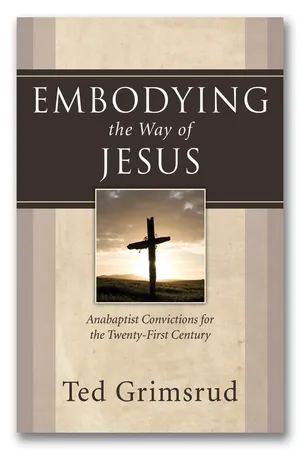
Embodying the Way of Jesus
Anabaptist Convictions for the Twenty-First Century
- 262 pages
- English
- ePUB (mobile friendly)
- Available on iOS & Android
eBook - ePub
About this book
The Anabaptist tradition, originating as part of the sixteenth-century Protestant Reformation, has from its beginning presented an alternative approach to Christian faith. Jesus-centered Anabaptist convictions such as pacifism, simple living, and community remain of vital concern for twenty-first-century Christians.
Embodying the Way of Jesus: Anabaptist Convictions for the Twenty-First Century traces the origins and historical expressions of Anabaptist faith and then suggests ways Anabaptist convictions speak to our contemporary world.
Ted Grimsrud proposes a fourfold approach to interpreting Anabaptist theology, considering themes from the Bible, from the tradition's history, from present experience, and from envisioning a hopeful future. What emerges is an engaging portrait of a living tradition that speaks with urgency and relevance to a world badly in need of a message of peace.
Information
Topic
Theology & ReligionSubtopic
Christian ChurchPART ONE: Getting Oriented
Our first task will be to get a sense of what we are considering when we reflect on Anabaptist convictions. What do we mean by “Anabaptist?” How will we approach the distinctive theology of this type of Christian faith? In Part One, I will explain why I believe the Anabaptist tradition presents an attractive perspective on Christian faith and flesh out my theological method in relation to an embodied peace theology.
Chapter one, “Anabaptism for the Twenty-First Century,” proposes that the Anabaptist tradition, with its strong message of dissent in relation to the linking of Christian faith with warfare and power politics so prevalent in contemporary America, might have a special contribution to make to our culture. With Anabaptism, we have a nearly five-century-long tradition of understanding Jesus’ message to be one of peace, of separation from the politics of empire, and of upside-down notions of power and economics. This tradition offers a source of encouragement for all Christians who desire a peace-oriented faith.
Chapter two, “Whither Contemporary Anabaptist Theology?,” interacts with the recent book by Anabaptist theologian Thomas N. Finger, A Contemporary Anabaptist Theology: Biblical, Historical, Constructive. This chapter proposes an approach to Anabaptist theology that emphasizes engagement with real-life issues of the present world.
Chapters three, “Constructing Anabaptist Theology in a Congregational Setting,” and four, “Is God Nonviolent?,” outline and illustrate a theological method that understands Anabaptist theology to be a conversation among biblical, historical, and present-day themes that gains its ultimate direction from the faith community’s vision of the world to which God calls us. The elements of this method—Bible, history, present experience, and vision—provide the outline for the next four sections of this book.
This Anabaptist-oriented theological method provides a basis for self-consciously articulating a vision for Christian convictions centered on embodying the way of Jesus. My approach is based on my understanding of the core elements of Anabaptism that promise to speak to the twenty-first century. However, I will be going further than most earlier Anabaptists in explicitly describing theological convictions. In doing so, I intend to help readers from outside Anabaptist communities better to understand core Anabaptist convictions. And I intend to help readers from within Anabaptist communities better to articulate their own convictions for the sake of fostering faithful discipleship in our contemporary world that has not shown itself particularly friendly to the traditional ethos of such communities.
chapter one
Anabaptism for the Twenty-First Century2
Anabaptist Christianity faces opportunities in North America today that may be unprecedented in its nearly five hundred year history. Its core convictions stand in tension with the dominant understandings of Christianity held by people with power and wealth. Especially, the Anabaptist belief and practice of pacifism offers a reading of Christianity that provides an alternative to traditional Christian comfort with militarism and violence. Such beliefs and practices will be attractive to many who believe the needs of our day are for closer adherence to Jesus’ way of peace.
In contemporary American culture, religious labels have become increasingly imprecise. Our dominant religion remains Christianity, but what does “Christian” mean?
Until very recently, many modern observers of America have spoken of moving into a post-Christian era. However, clearly we have not yet arrived at such a state. Currently, we are in the midst of a revival (of sorts) of the public expression of overt Christian religiosity. High-profile politicians use explicitly Christian language as much as, if not more than, ever.3 Evangelical and fundamentalist Christians such as James Dobson exercise extraordinary influence over public policy makers.4
For those Christians who find their faith calling them to Jesus’ way of peace,5 of resistance to injustice, of exercising strong support for addressing the needs of vulnerable people, of a desire for more mercy and less retribution, the current scene is profoundly challenging. Such Christians see the very basis for their core convictions—the Bible (which they read as centered on Jesus’ message)—being associated in the public eye with policies and rhetoric and values that they abhor.
What is presented as the “biblical” or “Christian” view, by common popular agreement among people who both agree and disagree with it, seems to include support for the wars and militarism of the United States6 and for capital punishment and a harshly retributive criminal justice system.7
So, what do Jesus-oriented Christians in America do? If they cede Christianity to those who are pro-military and pro-death penalty, they cut themselves off from the taproot of their own meaning system and spiritual empowerment. If they explicitly affirm their Christian convictions, they run the risk of being lumped in the public eye with these prominent expressions of “Christianity” that so contradict their reading of the gospel message.
The Relevance of Anabaptism
Our time of anxiety, uncertainty, and contention concerning the viability of Jesus-oriented Christian faith actually may provide heirs of the sixteenth-century Anabaptists8 an important opportunity. The time may be right to present Anabaptism as an important resource for articulating an alternative style of Christianity in a culture that too-often associates Christian faith with domination.9
I want to reflect, as a theological ethicist and pastor, on how pacifist, Jesus-oriented Christians might best draw on the Anabaptist story for inspiration and guidance for their witness in our current highly militarized environment in twenty-first-century America—and especially in face of the association in the public eye of this militarism with Christianity.
What do I mean by “Anabaptist”? I will not equate the term “Anabaptist” with “Mennonite,” though they are closely related. The Mennonite tradition evolved directly from the first Anabaptists of the sixteenth century and remains the most visible and widespread embodiment of the fruits of the Radical Reformation. However, “Mennonite” seems too narrow a term for a perspective that will help a wide range of pacifist, Jesus-oriented Christians to affirm and witness to their faith in contrast to imperial Christianity.
“Mennonite” refers to a specific denomination with limited relevance for those not part of that denomination. I seek a label with broader appeal that in some sense might be relevant to people with similar convictions from other traditions—be they near “relations” to Mennonites such as Church of the Brethren, more distant “cousins” such as Baptists or Disciples of Christ, or even more distant “cousins” such as Lutherans, Presbyterians, and Roman Catholics.
The term “Anabaptist” may be closely linked with a concrete embodiment (which is important for my purposes, showing how a set of convictions works on the ground) in the Mennonite tradition, yet also may speak more of vision and ideals and be freer from being reduced to denominational specificity than “Mennonite.” “Anabaptist” may be seen as more amenable to being linked directly to the way of Jesus, having a sense of transcendent ideals combined with concrete embodiment.
So what is “Anabaptism” and how might it contribute to a renewal of peace-oriented Christianity in the twenty-first century? To answer this question, we will be helped by looking at the development of the modern use of the term.
Though the term “Anabaptist” (literally meaning “re-baptizer”) dates back to the sixteenth century, only in the past sixty years has it gained wide currency as a positive, self-affirming label. Mennonite historian Harold Bender, in his famous 1943 presidential address to the American Society of Church History, entitled “The Anabaptist Vision,” played a major role in transforming the term. Bender provides what is still a useful perspective on the term “Anabaptism.”
Bender boiled the Anabaptist vision down to three basic convictions. “First and fundamental in the Anabaptist vision was the conception of the essence of Christianity as discipleship.”10 Anabaptists saw Christian faith as requiring outward expression, the response to God’s grace with the “application of that grace to all human conduct and the consequent Christiani...
Table of contents
- Title Page
- Introduction
- Part One: Getting Oriented
- Part Two: Bible
- Part Three: Tradition
- Part Four: Experience
- Part Five: Vision
- Part Six: Church
- Bibliography
Trusted by 375,005 students
Access to over 1.5 million titles for a fair monthly price.
Study more efficiently using our study tools.
Frequently asked questions
Yes, you can cancel anytime from the Subscription tab in your account settings on the Perlego website. Your subscription will stay active until the end of your current billing period. Learn how to cancel your subscription
No, books cannot be downloaded as external files, such as PDFs, for use outside of Perlego. However, you can download books within the Perlego app for offline reading on mobile or tablet. Learn how to download books offline
Perlego offers two plans: Essential and Complete
- Essential is ideal for learners and professionals who enjoy exploring a wide range of subjects. Access the Essential Library with 800,000+ trusted titles and best-sellers across business, personal growth, and the humanities. Includes unlimited reading time and Standard Read Aloud voice.
- Complete: Perfect for advanced learners and researchers needing full, unrestricted access. Unlock 1.5M+ books across hundreds of subjects, including academic and specialized titles. The Complete Plan also includes advanced features like Premium Read Aloud and Research Assistant.
We are an online textbook subscription service, where you can get access to an entire online library for less than the price of a single book per month. With over 1.5 million books across 990+ topics, we’ve got you covered! Learn about our mission
Look out for the read-aloud symbol on your next book to see if you can listen to it. The read-aloud tool reads text aloud for you, highlighting the text as it is being read. You can pause it, speed it up and slow it down. Learn more about Read Aloud
Yes! You can use the Perlego app on both iOS and Android devices to read anytime, anywhere — even offline. Perfect for commutes or when you’re on the go.
Please note we cannot support devices running on iOS 13 and Android 7 or earlier. Learn more about using the app
Please note we cannot support devices running on iOS 13 and Android 7 or earlier. Learn more about using the app
Yes, you can access Embodying the Way of Jesus by Ted Grimsrud in PDF and/or ePUB format, as well as other popular books in Theology & Religion & Christian Church. We have over 1.5 million books available in our catalogue for you to explore.