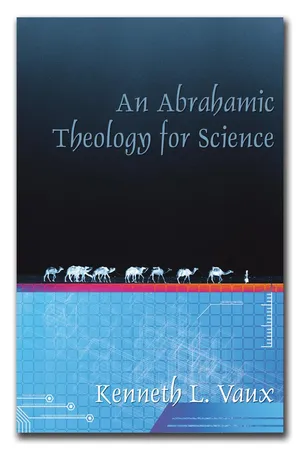
Kenneth Vaux advocates an Abrahamic theology as a dynamic and ethical axis for science and technology and argues for its continuing salience for a vital and humane science. He demonstrates a historical correlation between an Abrahamic theological tradition (monotheism and venturism) and the rise of science.
Vaux illustrates these developments in the work of six scientists: Avicenna, Boyle, Schweitzer, and Teilhard, as well as contemporaries Amartya Sen and Leon Kass. In the course of his discussion, Vaux engages the contemporary dialogue between religion and science.
- 190 pages
- English
- ePUB (mobile friendly)
- Available on iOS & Android
eBook - ePub
An Abrahamic Theology for Science
About this book
Information
Topic
Theology & ReligionSubtopic
Christian Church1
Avicenna/Maimonides
the alethic vector
Al Andalus. The faint lure of an halvalero over the Granada evening turned into a commanding staccato of flamenco after 9/11. Fratricidal animosity among Abraham’s children—Americo-Israel vs. Arab—had the world on the brink of calamity in Palestine and Iraq. Where to look for peace and wisdom? What was ancient Andalusia? A pulsing center of the Roman Empire? An Iberian Peninsula jutting out like the Rock of Gibraltar toward the new world? The yearning if not the sun-setting where the Apostle Paul concluded his ministry? Here beginning in the seventh century CE the Muslim world would gain a European stronghold as its poised mission, initially thwarted, toward the fragile dawnings of tribal peoples who would begin to become consolidated Europe under Charlemagne. Here in Granada, Cordoba and Seville, Jews, Christians and Muslims would interact with magnanimity and mutual edification until the Inquisition. Here Maimonides, Averroës and Aquinas—all protégés of Avicenna of Isfahan—would find common insight in medicine, mathematics, philosophy and theology. Here Greek wisdom would synergistically intertwine with Judaic and Islamic monotheism to evoke the dawn of Western science. From the Crusades onward a fateful trifurcation had set in.1 Recently, phenomena like global warming, weapons of mass destruction and religious war have increased the breach of irenic truth and justice—the atmosphere of science.
So on New Years of 2003, after forty years absence from Spain, I returned. Not only Pan-Abrahamic peace but also theology for science took its strong beginnings here in early medieval Andalusia. Here devout theologians who laid the foundations not only for the modern age of science, but for the concord and rapprochement among monotheistic theology, philosophy and knowledge, more generally, are first found. In Avicenna of Isfahan, Iran and Maimonides and Averroës of Cordoba, Spain, the age reaches its zenith.
It was these clinician sages—offering Boethius’ consolatio philosophia and strong comfort (Isaiah 40) to Abraham’s terrorized seed—who preserved and transmitted Greek science and philosophy to medieval and renaissance Europe. Aristotle’s De Anima and Metaphysic—the science of antiquity when theologized through Platonic Augustinianism, into Jewish mysticism then into the soaring visions of reality of Thomism and of Islamic Sufism—would constitute faith and science for half a millennium. Even the Renaissance and Reformation, which would convey Christendom’s greatest scientific and political force into Puritanism, were marked by the sacred biblical and empirical heritage derived from this Andalusian awakening.
The more I read in preparation for this pilgrimage the stronger a more Western-Asian profile arose for the founder of this movement. The sure foundation for an ongoing theology for science in the west was provided by Avicenna (980–1037 CE), the Persian physician-philosopher who is the inspiration of Maimonides of Cordoba and the “Great Philosopher” of Thomas Aquinas. Our construction of an extant theology for science, a useful knowledge and helpful technology, begins therefore near Isfahan, Iran and Baghdad, Iraq where today a crisis of war, causing science and faith to tremble, finds its epicenter.2 Like Maimonides, physician and guide to Prince Saladin in Palestine, and Thomas, the wise doctor to priest and physician in Upper Europe, Avicenna is physician and counsel to the Amir Ibn Mansúr al Sãmani at Bukhārā. His lasting contribution to a theology for science is alethic (Greek aletheia = truth)—an absolute insistence on honesty and veracity with a stern repudiation of falsehood. Assurance of truth was best insured as subjectivity verged toward objectivity, relativity toward transcendence. Let us unfold this dimension of theology so crucial to true science.
Avicenna: Biography
The crèche is found throughout Spain at Navidad. In the great cathedral of Seville (tragically built atop the Almohad Mosque, though the magnificent Giralda minaret built in 1196 still stands) the visitor finds a vast desert oasis looking all like Andalusia with wise men, shepherds, and all the Sagra familia in what looks like a cave on the Campo de la Mancha. If ever a wise man came from the East it was Avicenna.
At ten years of age he knew the Qur’an by heart along with much of the corpus of Arabic poetry. The theologian must become the physician and by sixteen he had mastered Greek and Latin medicine and had already innovated medical treatments for the sick. In my 25 years in the medical school I often observed an impressive theological and ethical commitment in my Muslim medical colleagues. Though I somewhat agreed with my colleague—hematologist Stanley Schade—that the “only theists were the Muslim doctors,” I also found devout Jews, Catholics and Protestant Christians, like himself. The intensity and through-going synthesis of medicine and theology was indeed impressive among Muslim doctors as it was with Seventh Day Adventists and Hutterites.
Likewise Avicenna. When he became intellectually confused or morally bewildered as he pondered the Greeks, he would resort to the Mosque to receive ablutions (at Minarets like Giralda). Often he would stay to pray until dawn. After illumination he thanked God and bestowed alms on the poor. He read Aristotle’s Metaphysics forty times. Its meaning only became clear when he found Al Farabi’s commentary. These brilliant ninth and tenth century Muslim translators and commentators would convey that wisdom into the Latin and European world.
In 997 CE he performed a miraculous cure on the Amir, which Avicenna saw as an empirical miracle. The honors following this cure gave him access to the library of the Samanids (which subsequently burned—a tragedy like the Alexandria library fire) and set his life course in a scholarly direction. At Hyercania, he wrote his Canon of medicine which guided Western medicine—at Louvain, Montpellier and elsewhere— until the seventeenth century. Imprisoned during the war between Isfahan and Hamadan, he spent the last twelve years of his life in service to Abu Addaula of Isfahan.
Though Averroës found his work pantheistic, especially the now lost text Philosophia Orientalis (this text is mentioned by Roger Bacon), Avicenna’s influence was pervasive and surprisingly lasting. Radically empirical, irrepressibly faithful, he established a foundation for a theology of medicine of our time. Of course, his insights do not come de novo. Mention must be made of several threads he wove together, like an Andalusian fabric, to prepare the early modern mind for a theology for science. Hellenic and Hebraic sources have set the stage.
Hellenic and Hebraic Sources
Avicenna sought initially to reconcile Greek philosophy with the traditional Semitic (Hebraic) wisdom called hikmah. This ancient sagacity chronicled in wisdom literature of Ancient Near Eastern lore and Hebrew Scripture trails back into the perennial Logos or understanding found in all cultures—Asian, African, and aboriginal. This wisdom sees a synthetic portrayal of divine power and expression apprehended and reiterated in human thought, faith and act (craft).
This apperception, though more full of fear, trembling and awe than the more critical and rational Greek intellect, shared with it the same confidence in human insight and instinct and the same sense of responsibility before the divine life-giver and law-giver. Titling a major work Oriental Philosophy, Avicenna intended not only to claim a kind of Asiatic illumination but the conviction found in Greece and Egypt that all human perception and technique were given in Tao. Scientia Inductiva (Aristotle) and Scientia Deductiva (Plato, monotheism) were now complementary.
The old Greeks like Thales, the poets like Homer, the pre-Socratics and the Golden Age philosophers, Plato and Aristotle, lived and worked in this confidence and piety. Pythagoras, from across the Mediterranean, two millennia before the Andalusian masters, sensed a mystic form and format behind all human ingenuity. For him mathematics, theology, and music touched and mimicked this divinity.
Epistemology
In much the Pythagorean manner, Avicenna held the priority of modes of knowledge to be grounded in metaphysics, followed by mathematics and then natural (physical) science. Put another way in his book on the “Divisions of the Rational Science,” Avicenna sees all knowledge (science) involving two parts: theoretical and practical. Theoretical knowledge, for example, the science of God’s unity or astronomy, seeks certainty beyond any human effect.3 Practical science (ethics, for example) combines a theoretical theme—truth—with the good in human behavior. In practical knowledge something is sought which is far greater than certainty. Moral habits and happiness (Aristotle’s Nicomachean Ethics) are sought here and now and in the hereafter. A third mode of knowledge pertains to society and politics. As with Pythagoras, political action, human ethics and science itself were in constant interaction. Forced from Samos by Polycrates’ tyranny in the sixth century BCE, the Pythagorean brothers, like the early Muslims, sought knowledge in order to effect human liberation. Truth was in order to goodness.
As one begins to probe science and conscience, knowledge and technology, as a Western person, one quickly becomes aware of a profound alteration of the human mind and its confidence in knowledge that has occurred since Avicenna, Aristotle and Pythagoras, to say nothing of Aquinas and Calvin. The revolution of epistemology brought about by Descartes, Hume, Kant and the “makers of the modern mind” has left us with a haunting sense of agnosticism. Now the age of post-modernity, post-positivism and deconstructionism allows a new sense of truth and goodness. Though it certainly rests on different grounds than on those of premodern metaphysics or Newtonian physics, confidence in particular perceptions and convictions is again possible. The reader cannot miss my appreciation of Avicenna. From my view, the retrieval of ancient wisdom is even more complex than a Derridia...
Table of contents
- Title Page
- Introduction
- Chapter 1: Avicenna/Maimonides
- Chapter 2: Robert Boyle
- Chapter 3: Pierre Teilhard de Chardin
- Chapter 4: Albert Schweitzer
- Chapter 5: Amartya Sen
- Chapter 6: Leon Kass
- Conclusion
Trusted by 375,005 students
Access to over 1.5 million titles for a fair monthly price.
Study more efficiently using our study tools.
Frequently asked questions
Yes, you can cancel anytime from the Subscription tab in your account settings on the Perlego website. Your subscription will stay active until the end of your current billing period. Learn how to cancel your subscription
No, books cannot be downloaded as external files, such as PDFs, for use outside of Perlego. However, you can download books within the Perlego app for offline reading on mobile or tablet. Learn how to download books offline
Perlego offers two plans: Essential and Complete
- Essential is ideal for learners and professionals who enjoy exploring a wide range of subjects. Access the Essential Library with 800,000+ trusted titles and best-sellers across business, personal growth, and the humanities. Includes unlimited reading time and Standard Read Aloud voice.
- Complete: Perfect for advanced learners and researchers needing full, unrestricted access. Unlock 1.5M+ books across hundreds of subjects, including academic and specialized titles. The Complete Plan also includes advanced features like Premium Read Aloud and Research Assistant.
We are an online textbook subscription service, where you can get access to an entire online library for less than the price of a single book per month. With over 1.5 million books across 990+ topics, we’ve got you covered! Learn about our mission
Look out for the read-aloud symbol on your next book to see if you can listen to it. The read-aloud tool reads text aloud for you, highlighting the text as it is being read. You can pause it, speed it up and slow it down. Learn more about Read Aloud
Yes! You can use the Perlego app on both iOS and Android devices to read anytime, anywhere — even offline. Perfect for commutes or when you’re on the go.
Please note we cannot support devices running on iOS 13 and Android 7 or earlier. Learn more about using the app
Please note we cannot support devices running on iOS 13 and Android 7 or earlier. Learn more about using the app
Yes, you can access An Abrahamic Theology for Science by Kenneth L. Vaux in PDF and/or ePUB format, as well as other popular books in Theology & Religion & Christian Church. We have over 1.5 million books available in our catalogue for you to explore.