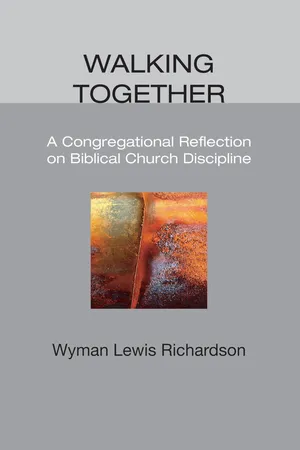
Walking Together: A Congregational Reflection on Biblical Church Discipline is a study of the biblical concept of church discipline. It seeks to show that church discipline, rightly understood, is a ministry of mercy and grace that will bless churches that return to it. Walking Together reveals that church discipline was a ministry that was very important to earlier believers, and that the modern church has abandoned it to her own detriment. It is a clarion call for individuals and churches to come back to this vital but long-neglected aspect of congregational and personal life. By doing so, churches can be healed and interpersonal relationships can be restored.
eBook - ePub
Walking Together
A Congregational Reflection on Biblical Church Discipline
- 134 pages
- English
- ePUB (mobile friendly)
- Available on iOS & Android
eBook - ePub
About this book
Information
Topic
Theologie & ReligionSubtopic
Christliche Kirche1
A Most Unlikely Development
Something interesting has been happening within Evangelicalism over the last few years. A long-neglected and almost forgotten topic has re-emerged as a viable topic of discussion. What was considered a bit taboo, uncouth even, is being looked at again with fresh eyes in many quarters. One can even sense a bit of urgency in the discussion, a growing momentum of conviction and a boldness in calling people back to this long lost topic. The topic is church discipline.
Consider: In February 2005, Ron Sider, the well-known author of Rich Christians In An Age Of Hunger, published a little book entitled The Scandal of the Evangelical Conscience. In it, he chronicles the shocking moral life of evangelical believers in the United States: a sky-rocketing divorce rate, miniscule giving, racial prejudice, etc. Near the end of his book he offers some proposals to address this scandal. The first one? The reinstitution of church discipline in congregational life.1
Consider: Christianity Today, largely regarded as the flagship publication of Evangelicalism, published a cover story for its August 2005 issue with these words boldly affixed across the top of the magazine cover: “Fixing Church Discipline.” To be sure, the curious drawing beneath these words—a man on his knees bent over with his head and hands entrapped in wooden stocks in the shape of a church (his helpless face crowned with a large scarlet “A” on his forehead, conjuring all the caricatures of Hawthorne’s oppressive Puritan New England)—seem to suggest in a none-too-subtle manner that legalism concerning church discipline, and not (more accurately) outright neglect, is the great danger we face. Nonetheless, the five articles on church discipline in this issue are a credit to the magazine and give one hope that the great tragedy of the disappearance of church discipline from congregational life in North America and beyond is finally being recognized and addressed.2
The growing sentiments of sympathy toward church discipline are no less obvious in my own denomination, the Southern Baptist Convention. The Winter 2000 issue of The Southern Baptist Journal of Theology, the journal of The Southern Baptist Theological Seminary in Louisville, KY, was dedicated entirely to the issue of church discipline. It contains an editorial, five articles, one sermon and a round-table forum calling for Baptists to reconsider church discipline. In May 2005, Danny Akin, President of Southeastern Baptist Theological Seminary in Wake Forest, NC, preached a sermon entitled “Church Discipline” in a Southeastern chapel service. On June 11, 2005, in two overflow sessions at the Southern Baptist Pastor’s Conference in Greensboro, NC, Mark Dever, pastor of Capitol Hill Baptist Church in Washington, DC, and founder of Nine Marks Ministries, called upon Southern Baptist pastors to return to the lost practice of church discipline. A September 29–30, 2006, conference at The Southwestern Baptist Theological Seminary in Fort Worth, TX, was titled “Maintaining the Integrity of a Local Church in a Seeker Sensitive World: The Baptist Perspective on Baptism, the Lord’s Supper, and Church Discipline.” At this conference, a number of Southern Baptist seminary professors and pastors gathered to consider, among other things, how church discipline might be reclaimed in a church-climate gone awry.3 Furthermore, numerous Baptists have called for a renewed consideration of church discipline in a number of recent books.4 This is just a sampling of the many calls coming from within the Convention for Southern Baptists to prayerfully consider a return to biblical church discipline.
These examples and others are signs of hope, yet it cannot be denied that the practice of church discipline has yet to make anything like a substantial impact on evangelical congregational life in North America. It is still, tragically, ensconced in the conversations and conferences and lectures of evangelical academia. Many churches that do practice church discipline are stellar in their examples, but they are also the exception and not the rule. James Leo Garrett, Jr.’s, 2004 observation that “there is little evidence of a renascence of the intentional and consistent practice of any congregational discipline . . . in churches related to the larger Baptist conventions in the United States” remains irrefutably true.5
Whatever Happened to Church Discipline
There have been many theses put forth to attempt to explain exactly why church discipline disappeared. Gregory A. Wills has chronicled the disappearance of church discipline from Southern Baptist congregations. “In the 1870s,” writes Wills, “the practice of church discipline in Southern Baptist churches began to subside. The trend accelerated in subsequent decades. By the 1930s discipline was quite rare—most reported exclusions were merely the cleaning of church rolls of names of members long inactive and forgotten. In the 1940s most associations stopped bothering to record exclusions.”6
A fear of the abuses of church discipline is widely regarded as one of the reasons for its widespread abandonment, but there are many others as well. John MacArthur, Jr., lists 4 “P’s” to explain why church discipline has disappeared: (1) Privacy, (2) Permissiveness, (3) Pride, (4) Persecution (of sinners by gossiping Christians).7 J. W. MacGorman cites (1) the “abuses of the past”, (2) a low “level of Christian commitment in our churches”, (3) the decline of adequate pastoral care in large congregations, (4) the ease with which excluded members may simply go to and join other congregations, (5) sympathy for an offender’s family, and (6) a fear of litigation.8
J. Carl Laney cites some interesting statistical data that sheds some light on this phenomenon: “In a recent survey of 439 pastors on the matter of church discipline 50 percent acknowledged situations in their ministry where discipline would have been appropriate but no action was taken. Three major hindrances to the practice of church discipline were mentioned: (a) fear of the consequences or outcome, (b) preference for avoiding disruptive problems, and (c) ignorance of the proper procedures.”9
Stephen M. Haines has detailed a number of reasons for the decline of church discipline, including: the secularizing results of increased urbanization and industrialization in American society, an overreaction to previous abuses of church discipline, the encroachment of Enlightenment optimism and the rejection of Calvinist theology, an emphasis on individualism, and the importation of secular management techniques into the life of the church.10 In his fascinating study of the decline of church discipline in the Church of Scotland at the end of the nineteenth and beginning of the twentieth century, Stewart J. Brown notes that an unbalanced preoccupation with sexual offenses, a distorted use of church discipline against women, and the unforgiving nature of the church’s policy of discipline led to its demise.11
R. Stanton Norman points to “the rise of a stringent individual autonomy,” the “absolute relativism that pervades Western secular society,” “a general lack of respect for authority within the church,” “differing denominational policies,” “confusion over Christian accountability within the local church” and “the rising fear of litigation.” Most damning of all, however, is Norman’s observation that the fear of a “loss of revenue” has hindered Baptist churches from practicing discipline.12
This list is not exhaustive and many other factors might be mentioned, but it will certainly not be closer to being complete until biblical illiteracy is added. Indeed, this lack of knowledge of what the contents of the Bible actually are is almost certainly the most prevalent reason for the disappearance of church discipline from the life of the church.
Regardless of the reasons, it would be hard for even the most casual observer to deny the absence of that communal accountability in the life of the average church that church discipline brings. As shown above, there are many and varied reasons that students of the topic have mentioned to account for this neglect. However, it is perhaps not inappropriate to suggest that an unstudied and non-technical observance of the workings of the average church life provides its own proof for this reality. In other words, personal experience must be taken into account as well.
It would be difficult, for instance, to find a member of a church who has not either experienced first-hand or watched from a distance as a church wrongly, badly, abusively, or negligently responded to members who had fallen into sin. It would be po...
Table of contents
- Title Page
- Foreword
- Acknowledgments
- Introduction
- Chapter 1: A Most Unlikely Development
- Chapter 2: A Conversation and a Plea
- Chapter 3: The Clash of Ecclesiologies
- Chapter 4: What It Means to Be the Church
- Chapter 5: The Hermeneutics of Integrity
- Chapter 6: Interpreter and Interpretation
- Chapter 7: The Process Defined
- Chapter 8: Beginning
- Chapter 9: Rightly Viewed, Rightly Handled
- Chapter 10: The Raising of the Stakes
- Chapter 11: Five Objections
- Chapter 12: The Widening of the Circle
- Chapter 13: Excommunication
- Chapter 14: The Returning Prodigal, the Rejoicing Church
- Conclusion
- Bibliography
Trusted by 375,005 students
Access to over 1.5 million titles for a fair monthly price.
Study more efficiently using our study tools.
Frequently asked questions
Yes, you can cancel anytime from the Subscription tab in your account settings on the Perlego website. Your subscription will stay active until the end of your current billing period. Learn how to cancel your subscription
No, books cannot be downloaded as external files, such as PDFs, for use outside of Perlego. However, you can download books within the Perlego app for offline reading on mobile or tablet. Learn how to download books offline
Perlego offers two plans: Essential and Complete
- Essential is ideal for learners and professionals who enjoy exploring a wide range of subjects. Access the Essential Library with 800,000+ trusted titles and best-sellers across business, personal growth, and the humanities. Includes unlimited reading time and Standard Read Aloud voice.
- Complete: Perfect for advanced learners and researchers needing full, unrestricted access. Unlock 1.5M+ books across hundreds of subjects, including academic and specialized titles. The Complete Plan also includes advanced features like Premium Read Aloud and Research Assistant.
We are an online textbook subscription service, where you can get access to an entire online library for less than the price of a single book per month. With over 1.5 million books across 990+ topics, we’ve got you covered! Learn about our mission
Look out for the read-aloud symbol on your next book to see if you can listen to it. The read-aloud tool reads text aloud for you, highlighting the text as it is being read. You can pause it, speed it up and slow it down. Learn more about Read Aloud
Yes! You can use the Perlego app on both iOS and Android devices to read anytime, anywhere — even offline. Perfect for commutes or when you’re on the go.
Please note we cannot support devices running on iOS 13 and Android 7 or earlier. Learn more about using the app
Please note we cannot support devices running on iOS 13 and Android 7 or earlier. Learn more about using the app
Yes, you can access Walking Together by Wyman Lewis Richardson in PDF and/or ePUB format, as well as other popular books in Theologie & Religion & Christliche Kirche. We have over 1.5 million books available in our catalogue for you to explore.